
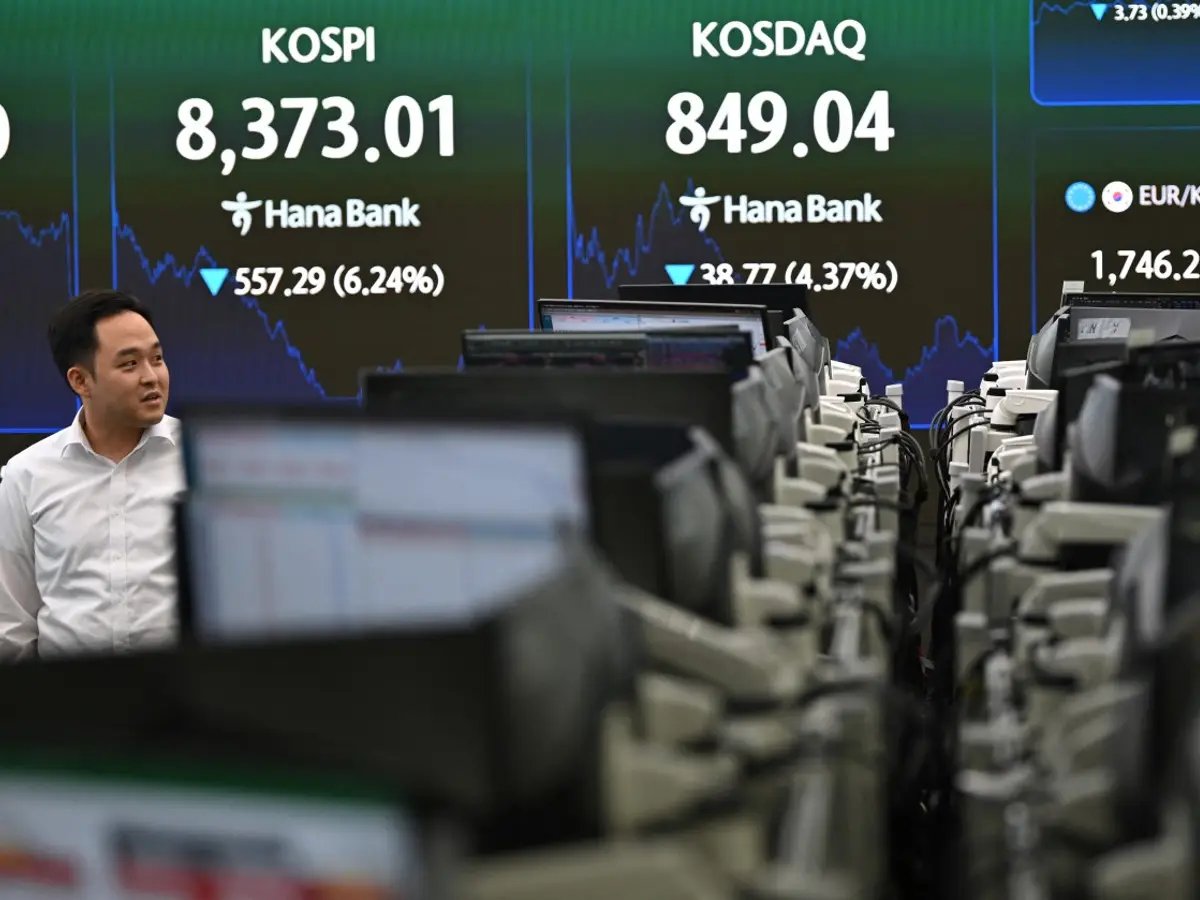
Asian equity markets are tumbling again across all major indexes on Friday. From South Korea’s Kospi, Japan’s Nikkei, Taiwan’s Taiex, Hong Kong’s Hang Seng, to Shanghai’s composite index, there was a massive sell-off as traders rushed to cash out on their AI gains. Following a massive 6.1 per cent overnight dive by Apple on Wall Street, institutional investors aggressively dumped AI-exposed and semiconductor equities across Asia.
The decline was led by South Korea’s Kospi, which fell by around 8 per cent, triggering another circuit breaker, the second such halt in a matter of days; it lost around $340 bn in market valuation. Kospi has seen the wildest swings over the last five days after hitting record valuation amid growing concerns about an AI bubble. The benchmark South Korean index reached at 9,385.59 points, before falling to 8,411.21 on Friday. Tokyo’s Nikkei plunged more than 4.15 per cent to 69,360, losing around $355 Billion. It was the heaviest hit index with SoftBank plunging more than 13 per cent. This was followed by Taiwan’s Taiex, which gave up 3.3 per cent, $127 Billion. A similar sell-off was seen in China’s blue-chip CSI300 index and Hong Kong Hang Seng at $229 billion.
The bloodbath in the Asian market followed a massive dip on Wall Street. The anatomy of the global feedback loop functioned like a mirror image as the two dragged each other down in a domino effect. On Monday night, June 22, Kospi hit its record valuation of 9,385.59 points. The next day was “Black Tuesday” when regulators issued stark leverage warnings on overextended retail ETFs. The KOSPI plunged 10 per cent, halting domestic trading via emergency circuit breakers. Tuesday afternoon, Wall Street faces an “AI Wake Up call,” Nasdaq 100 drops 2.21 per cent, Nvidia drops 4.1 per cent, and Micron sinks 13.2 per cent. On Thursday, Apple rises price of its Mac, iPad, and home device lineups. There were hikes of 15 per cent to 25 per cent, driven by exuberant demand for AI chips, triggering a massive sell-off in Apple stocks 6.1 per cent overnight. Nasdaq futures dive another 1.7 per cent amid rumours of an OpenAI IPO delay. Then on Friday, Asian investors executed a massive sell-off.
Analysts are divided on calling it a signal of an AI bubble burst or a market correction. The correction camp argues that KOSPI was up 62 per cent for the quarter and the Nikkei was up 34 per cent leading into this week. So a pullback was normal. While the AI Bubble camp argues that massive AI capex without any proper demand has been a warning sign for investors. Now, delays from the OpenAI IPO are hinting at the market’s ability to sustain another AI IPO. The significant indicator is the lock-up expiry of SpaceX IPO, which is due in August, when the float of 5 per cent stocks will receive additional 20 per cent, a massive supply shock. The ongoing global technology rout heavily changes how insiders will behave when the unlock gate drops.