
Hong Kong
For the past three decades, China has been a nation of homeowners — supercharging the world’s second-largest economy and fulfilling the dreams of millions.
Since the decline and eventual end of a welfare housing policy in the 1990s, government planning has coalesced with deep-seated cultural norms to create a level of private ownership unfathomable in the West.
While tens of millions of Americans are laden with tuition loans – many well into their 30s, leaving renting their only option – their Chinese counterparts start planning the purchase of their first homes straight out of university.
But a slowing economy and crisis-battered housing market could upend that.
Last year, new home sales dipped to their lowest value since 2014, according to official statistics, totaling only 7.3 trillion yuan ($1.06 trillion), versus 16.2 trillion yuan ($2.3 trillion) in 2021, at the height of the boom.
By volume, new home sales dropped by 8.7% last year, economists from the Macquarie financial group wrote in January, noting that there was “no end in sight” for the downward trend.
Many prospective buyers are now wary of taking on a mortgage.
Among them is Cai Youcheng, a 36-year-old graphic designer in Beijing who has set aside plans to buy for now. Renting feels nomadic, he said, and he dislikes not being able to decorate the apartment however he pleases. But he’ll stick with rentals for now.
“For me personally, if you really do the math, renting actually makes more sense. But deep down, I still really want to own a place of my own.”
That feeling is common in the country of 1.4 billion, where home ownership means much more than just a deed of sale.
In Chinese culture, owning a property represents more than financial stability and social standing. It suggests one is taking care of their family, said Eric Fong, chair professor in sociology at the University of Hong Kong.
“The traditional Confucian value emphasizes so much on family, and that everything should start from the family,” he said.

Traditional tendencies were given license to run wild starting in the 1980s, when China’s communist government launched an era of breakneck economic liberalization. Reliance on employer-assigned housing was reduced, and private ownership strongly incentivized. The push accelerated in the 1990s with heavy subsidies.
“A lot of people, overnight, became homeowners at a very cheap price,” said Huang Youqin, professor of geography and planning at University at Albany. “That converted a lot of people who used to be renters, into homeowners.”
This tapped into another key tenet of Chinese culture: a strong saving habit. Owning a home became the most popular investment as property prices surged, Huang said, with limited other avenues to accommodate expanding private wealth.
Research has pointed to other intangible perks: rural migrants feel more accepted if they own a home in their adopted cities, while parents will buy their children apartments to boost marital prospects.
All of this contributed to China having one of the highest home ownership rates in the world: nine in 10 households own their home, multiple surveys and academic journals have reported.
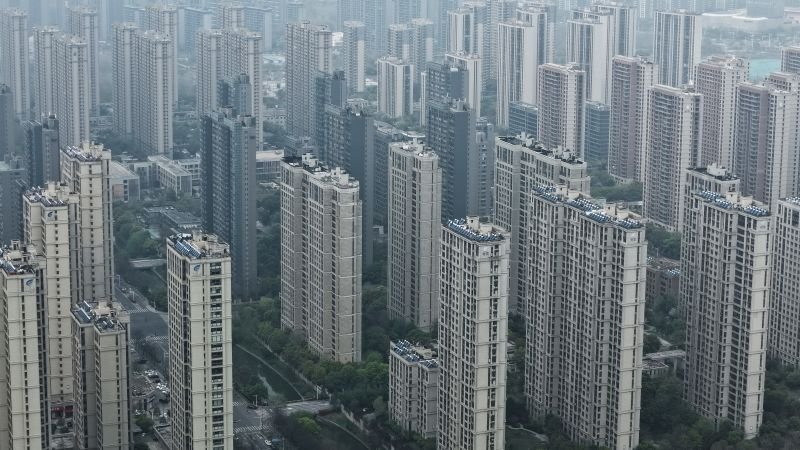
Over much of the past two decades in China, units that easily go beyond 1,000 square feet in the towering apartment blocks of exclusive districts sold out fast.
Meanwhile in the US, where properties have become increasingly unaffordable and university graduates are often encumbered by tuition loans, home ownership rates lag at 65%, according to the OECD Affordable Housing Database. In other Western countries, many feel resigned to a lifetime of renting with little hope of following their parents and grandparents’ footsteps up the property ladder.
But for China’s property market, like all property markets, the good times couldn’t last forever.
During the boom, many developers amassed huge debts, and the oversupply of housing led to whole ghost districts and empty projects in many places. Badly run local governments, keen to massage numbers as well as find avenues for the huge oversupply of concrete and steel, compounded the problem.
As a result, the central government took drastic steps in 2020 to rein in a freewheeling property sector that once accounted for 30% of the country’s economic activity.

The move began curbing problematic construction, but it also dealt a huge blow to homeowners, who watched property prices freefall. Buyers were left with incomplete or delayed apartments as many major developers defaulted or collapsed.
Debt-laden property behemoth Evergrande, once China’s biggest developer, was ordered to wind up by a Hong Kong court in 2024 . Other major property developers also showed signs of distress, including Country Garden, which recently fended off a wind-up petition, and Vanke, which is awaiting an $11.6 billion rescue package from a local government.
All of this was aggravated by a raft of economic uncertainties, from weak domestic consumption to the threat of a historic trade war with the US, leaving the keenest buyers, like Cai, to think twice before entering the market.
“I do plan to buy a home at some point, but probably not in the next few years. I don’t see myself buying anytime soon,” he told CNN.
Five years since the initial wave of defaults by property developers, the sector remains scarred.
New home prices extended their decline in March nationwide, even though some major cities have seen some month-on-month improvement.
The Chinese leadership has put stabilizing the housing market on its agenda, but analysts say that the central government – preoccupied by pushing tech advances – is not interested in seeing the sector return to its former prominence as an economic driver.
Zhang Xiaoduan, head of business development services for south and central China at real estate firm Cushman & Wakefield, noted a detachment between what authorities are wishing for and the reality on the ground.
“There’s still a gap between these signals and a real pickup in actual buying power across the market, or a rapid recovery driven by that demand,” she said.
Defying on-and-off tariff threats from the US, China notched a historic $1.2 trillion trade surplus last year, with its economy hitting a 5% growth target. But the export success has hardly trickled down to ordinary citizens and transformed into buying power that can reverse the ongoing property slump, analysts say.

Renter Mandy Feng, who prefers to use a pseudonym for fear of being seen criticizing the authorities, said the stimulus the government is offering has failed to offset people’s anxiety over an uncertain economic outlook.
“Although property prices are low, the economy is not doing well,” said the 30-year-old photographer who lives with her husband and daughter in the southwestern city of Kunming.
“It isn’t the case that people aren’t unwilling to buy,” she said. “But when everyone is struck by unstable income and isn’t making a lot of money, no one dares to get a mortgage.”
For a generation of homeowners, China’s housing crisis has shown that even property investment has its risks.
“People have realized the market can go through periods of turbulence, which has made them much more cautious about investment-driven purchases,” said Zhang, from Cushman & Wakefield.
The current generation also think differently from their parents and grandparents when it comes to home ownership.
Mother Zoe Zhang, 35, told CNN that she would “most likely not” buy her children homes despite herself relying on her parents’ help to buy her current apartment in Beijing.
“China’s market is gradually becoming more similar to Western countries, where renting might become more mainstream in the future,” the public relations director said.