

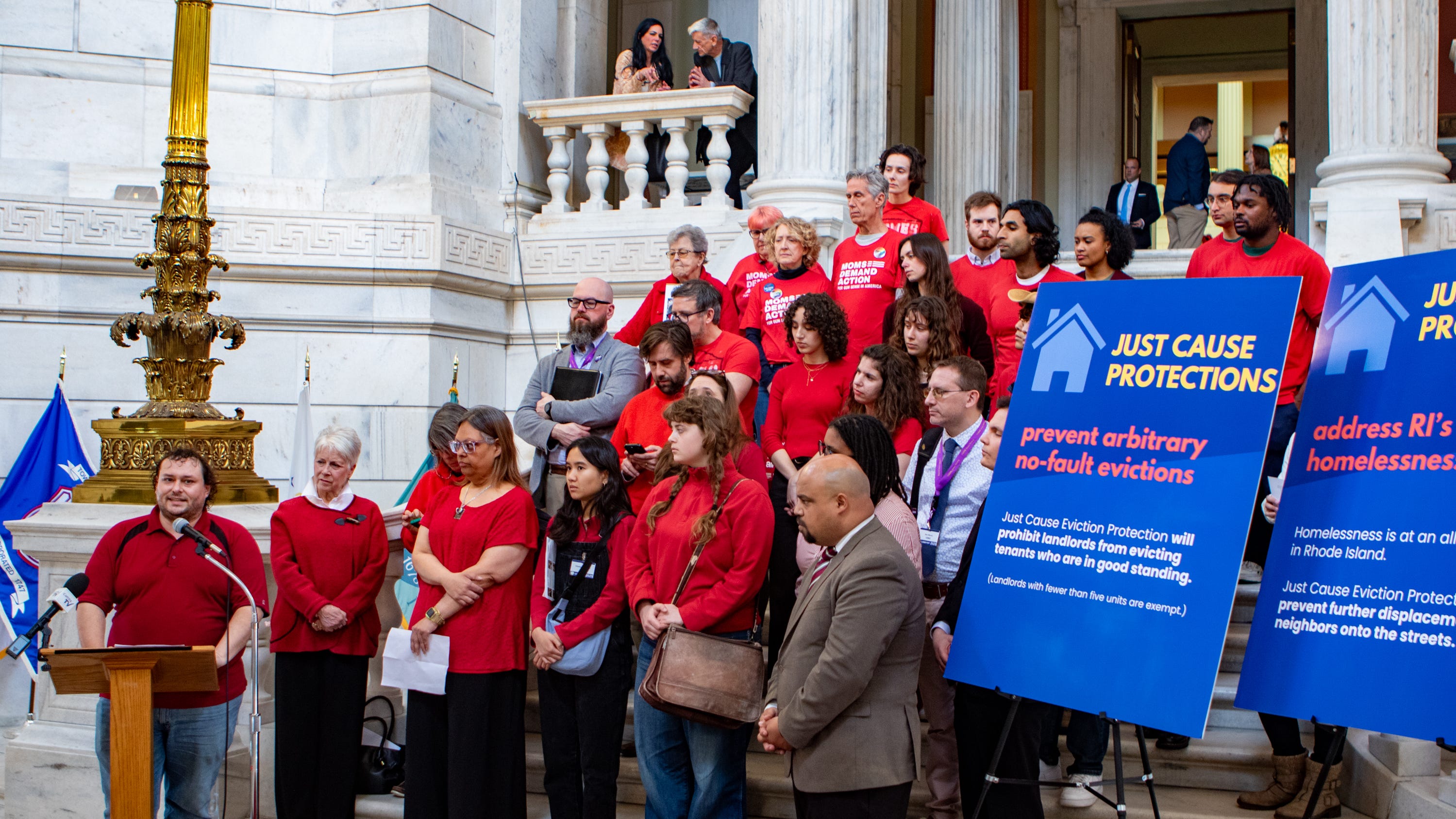

See legislators rally for ‘just cause’ evictions bill at the statehouse
Legislators and tenants describe why just cause eviction protections are needed in Rhode Island.
- A new report from the Rhode Island Public Expenditure Council says cities and towns need to be putting more money into their schools.
- To accomplish this, the group says changes to the property tax system are needed.
- The state should also step in to address the inequalities between cities and towns.
The Rhode Island Public Expenditure Council has been sounding the alarm for years over how the state’s property tax systems further inequality, but the nonprofit’s latest report took a look at how the issue is intertwined with public education.
Over the last few years, as people’s incomes rose and consumer spending bounced back from the pandemic, the state government has seen a surge in income and sales tax revenue, even outpacing inflation.
Property values have also soared, but in stark contrast, local governments have been slow to alter property tax rates, resulting in barren municipal bank accounts that can’t keep up with the cost of community services.
What does the report say?
The gist of RIPEC’s report is that cities and towns need to contribute more money to fund their K-12 schools.
Addressing inequities in how they collect property taxes could be the solution to helping them find those extra funds, and the state needs to rethink how it doles out money in order to prioritize disadvantaged communities, the report argues.
“Part of what I think this report does, is it reframes how we think about property taxes, local revenues and state revenues and puts them all together to discuss how we fund services in Rhode Island,” said Justine Oliva, RIPEC’s director of policy and research. “We fund services like K-12 schools with local dollars and state dollars. But when we talk about property tax systems, income tax or sales tax, we talk about those things as existing separately.”
Is the answer raising taxes?: RIPEC leaders noted that the organization doesn’t typically advocate for tax increases. They want people to understand that their recommendations don’t involve raising property taxes for everybody, but rather focusing on communities where high-income homeowners receive substantial tax breaks and everyone else bears the rest of the burden.
How do RI cities and towns compare?
Property taxation and school funding are closely linked in the U.S. According to the Lincoln Institute of Land Policy, nearly half of all the money that goes to public K–12 education comes from local governments, and about 80% of that is raised through property taxes. From 2020 to 2021, the money raised from property taxes was considerably higher across New England, reaching 97% in Rhode Island.
These contributions are supposed to help communities maintain local control of their schooling. They’re also considered a stable source of funding; however, overreliance on property tax revenue can be problematic.
The RIPEC analysis compared how much money each of Rhode Island’s 39 cities and towns raised annually through property taxes. Those figures varied drastically.
“We have this disparity between communities and the wealth that they have to work with,” Oliva said. “There’s a significant difference between somewhere like Central Falls – which has under $40,000 of property value per person as of 2022 – and some of our more wealthy coastal communities – that have over $250,000 per person.”
Rhode Island does not require local governments to increase their funding contributions toward public education each year. RIPEC President and CEO Michael DiBiase said that’s highly unusual compared with other states, and it has resulted in a lot of communities neglecting their obligations to the schools – even well-off suburban ones.
“There were a number of cities and towns that were less generous than Providence before Providence got into hot water,” he said. “Woonsocket has only put in about $10,000 in additional funding over four years.”
Tax burden or tax break?
RIPEC concluded that the second mechanism exacerbating inequity is the rise in generous tax breaks for homeowners, such as the popular homestead exemption.
“These systems favor resident homeowners regardless of whether they have higher or lower levels of need,” Oliva said. “You have renters shouldering a larger proportion of the total property tax burden while also having lower income.”
DiBiase added that, of course, there are many homeowners who need those programs to help them afford homeownership, but where the laws stand now, a lot of high-income homeowners also qualify and avoid paying property taxes that reflect their wealth.
“They’ve adjusted tax rates over time to favor homeowners and disfavor landlords and renters,” he said. “That disparity and trend seems to be accelerating. Just the general unfairness of tax burdens across communities where people pay wildly different tax bills for the same [type of] property.”
Although renters don’t directly pay property taxes, landlords tend to raise rents to accommodate the property taxes. RIPEC’s report touched on how high property taxes affecting renters and commercial businesses hinder economic growth and housing development.
After calculating renter versus homeowner tax burdens, the team found that in some communities, renters were paying several thousand dollars more.
Studies have also shown that Black and Hispanic homeowners pay disproportionately high taxes relative to their home values, partially stemming from legacies of racial segregation, redlining and neighborhood inequality.
How does RIPEC suggest cities and towns fix this?
To address education disparity between municipalities, the state must be part of the solution and redesign its education funding formula, DiBiase said. Under this model, Rhode Island’s urban core – home to a higher concentration of low-income students – would receive increased allocations from the state, which would mean less state funding for suburban communities.
Ultimately, though, all municipalities would be held accountable to contribute to their public schools based on how much wealth they have.
“I think the biggest takeaway is to make education part of this case,” DiBiase said. “If your house doubles in value, it doesn’t necessarily mean you can afford a much higher tax bill. But there is something wrong with the picture when school districts are significantly underfunded.”
The report suggests expanding property tax relief for low-income seniors and other vulnerable taxpayers, as well as considering annual property revaluations. Presently, communities update their property records every three years but only do the full revaluation every nine years. DiBiase said that, unfortunately, legislative efforts may be moving in the opposite direction.
“What we’ve lamented is that the General Assembly, which empowers the property tax system, has not been willing to put any guardrail limits except around certain parts of the assessment,” DiBiase said. “They let the cities and towns do what they want.”
RIPEC also favors maintaining Rhode Island’s cap that limits tax increases to 4% or less each year. Providence is currently seeking approval from the General Assembly to remove that cap in response to the city’s cash shortage from the $15 million settlement it owed to the public school district.