
Hong Kong
China’s robust growth, one of the fastest sustained expansions for a major economy in history, was propelled for decades by a housing boom fueled by a rising population and urbanization.
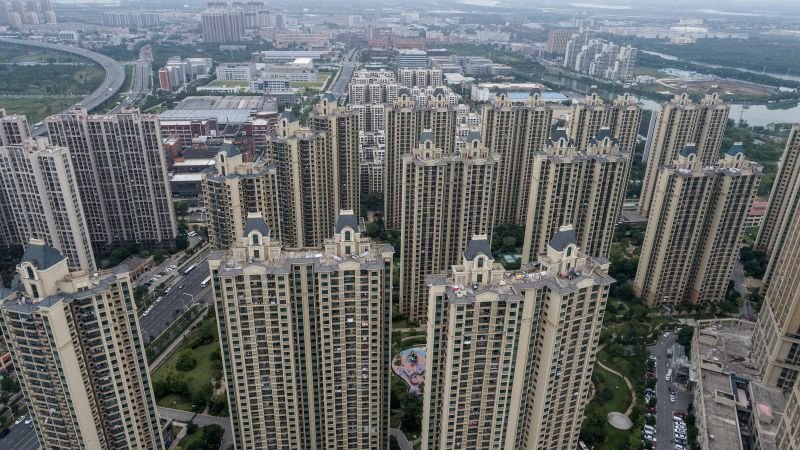
But the all-important property market, which has accounted for as much as 30% of the economy, fell into crisis more than two years ago after a government-led clampdown on developers’ borrowing.
Investment in real estate fell last year for the first time in a decade, and with no bailout from Beijing in sight, the property downturn is likely to drag on, posing a major threat to China’s growth prospects over the next three to five years.
“For China, the only way out of this [property] crisis is a slow but painful adjustment,” said Alicia Garcia-Herrero, chief economist for Asia Pacific at Natixis. “The adjustment has only started and will take years to conclude.”
The country needs to match the supply of housing with much lower demand, which is waning because of an aging population, she added.
It’s a tall order. Last month, a former deputy head of the national statistics bureau was quoted by state media as saying China’s entire population of 1.4 billion would not be enough to fill all the empty apartments littered across the country.
The government has already introduced a “de-stocking” policy nationwide to reduce oversupply, including slowing the pace of land sales in cities and encouraging developers to lower housing prices to spur demand.
Absorbing this “excess capacity” in the property sector will inevitably hurt China’s economic growth, according to Garcia-Herrero.
“Expect China to be shaving off around one and a half percentage points of growth every year, at least until 2026,” she added.

The World Bank cut China’s gross domestic product (GDP) forecast for 2024 to 4.4% from 4.8% on Sunday, citing persistent domestic difficulties such as elevated debt, property weakness and an aging population.
Days earlier, the International Monetary Fund (IMF) said it expected China’s growth to slow to around 3.5% over the medium term from around 5% this year due to demographic headwinds and slowing productivity growth.
The last time China’s economy saw sustained growth around that level was in 1989 and 1990, when expansion slumped to 4.2% and 3.9% respectively from the 11.3% seen in 1988, due to international sanctions sparked by the Tiananmen Square crackdown.
The IMF said future growth could exceed 3.5% if Beijing comes up with more stimulus and economic reforms.
For years, many developers in China had a simple business model: sell apartments before they’re completed. Regulators introduced the model in 1994 to meet surging demand, as the country entered a rapid period of urbanization after the adoption of market-oriented reforms.
The money from the sales funded their breakneck expansion, making real estate moguls some of the country’s richest people.
The strategy largely worked until about three years ago when the Chinese government cracked down on excessive borrowing by the real estate industry because it was worried about the risk of financial instability. It also wanted to rein in soaring property prices and curb the risks associated with rocketing debt.
The decision worsened a cash crunch at developers like Evergrande, which eventually defaulted on its obligations to debt holders in December 2021, triggering a wider crisis in the industry.
Evergrande was meant to be restructured and allowed to get back on its feet, but its troubles have only deepened. Last week, the company said its founder and chairman Xu Jiayin had been detained by authorities on suspicion of crimes, sending a chill through investors who had hoped to see the company make peace with its creditors this month.
Fears have mounted over the fate of Evergrande, which has more than $300 billion in unpaid debts and hundreds of thousands unfinished apartments across the country.
A potential liquidation of the firm could hit households and confidence in the battered real estate market, setting back Beijing’s efforts to revive the sector and prevent bigger economic problems.
There was a glimmer of hope for Sunac China, another major developer, which won approval from a Hong Kong court on Thursday for its multibillion-dollar offshore debt restructuring plan.
But overall, the property sector has contracted severely as it adjusts to a collapse in demand. In 2020, 2021 and 2022, new construction starts measured by floor area dropped by 2%, 11%, and 39% respectively compared with the year prior, according to official data.
With the property sector stalling, Beijing is trying to find alternative engines of growth.
Last month, President Xi Jinping stressed the need to promote “a new type of industrialization,” in which sectors like green technology could take the place of property.
But that goal may be impossible in the near term, analysts from Capital Economics said.
“Many of these sectors have been growing rapidly for years, but they are too small to make up for property’s gargantuan role,” Mark Williams, Sheana Yue and Zichuan Huang wrote in a research note last week.
Sectors already defined as “strategic emerging industries,” including advanced materials and tools and green energy products like electric vehicles, generated a little over 13% of GDP in 2022.
“It is unlikely that emerging new manufacturing sectors on their own will reach the scale or generate the growth or jobs that property did,” they said.
The property sector has played an outsized role in the Chinese economy. Housing assets account for about 70%, the biggest proportion, of household wealth, according to the central bank’s most recent figures in 2020.
Land sales to developers had made up more than 40% of local government income for years before 2021. That dropped to 37% in 2022.
Xi’s new industrialization plan looks more like a way to contextualize China’s policy goals, which are primarily intended to help achieve tech self-sufficiency and compete with the West, rather than to boost GDP growth, analysts from Capital Economics said.
“In our view, by diverting resources to compete at the technological frontier, they will probably result in weaker economic growth overall,” they added.
Consumption doesn’t look like a viable immediate option to fill the hole left by the property sector, either.
For decades, the property boom fueled spending by China’s growing middle class, who kept a great portion of their wealth in real estate and felt confident when their homes increased in value.
Now, the “negative wealth effect” of falling home prices has curbed their desire to spend, and people are hoarding cash.
By June, households’ bank deposits totaled a record $132 trillion yuan ($18 trillion), surpassing China’s entire GDP for last year, according to data from the People’s Bank of China.
Household savings surged by 17.84 trillion yuan ($2.6 trillion) in 2022, up 80% from 2021. That’s more than one third of their total income. Before the pandemic, people saved about a fifth of their income.
Capital Economics estimated that China’s net household wealth contracted by 4.3% in 2022, due to falls in home prices and the stock market. It was the first such decline in more than two decades.
“Like Japan in the 1990s, a more widespread loss of confidence among Chinese consumers and investors in the post-bubble growth model is emerging,” analysts from Oxford Economics wrote in a research report last month. “The obvious place to look for growth is consumer spending, but achieving this requires major structural policy changes.”
Chinese policymakers face multiple challenges in making those changes.
“Households are already highly leveraged for housing and have little room to borrow for consumption, ” said analysts from Stanford University and the Asia Society Policy Institute (ASPI) in a recent report.
“The priority … [should be] for the government to rapidly create alternative venues of income growth aside from housing that will encourage households to consume.”
Demographics is another key headwind, and helps explain the desire of many Chinese to save heavily.
“The social security system is still developing slowly, with the main pillar of China’s pensions stuck in deficit since 2014,” Oxford Economics analysts said.
Without an adequate pension system, precautionary savings have been “high and sticky,” at around 32% of personal disposable income, they pointed out.
Both research firms suggest Chinese authorities need to find ways to boost disposable incomes and improve productivity.
“A fundamental rewiring of China’s economy will necessitate a focus on developing new industries, improving productivity, and bolstering rental markets,” said analysts from Stanford University and the ASPI.
— Michelle Toh contributed reporting.