
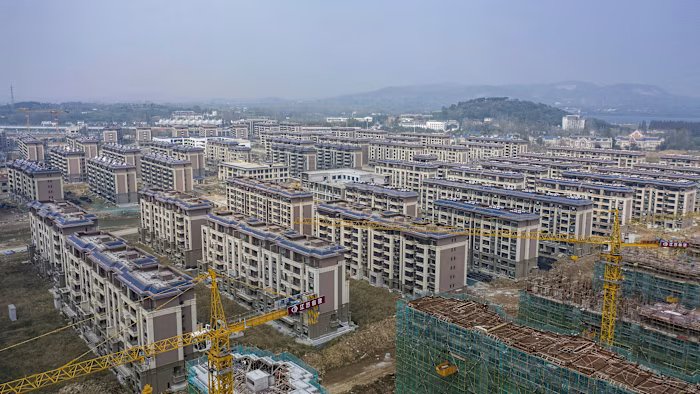
China has expanded trials for a property tax, a decision that pitches President Xi Jinping against deeply entrenched vested interests across an economy fuelled for decades by real estate development.
The state council, China’s cabinet, will expand pilot schemes to tax residential and commercial property in cities, according to an announcement by the National People’s Congress — the rubber-stamp legislature — on Saturday. The locations were not disclosed but rural households will be excluded.
The reform threatens to be far thornier to implement and affect a greater number of people than a regulatory assault that has been launched over the past year in the world’s second-largest economy. A property tax could alter China’s economic model, reshaping government revenue streams from land sales to taxes and deterring property speculation.
Xi privately instructed economic planners in August to forge ahead with developing a property tax, the next step of his broader “common prosperity” reforms, which are intended to redistribute wealth and “regulate excessively high incomes”.
But the proposals have raised concerns among some ordinary Chinese, whose savings are enmeshed in the value of the property they own. Others fear it is too risky and could cause a housing market crash.
How would a property tax work?
Proposals to introduce a property tax have been discussed for almost 20 years. The tax is envisaged as an annual levy on home ownership and would be set and collected by local governments.
Yilin Hou, a professor of public policy at Syracuse University who has advised Beijing on the levy, has said the tax base should be “as broad as possible” but with relief measures for economically vulnerable people.
“If the tax is efficient and equitable, adequate and transparent, then it will be much easier to levy, collect and enforce. In this way, the tax will . . . also be politically acceptable,” Hou added.
Many tax specialists and economists believe it will also help wean local governments off their chronic dependence on selling and leasing public land to developers. This relationship has contributed to widespread property speculation and pushed land and house prices higher in a cycle that many experts believe is unsustainable.

According to research group Capital Economics, an effective tax rate of 0.7 per cent of the total property value would have generated Rmb1.8tn ($282bn) last year in China.
That compares with Rmb1.6tn local governments generated in net revenue from land sales, after paying billions of dollars in land transfer expenses, including compensation payments.
The tax and subsequent pressure on prices could also dent the appeal of property investment, redirecting private capital towards sectors such as high-tech exports and services that boost domestic consumption, according to proponents.
What stands in the way?
Many believe earlier efforts to tax residential property failed because of resistance from wealthy and politically connected elites, particularly in cities such as Beijing, Guangzhou, Shenzhen and Hangzhou, as well as local government officials across the country.
Some experts say a potentially bigger problem for the Chinese leadership is the fear of instability that could be caused by a market crash.
“In speculative markets, once prices stop going up, they tend to go down. If this were to happen to Chinese property prices, this would not only be terribly damaging to the banking system, but it would also reverse the major source of wealth accumulation among Chinese households,” said Michael Pettis, a finance professor at Peking University. “How do social, financial and economic institutions adapt after 40 years of inexorably rising prices, during which the belief developed that Beijing will never let real estate prices fall?”
China’s real estate sector has been thrust into the global spotlight by the plight of Evergrande, the world’s most indebted property developer with $300bn in liabilities.

Official data released this week showed the first month-on-month decline in new home prices across 70 of China’s biggest cities in more than six years, indicating that a slowdown is already feeding through into the housing market.
The downturn has heaped pressure on the leadership in Beijing, which last summer introduced deleveraging rules to constrain the amount developers could borrow. The measures were introduced at a time when rate cuts and an industrial boom to counter the economic hit of the pandemic had raised fears of asset bubbles.
Xi’s desire to push ahead with the tax reflected rising confidence in Beijing that China could manage a plethora of acute housing market problems and other economic risks despite the potential hit to short-term growth, said Gan Li, a professor of economics at Texas A&M University.
“The president has said himself openly that we need to establish a property tax,” said Gan. “We have all learned that we have to take him very seriously. What he says, he will deliver.”
When would it be implemented?
Beijing has not said when the tax will be rolled out, nor where it will be introduced.
Some economists would like the levy to be deployed nationwide as soon as possible but the consensus view is that trials in Shanghai and Chongqing, running since 2011, will be gradually expanded, starting with wealthier cities.
“By our design, a good tax system is one that grants authority to local governments to levy this tax,” Hou added. “They decide whether they want to start now or years later. They decide for themselves how high the tax rate will be, how high the assessment ratio will be.”
Despite reports of political opposition, the chances of a national tax being implemented are much higher than previous attempts, said Mark Williams, chief Asia economist at Capital Economics.
“Opposition from insiders is not new. The correlation between party membership and ownership of multiple properties is probably fairly high,” he added. “But demographics means the 25-year property boom is ending. Land sales are not a sustainable source of government revenue any more. A modest property tax could be.”
What do Chinese people think about the tax?
Interviews and online discussions reflect a sharp division over the tax in China.
“Nobody likes taxes, but it won’t have too much effect on me because I am not a real estate speculator,” said a businessman in Zhejiang province.
Some believe the levy will be ineffective in addressing inequality, is simply being used as another government revenue stream, or both.
Others are betting property prices will continue to rise in the medium to long term, with local government officials unlikely to implement a tax that cuts directly against their own interests.
“Because the class that owns the most property is actually the bureaucracy, it is most likely that the property tax will become a formality and has no actual effect in the end,” said a company manager in Beijing. “I will continue to invest in houses.”
Additional reporting by Emma Zhou in Beijing