
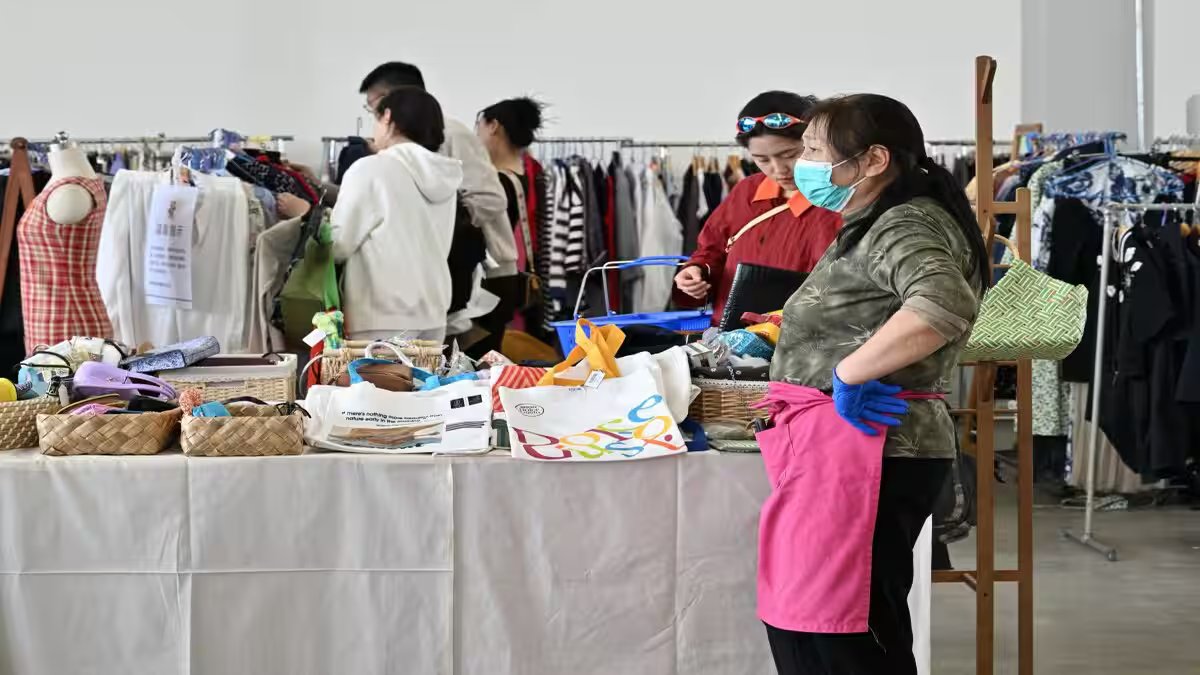
China’s retail sales growth slowed to its weakest pace since 2022 in April, highlighting fragile consumer demand as rising energy costs from the Iran war, weak property investment and slowing factory output weigh on the economy
China’s economic recovery showed fresh signs of strain in April as consumer spending nearly stalled and factory activity slowed sharply, underscoring mounting pressure on the world’s second-largest economy from rising energy costs linked to the Iran war and persistently weak domestic demand.
Data released Monday by China’s National Bureau of Statistics (NBS) showed retail sales — a key gauge of household consumption — rose just 0.2 per cent year-on-year in April, cooling sharply from 1.7 per cent growth in March. The reading marked the weakest expansion since December 2022 and fell far short of analysts’ expectations for a 2 per cent increase.
Industrial output growth also weakened significantly. Factory production expanded 4.1 per cent in April from a year earlier, down from 5.7 per cent in March and below Reuters estimates of 5.9 per cent growth. It was the slowest pace of industrial growth since July 2023.
The disappointing figures suggest China’s economic momentum is fading after a relatively strong start to the year, with analysts warning that the recovery remains uneven and heavily reliant on industrial activity while household demand continues to lag.
China’s economy grew 5 per cent in the January-March quarter, placing growth at the upper end of Beijing’s full-year target range of 4.5 per cent to 5 per cent. However, economists have increasingly cautioned that the rebound is vulnerable to both domestic and external shocks.
Consumer confidence remains fragile amid falling property prices, weak income growth and uncertainty over the broader economic outlook. The slowdown in spending was reflected across sectors, including automobiles, where domestic car sales plunged 21.6 per cent in April from a year earlier, marking the seventh consecutive monthly decline.
Chinese automakers have increasingly turned to overseas markets to offset weak demand at home, intensifying their export push even as domestic inventories rise.
Investment activity also deteriorated. Fixed-asset investment contracted 1.6 per cent in the first four months of 2026, reversing from a 1.7 per cent increase recorded in the January-March period.
Economists attributed part of the weakness to a drop in China’s official construction purchasing managers’ index and heavy rainfall in parts of southern China, which disrupted building activity and infrastructure projects.
The prolonged downturn in the property market continued to weigh heavily on growth, with property investment contraction widening further in April. China’s real estate sector, once a major driver of economic expansion, remains under pressure from weak homebuyer sentiment and debt troubles among developers.
At the same time, the escalating conflict in West Asia has exposed China to fresh external risks through higher energy costs. While China has so far managed to cushion some of the impact through fuel-pricing controls and stronger-than-expected exports, analysts warned that sustained increases in oil prices could squeeze manufacturers’ profit margins and further weaken household purchasing power.
Top Chinese leaders have recently pledged to strengthen energy security, accelerate technological self-sufficiency and tighten control over critical supply chains in response to growing geopolitical uncertainties.
However, Beijing has so far stopped short of unveiling major new stimulus measures. The ruling Politburo reiterated its commitment to a “proactive” fiscal policy and an “appropriately loose” monetary stance in its latest meeting, language largely unchanged from previous policy statements and interpreted by markets as a sign that authorities are not preparing immediate large-scale support.
The April data is likely to intensify pressure on policymakers to roll out additional measures to support consumption and stabilise growth as the economy faces rising uncertainty at home and abroad.
First Published:
May 18, 2026, 08:37 IST
End of Article