
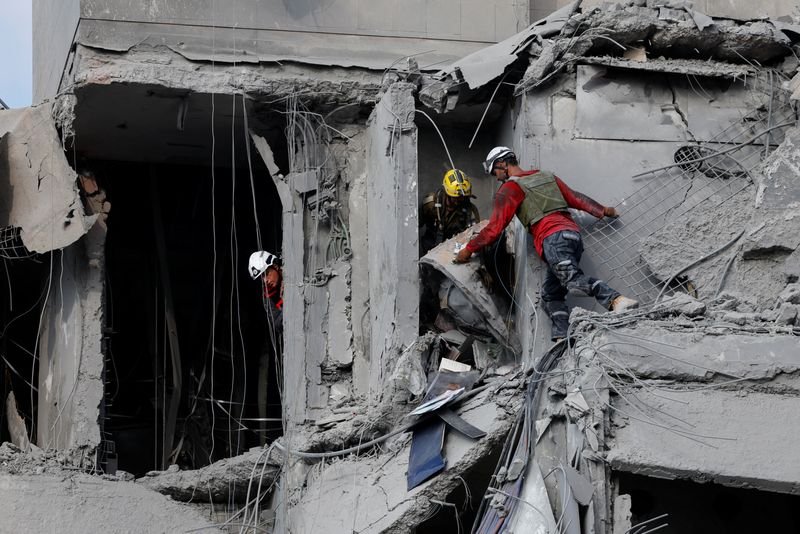
Investing.com – Israel attacked Hezbollah targets in Lebanon and targeted Iranian infrastructure in Tehran on Friday, as an escalating conflict in the Middle East showed few signs of easing.
According the Wall Street Journal, the Israeli military has said it is now shifting into the “next phase” of its campaign against Iran, following an initial “surprise strike phase.”
Iran’s Revolutionary Guards launched its own barrage of drones and missiles at Tel Aviv, Iran’s state news agency has said. Bahrain and Saudi Arabia were among a host of nations in the Gulf which said they were also targeted by Iranian attacks.
As the joint U.S.-Israeli assault on Iran entered its seventh day, Iran’s foreign minister has warned that the conflict could spiral into a “quagmire” for those who choose to pursue it further. However, U.S. Defense Secretary Pete Hegseth has said the U.S. has no shortage of offensive and defensive armaments and could carry on the fighting for as long as it deems necessary.
Iran has also delayed the naming of a successor to Ayatollah Ali Khamenei, who was killed in U.S. and Israeli air strikes, the New York Times has reported. Ayatollah Khamenei’s son Mojtaba Khamenei is viewed as the frontrunner for the post, but U.S. President Donald Trump has called the possible appointment “unacceptable.”
Oil on pace for weekly gains
For financial markets, fears have continued to swirl around the choking off of supplies through the narrow Strait of Hormuz, a key waterway south of Iran through which a fifth of the world’s oil travels.
Container shipping giants and have halted several shipping routes heading through the Middle East which connected to Europe and East Asia.
have spiked by almost 21% since the U.S. and Israel launched joint strikes against Iran. As a result, average gasoline costs in the U.S. have jumped by 27 cents following the start of the assault to $3.25 per gallon, according to Reuters, citing data from travel group AAA.
Faced with the prospect of increased gas prices, some investors have begun to worry that a prolonged conflict may spark a surge in inflationary pressures, which could delay the timeline for potential Federal Reserve interest rate cuts later this year. U.S. bond yields have risen, denting stocks, although equities have remained largely resilient this week.
Beyond the U.S., soaring crude prices have weighed on Asian equities and currencies, especially in South Korea, which heavily imports oil that passes through the Strait of Hormuz. ended Friday’s session broadly unchanged, but has slipped by 10.56% over the past one-week period. The main indices in Europe were also on course for their biggest weekly drops since last April.
In a move to soothe some concerns around the oil price spike, the U.S. has announced it would allow the sale of Russian oil to India for a period of 30 days.
“This action by the U.S. is part of the administration’s plan to try to cap oil prices,” analysts at ING said in a note.
The U.S. Treasury Department is also anticipated to unveil measures aimed at corralling energy prices through financial markets, Reuters reported.
(This is a developing story. Please check back later for updates.)