
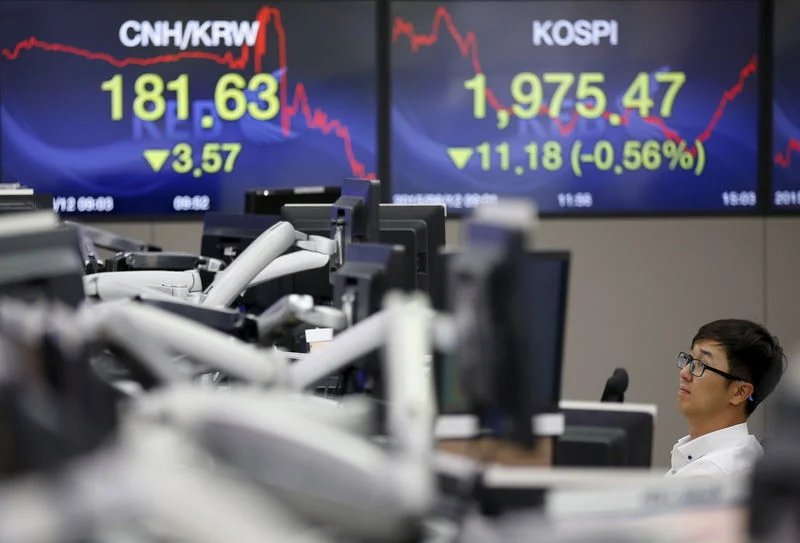
Investing.com — South Korea’s is living a tale of two timeframes: up +71.87% over the past year on the back of an AI semiconductor supercycle, yet down -34% in just one month — a collapse so severe that more than half of all KOSPI circuit breakers ever triggered in history fired in the past six months alone. The world’s most concentrated AI trade has become the world’s most volatile major index.
The Index at a Glance
KOSPI: 5,593.56 (-1.23% today) || 52W Range: 3,079 — 9,385 || 1M: -34.01% || YTD: +32.41% || 1Y: +71.87%
That 52-week range — spanning from 3,079 to 9,385 — is not a misprint. It represents a 205% gap between low and high, a volatility profile more typical of a single speculative stock than a G20 nation’s benchmark index. The engine behind both the rise and the violent reversal is the same: AI memory chips.
The Samsung- Problem
The KOSPI has a concentration problem that is both its greatest strength and its most acute risk. (005930) and SK Hynix (000660) together represent more than 50% of the KOSPI’s weight. When AI chips sneeze, the entire Korean market catches a cold.
| Stock | Price (KRW) | 1D | 1W | 1M | 1Y |
|---|---|---|---|---|---|
| Samsung Electronics (005930) | ₩207,000 | -0.72% | -23.33% | -38.02% | +185.12% |
| SK Hynix (000660) | ₩1,322,000 | -5.64% | -31.11% | -50.11% | +401.71% |
| KOSPI | 5,593.56 | -1.23% | -21.18% | -34.01% | +71.87% |
The cruel irony: SK Hynix just delivered the greatest quarterly result in Korean corporate history — Q2 2026 revenue of ₩79.32T (+257% YoY), operating profit of ₩60.54T, and a 76% operating margin. Yet shares fell -8.98% the day results were published. Read more
This is the “buy the rumor, sell the news” dynamic taken to an extreme — markets had already priced in perfection, and perfection was delivered but not exceeded.
The Valuation Paradox
Despite the AI boom, Samsung and SK Hynix are trading at P/E ratios below 5x — extraordinarily cheap for companies with 76% operating margins and sold-out order books through 2026. Meritz Securities analyst Kim Sunwoo warned that DRAM suppliers are currently meeting only 75-80% of market demand, with fulfillment potentially deteriorating to 60% by 2027. SK Hynix’s CEO has called 2027 potentially “the worst supply shortage in global memory industry history.” Read more
That’s a fundamental disconnect: the supply-demand picture is structurally bullish, but the stock is selling off — suggesting the volatility is driven by financial mechanics, not fundamentals.
The Leveraged ETF Time Bomb
The KOSPI’s wild swings have an accelerant: single-stock leveraged ETFs. A Hong Kong-listed 2x SK Hynix fund grew 20-fold to $7.78B in assets since early 2026, becoming the largest single-stock leveraged fund globally. Korean retail investors held ₩34.37T ($23B) in margin loans as of mid-July, down slightly from a June record of ₩38.6T. Read more
Seoul’s response: the finance ministry announced immediate caps and higher trading costs on single-stock leveraged ETFs, with the minimum cash balance to trade them tripling to ₩30M (~$20,300) from August 5, 2026. Read more This deleveraging process — forced selling of margin positions — is a key driver of the near-term selling pressure.
The Macro Backdrop: Surprisingly Solid
Away from the chip volatility, Korea’s underlying economy is genuinely strong:
- Q2 2026 GDP: +3.7% YoY, beating the 3.5% forecast — driven by semiconductor exports Read more
- Won strengthening — hit a 2.5-month high of 1,466.9, reflecting capital inflows and GDP strength
- Bank of Korea rate hike risk — August 2026 meeting could bring another 25bps hike, which would pressure equities
- Geopolitical premium — Middle East tensions pushing Treasury yields higher, weighing on all rate-sensitive growth stocks
- Presidential diplomacy — Major long-term memory chip supply deals announced with U.S. tech companies during President Lee’s San Francisco visit Read more
Beyond Chips: Other Korean Stories
Shipbuilding is emerging as a second pillar. CLSA maintains a “high-conviction Outperform” on with a ₩990K target — the sector benefits from LNG infrastructure demand, including South Korea’s review of a $19.8B Texas LNG power plant investment as part of a Korea-U.S. bilateral trade commitment. Read more
Samsung C&T reported Q2 operating profit up ₩279B YoY on Hi-Tech semiconductor fab construction but warned Q3 trading earnings may moderate — a microcosm of the broader Korean story: AI infrastructure boom with near-term earnings visibility questions. Read more
Bull vs. Bear: The Korea Decision Framework
Bull case: Sub-5x P/E on companies with 76% operating margins and sold-out 2026 capacity is a compelling entry for long-term investors. Memory supply shortfalls deepening toward 2027, AI capex globally accelerating (as Meta’s $125-145B and Alphabet’s increased guidance show), and a presidential-level diplomatic push securing U.S. chip contracts. Citi still sees 12% upside in MSCI EM broadly — the derating may be the setup.
Bear case: Citi already downgraded Korea to Neutral from Overweight on July 19, citing the rally being “almost entirely driven by AI-linked stocks.” Read more Forced leveraged ETF deleveraging isn’t finished — ₩34T in margin loans still needs to unwind. A Bank of Korea rate hike in August would add further headwind. And the PHLX Semiconductor index is down -18% for July alone, suggesting global semis remain in a corrective phase. KB Securities noted that markets are “valuing AI investments through the lens of funding costs rather than long-term growth prospects.” Read more
The Bottom Line
Korea’s market is not broken — it’s repricing. The fundamental AI memory thesis remains intact and arguably stronger than ever. What’s unwinding is the speculative positioning layered on top: leveraged ETFs, margin debt, and options that priced in perpetual upward momentum. The deleveraging cycle + potential BoK rate hike + global risk-off suggest near-term volatility isn’t over. But for investors with a 12-24 month horizon, sub-5x P/E on dominant AI infrastructure suppliers — with the CEO warning of the worst-ever supply shortage coming — is a rare combination.
This article was generated with the support of AI and reviewed by an editor. For more information see our T&C.