
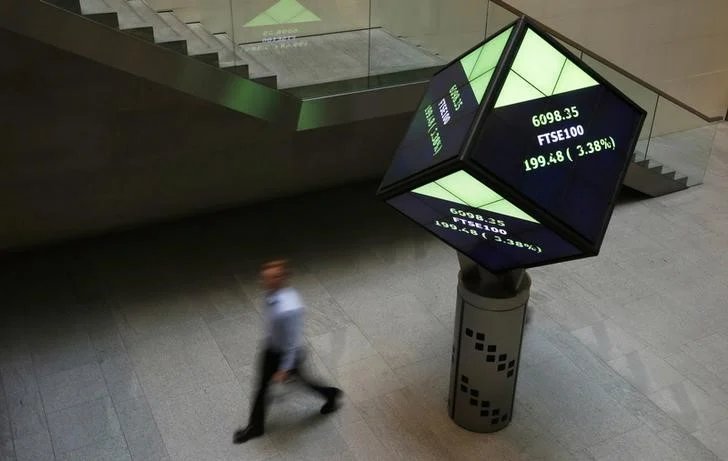
Investing.com — British stocks held gains on Friday, with the index extending its advance as a surge in gold, silver and prices lifted London-listed miners, offsetting a soft UK retail sales print and escalating US-Iran tensions that rattled continental peers.
The rose 0.7%. Germany’s and France’s , both down earlier in the session, turned positive, closing up 0.5% and 0.4% respectively. GBP/USD extended its gains, up 0.1% at 1.3640.
is now trading above $4,600 an ounce on Friday and is on course for a third consecutive weekly gain, with futures up 2.2% to $4,670 and gaining 2.1% to $4,613.
was up 2.1% and copper adding 2.2%, all buoyed by haven demand and a weaker dollar backdrop following the U.S. Treasury’s buyback announcement.
was up 0.30% to $94.08 a barrel and WTI inched up 0.18% to $86.98.
Investors turned to safe-haven metals amid heightened volatility across currency and bond markets, with silver up 2.58% and copper up around 2.2% in tandem.
The precious metal jumped more than 4% on Wednesday after the US Treasury announced plans to at least double its long-term debt buybacks to contain borrowing costs.
Continued central bank purchases, particularly from China, have added further support.
The commodities move mapped onto the FTSE’s leaderboard: led with a 6.6% jump, followed by , , , and .
Iran’s armed forces chief, Major General Abdolrahim Abdollahi, warned that Tehran was prepared to deliver a “devastating” response to any “miscalculation” by its adversaries, while acting Defense Minister Seyed Majid Ibn al-Reza linked national security to economic resilience.
Washington’s economic campaign against Iran drew pushback from Beijing, with foreign ministry spokesman Lin Jian saying that “sanctions and pressure will not help resolve the issue,” calling for a diplomatic solution.
Treasury Secretary Scott Bessent warned of the “toughest sanctions in history” following what U.S. President Donald Trump called on social media platform Truth Social the “most crushing economic operation ever taken” against Tehran, as pulled back on the session.
Washington’s Iran pressure campaign intensified across multiple fronts on Thursday. Trump told 77 WABC that the U.S. was “essentially controlling the straits” and that Iran’s navy, air force and leadership were “gone.”
He separately announced what he called an “Economic D-Day,” sweeping measures targeting oil smuggling networks, financial transfers, exchange houses, ship registries and front companies, and warned countries maintaining ties with Tehran of “tremendous economic consequences.”
Iranian Foreign Minister Abbas Araghchi dismissed Trump’s “Economic D-Day” as a diversion from US debt and surging interest costs. Parliament Speaker Mohammad Bagher Ghalibaf said Tehran would not reopen the Strait until Washington fulfilled a 14-point Memorandum of Understanding, including lifting the blockade and releasing frozen assets.
Jefferies strategist Mohit Kumar in a note said that Washington’s Iran sanctions would prove “ineffective without the support of China, Russia and a number of Asian countries who are active trading partners of Iran,” warning that targeting those nations risked “creating a wider trading conflict.”
UK retail sales fell 0.5% month-on-month in July 2026, the first decline since April and in line with consensus, as non-food stores pulled back following early June promotions.
Non-food sales volumes dropped 1.3%, led by weaker clothing and household goods. Food sales rose 0.5%, supported by hot weather and the World Cup.
Annual growth slowed to 1.6% from 3.8% in June, the smallest rise in three months, according to the Office for National Statistics.
UK round up
cut its 2026 EBITDA guidance after weaker OCTG and Advanced Manufacturing activity, while first-half revenue and adjusted profit fell 6% and 21%, respectively.
The company cited the absence of KOC orders and delayed Middle East tendering, while Perforating Systems and Subsea Technologies delivered strong growth.