
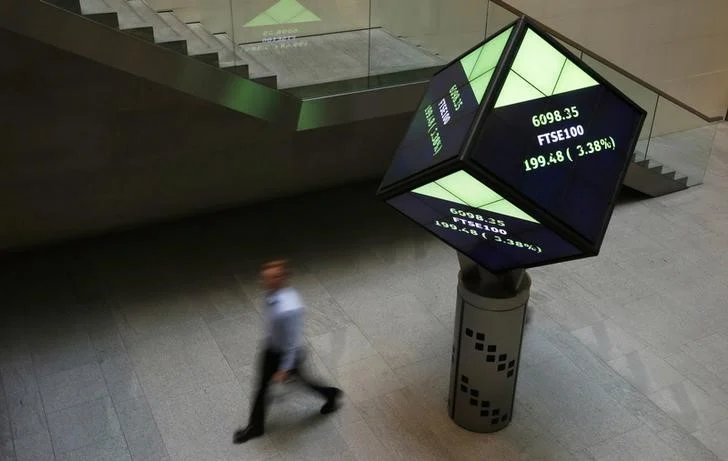
Investing.com — British stocks on Friday posted a four-week win streak, helped by gains in precious metal miners and a rally across the Atlantic on Wall Street following a weak jobs report. prices jumped while the dollar weakened after the data.
Meanwhile, Saudi Arabia, Türkiye, and Pakistan signed a landmark trilateral defense pact and Riyadh warned of imminent coordinated attacks by Houthi and Iran-backed Iraqi militias. Oil rose against this backdrop.
The added 0.3% to close at 10,903.41 points. For the week, the index improved 0.3% as well.
U.S. Labor Department data released Friday showed the economy unexpectedly shed 23,000 jobs in July, against economist expectations for nonfarm payrolls growth of 85,000, while the unemployment rate cooled slightly to 4.1% from 4.2%. June’s job gains were revised down to 20,000 from 57,000, and May’s were slashed to 63,000 from 129,000, leaving the combined two-month total 103,000 lower than previously reported.
Traders reacted to the data by paring their expectations for Federal Reserve rate hikes, as the central bank now finds itself caught between high inflation and a resilient labor market. The Bank of England at the end of last month held its key policy rate steady and predicted a rise in inflation later in the year due to the oil shock from the Middle East conflict.
Gold and prices advanced after the jobs report, boosting and and helping the stocks end as the top gainers on the FTSE 100. The dollar slid, which in turn helped the gain 0.4% to $1.3505.
On the domestic front, ’ House Price Index showed UK house prices flat in July (0.0%), following a 0.2% rise in June, with the average property price at £299,253. Annual growth slowed to 0.1%, the weakest pace since November 2023.
“The UK housing market remained steady in July, with the average property price effectively unchanged over the month,” said Amanda Bryden, Head of Mortgages at Lloyds, adding that mortgage rates “have edged higher again after easing earlier in the summer” following the Middle East escalation.
Away from the economic calendar, Türkiye, Saudi Arabia, and Pakistan formally signed their joint defense agreement Friday, Pakistan’s Foreign Ministry said, with President Erdogan, Crown Prince Mohammed bin Salman and PM Shehbaz Sharif meeting in Riyadh.
A senior Saudi official told Reuters intelligence points to imminent attacks on civilian and energy infrastructure, including ports and airports, from Houthi forces in the south and Iraqi militias in the north, allegedly under IRGC direction. A Houthi political bureau member vowed operations against Saudi forces would continue.
Strait of Hormuz traffic remains severely constrained: only 33 vessels crossed between Monday and Thursday, down from 50 the prior week, per Kpler data cited by Reuters, with just six tankers exiting the strait this week and traffic through Bab al-Mandeb rising to 26 vessels, suggesting rerouting.
Chinese and Indian refiners are separately seeking tankers for steeply discounted Iraqi crude via Hormuz, though shipowners remain wary of transiting the strait.
Diplomatically, the picture is mixed: Iranian Parliament Speaker Mohammad Bagher Ghalibaf accused Washington of “theater diplomacy,” writing on X that “using bullying + broken promises + fake news as leverage is a failed strategy.”
Mohit Kumar, an analyst at Jefferies, cautioned the market could grow “desensitized to the Middle East, as long as oil stays around of below $80,” noting broader fundamentals remain solid, with a resilient U.S. labour market and ample global liquidity supporting risk assets.
However, he flagged near 4.70% as the “biggest worry,” with oil at $75-$80 still 25%-30% above pre-war levels, a level that would “feed into inflation globally.”
Kumar added that an Iran-Oman agreement on Strait of Hormuz passage was unlikely to satisfy Washington, since it would effectively cede Iran control over the waterway, while reports that Tehran wants to bar US and Israeli vessels from the strait suggest “we are still some distance from a deal.”
Oil was higher on Friday, with up 1.3% to $78.30 a barrel, and up 1.5% to $83.70 a barrel.
UK round up
appoints former IKEA CEO Peter Agnefjäll as chair from Sept. 1.
in talks to sell defence business after order delays, FT reports.
Anuron Mitra contributed to this article