
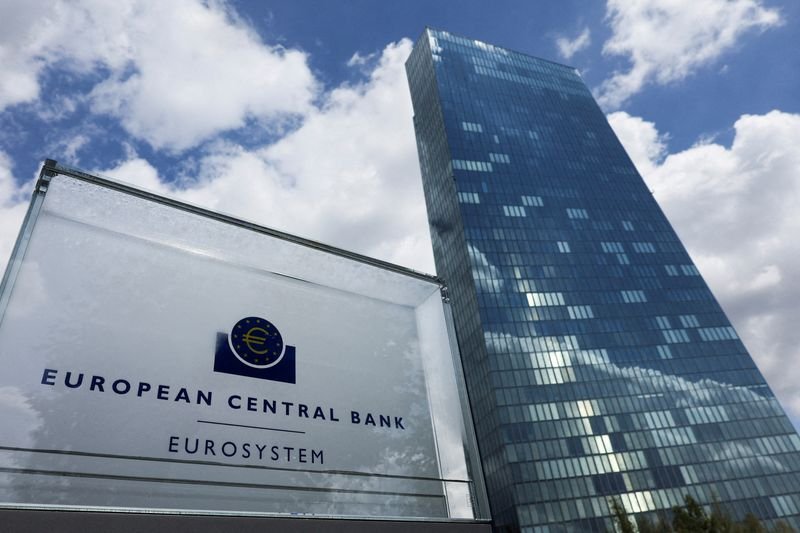
Investing.com – The European Central Bank is expected to hike rates for a second time this year at its September gathering, though lower oil prices and signs that headline inflation has likely peaked could argue for a less proactive monetary policy stance, according to analysts at Barclays.
In June, the ECB raised interest rates for the first time in roughly three years, becoming the first central bank in the G7 to respond to energy-fueled inflation concerns by lifting borrowing costs. The Eurozone’s monetary policy setter also revised up its baseline projection for inflation in 2026 and 2027, warning that the joint U.S.-Israeli assault on Iran is “generating inflation pressures.”
Although the Barclays strategists including Silvia Ardagna and Mariano Cena highlighted that consumer price growth in the Eurozone eased on an annual basis last month, there may still be some “pipeline pressure in the system” in the form of the European Commission’s selling price expectations indicators.
“[T]hese indicators remain elevated relative to both their historical averages and pre-war levels, particularly in the manufacturing and retail sectors, suggesting that the cost-push pressures generated by four consecutive months of elevated energy prices are likely to give rise to indirect effects outside the energy complex in the near term,” they wrote.
In the twelve months to June, consumer prices in the 21-member currency area rose by 2.8%, compared to 3.2% in May and economists’ expectations of 3.0%, according to preliminary data from Eurostat on Wednesday.
While energy costs are anticipated to have the highest annual rate last month, their gain of 8.7% was slower than 10.8% in May. , the global oil benchmark, have dropped back down to around pre-war levels following a framework peace deal between the U.S. and Iran signed last month. Oil prices had spiked to well above $110 a barrel after the outbreak of the conflict in late February, driven largely by the effective closure of the Strait of Hormuz, a vital conduit for a fifth of the world’s oil and liquefied .
While not as exposed as other regions to the shuttering, Europe was impacted by the war, particularly attacks on key natural gas production facilities in the Gulf. The sharp climb in energy costs underpinned fears of a wave of inflation pushing up prices across a range of items.
Still, an uptick in expenses for services, food, alcohol, and tobacco moderated in June. Meanwhile, stripping out volatile costs like food and fuel, the so-called “core” consumer price index decelerated to 2.4%, versus 2.6% previously and projections of 2.5%.
At a key central banking forum in Portugal this week, ECB President Christine Lagarde pushed back against the characterization of the June hike as a form of insurance to mitigate the effect of surging prices, arguing instead that it was robust across the full range of potential inflation scenarios.
“While she emphasized that the euro area is entering an environment of more frequent supply shocks, she also argued that the economy’s resilience could increasingly place monetary policy in an intermediate zone — between shocks that can be looked through and those that require a forceful response. At the same time, she stressed that the rapid evolution of these shocks means policy must be able to adapt quickly,” the Barclays analysts wrote.
However, they flagged, Lagarde refrained from giving any “clear directional signal,” saying only that risks to both Eurozone inflation and growth have become more balanced. Other members of the ECB’s rate-setting Governing Council also suggested that “all options” are on the table for upcoming meetings, the Barclays analysts said.