
Key Takeaways
- A zero-sum game is a situation where one participant’s gain results in another’s equivalent loss, with no net change.
- Examples of zero-sum games include chess, poker, and specific financial market transactions like options and futures trading.
- In contrast to zero-sum games, positive-sum games benefit all parties involved, often seen in trade agreements and economic exchanges.
A zero-sum game ends with a winner and a loser, but no net change. In financial markets, futures and options contracts are considered zero-sum games because they end with one participant transferring wealth to the other participant. There’s a winner and a loser, but no net change in wealth.
What Is a Zero-Sum Game?
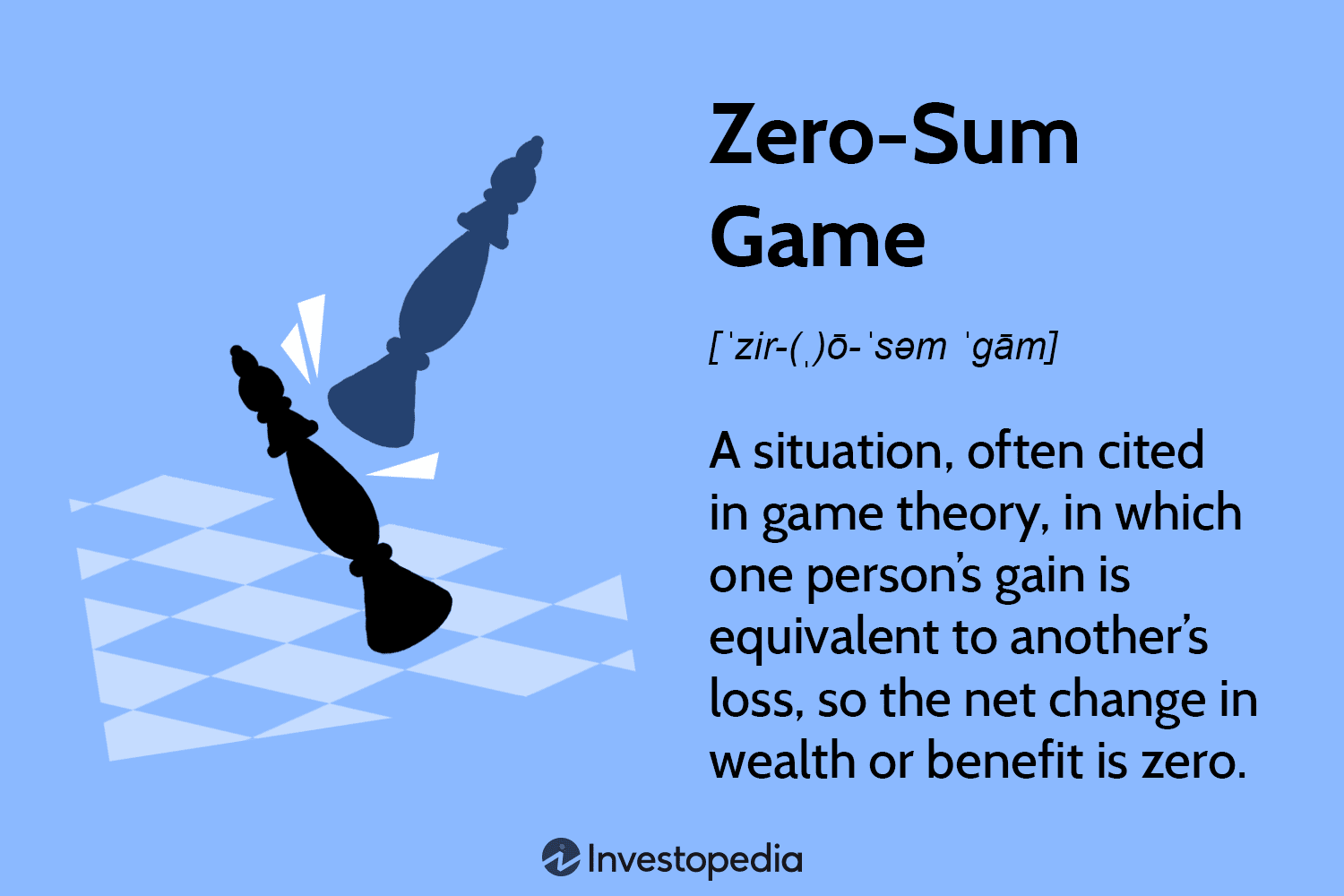
A zero-sum game is any interaction where one person’s gain results in an equivalent loss by another participant. The concept of a zero-sum game is prominent in game theory. Chess is an example of a zero-sum game, in which one person wins at the expense of another.
Some transactions in the financial market are zero-sum games. Trading in options and futures are common examples: Every contract is an agreement between two parties, where one party wins and the other party loses.
In financial markets, there may be millions of participants in a zero-sum game. Assets can be bought and sold among millions of investors, redistributing wealth but not increasing the total.
Investopedia / Laura Porter
Core Concepts of Zero-Sum Games
Zero-sum games are found in many contexts. Poker is a zero-sum game since the sum of the amounts won by some players equals the combined losses of other players. The pot does not grow, it is simply redistributed.
Games like chess and tennis, where there is one winner and one loser, are also zero-sum games.
Derivatives trades are often cited as zero-sum games, since every dollar earned has to be lost by another party to the transaction.
Differences Between Zero-Sum and Positive-Sum Games
Zero-sum games are the opposite of win-win situations, such as a trade agreement that significantly increases trade between two nations. There can also be lose-lose situations, such as a breakdown in a diplomatic negotiation that ends with no positive outcome for either party.
In real life, things are not always so obvious, and gains and losses can be difficult to quantify.
The Perfect Competition
When applied to economics, there are multiple factors to consider when understanding a zero-sum game. A zero-sum game assumes a version of perfect competition and perfect information; both opponents in the model have all the relevant information to make an informed decision.
Taking a step back, most transactions or trades are inherently non-zero-sum games because when two parties agree to trade, they do so with the understanding that the goods or services they are receiving are more valuable than the goods or services they are giving up. This is called positive-sum, and most transactions fall under this category.
Many well-known game theory examples like the prisoner’s dilemma, the Cournot Competition, the Centipede Game, and Deadlock are non-zero-sum games.
Fast Fact
A positive-sum game is where the net result is greater than zero, even though there may be some winners and losers. In economics, trade and exchange are thought to be examples of a positive-sum game.
Zero-Sum Games’ Role in Game Theory
Game theory is a complex theoretical study in economics. The 1944 groundbreaking work “Theory of Games and Economic Behavior,” written by Hungarian-born American mathematician John von Neumann and co-written by Oskar Morgenstern, is the foundational text.
Game theory is the study of the decision-making process between two or more intelligent and rational parties. It can be used in a wide array of economic fields, including experimental economics, which tests economic theories in a controlled setting.
When applied to economics, game theory uses mathematical formulas and equations to predict outcomes in a transaction, taking into account many different factors including gains, losses, optimality, and individual behaviors.
In theory, a zero-sum game is solved via three solutions, perhaps the most notable of which is the Nash Equilibrium put forth by John Nash in a 1951 paper titled “Non-Cooperative Games.” The Nash equilibrium states that two or more opponents in the game—given knowledge of each others’ choices and that they will not receive any benefit from changing their choice—will therefore not deviate from their choices.
Real-World Examples of Zero-Sum Games
The game of matching pennies is often cited as an example of a zero-sum game, according to game theory. The game involves two players, A and B, simultaneously placing a penny on the table. The payoff depends on whether the pennies match or not. If both pennies are heads or tails, Player A wins and keeps Player B’s penny. If they do not match, Player B wins and keeps Player A’s penny.
Matching pennies is a zero-sum game because one player’s gain is the other’s loss. The payoffs for Players A and B are shown in the table below, with the first numeral in cells (a) through (d) representing Player A’s payoff, and the second numeral representing Player B’s payoff. As can be seen, the combined payoff for A and B in all four cells is zero.
Image by Julie Bang © Investopedia 2020
Application of Zero-Sum Games in Finance
In the stock market, trading is often thought of as a zero-sum game. However, because trades are made based on future expectations and traders have different risk preferences, a trade can be mutually beneficial.
Investing long-term is considered a positive-sum situation because capital flows facilitate production and create jobs that then provide savings and income, fueling investment to continue the cycle.
Options and futures trading is the closest practical example to a zero-sum game scenario because the contracts are agreements between two parties, and if one person loses, the other party gains.
Generally, if the price of that commodity or underlying asset rises (usually against market expectations) within a set time frame, an investor can close the futures contract at a profit. Thus, if an investor makes money from that bet, there will be a corresponding loss, and the net result is a transfer of wealth from one investor to another.
Applying Zero-Sum Game Concepts in Daily Life
Even if you never work in business or finance, daily life is full of zero-sum interactions where one person’s success comes at another’s expense. For example, imagine two people fighting over a taxi, or roommates arguing over fridge space. Since there’s only one taxi and a finite amount of fridge space, there’s no way for one party to gain without the other party suffering an equal loss.
Luckily, real life is also full of positive-sum interactions, where both players feel better off. If you spend a dollar on an apple, it’s because you feel better off with the apple than with the dollar. Likewise, the supermarket prefers to have your dollar rather than the apple.
Does Zero-Sum Game Mean All or Nothing?
Yes. Often, the terms zero-sum and “all or nothing” are used to describe the same phenomenon, in which there can only be one winner at the expense of the loser(s).
Why Is It Called Zero-Sum?
The term zero-sum comes from the fact that some situations require winners to gain at the expense of losers while the net value of the system remains unchanged.
For example, a winner with +3 would result in, say, two losers, one with -1 and one with -2. The sum is zero (3 – 2 – 1).
What Is a Zero-Sum Game in Relationships?
In the context of personal relationships, a zero-sum game implies that there can only be one winner at the expense of the other person or people. This can create conflict and tension.
The Bottom Line
In a zero-sum game, or any zero-game interaction, there are winners and losers but there is no net gain. Luckily, most interactions in life are non-zero-sum games. Some of the participants can gain while others lose, but it is not a winner-take-all outcome. And, in the end, the amount gained can be greater than the amount risked.