

Transition finance is rapidly becoming one of the most important instruments in sustainable finance, particularly for economies with carbon-intensive industrial bases such as South Africa.
It focuses on funding credible decarbonisation pathways in carbon-intensive sectors, including cement, steel, chemicals, power, energy, and agriculture.
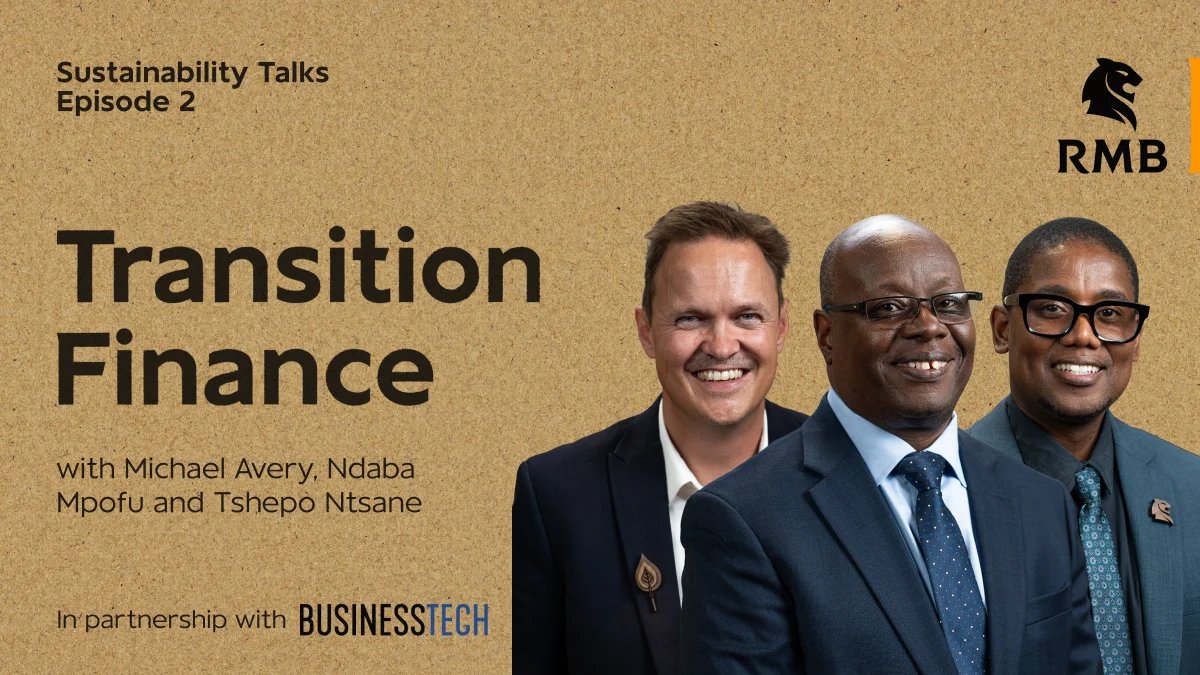
Transition finance is the focus of the second Sustainability Talks podcast episode, where host Michael Avery speaks to Tshepo Ntsane, Transactor in RMB’s Sustainable Finance team, and Ndaba Mpofu, Managing Director and Head of Financial Services, Debt, and Trade Finance at British International Investment.
Their conversation explores what transition finance is, what it is not, and why it is becoming central to achieving net-zero ambitions across emerging markets.
Defining transition finance
Unlike traditional green finance, which typically supports assets that have green alternatives, transition finance is designed to reduce emissions in sectors that cannot yet operate without carbon-intensive inputs.
These industries are essential to economic growth, creating jobs, and maintaining export competitiveness, yet they are still expected to lower their carbon intensity in alignment with global climate targets.
Ntsane explains that the starting point of implementing transition finance is understanding a company’s carbon maturity.
This includes assessing whether emissions are being measured accurately, whether a clear decarbonisation strategy exists, and which mitigation levers have been identified.
From there, funders work with companies to determine the best solutions for their needs – as well as which solutions can be implemented immediately, which require medium-term investment, and how different technologies complement one another.
Once all of this has been determined, a formal transition finance framework is developed to outline eligible activities and provide transparency to investors.
This framework must be validated by an independent external reviewer to ensure credibility and alignment with international principles.
For example: RMB recently concluded a R2.6 billion deal anchored in a Moody’s-validated transition finance framework.
The independent validation provided assurance that the framework aligns with emerging global transition finance principles.
It also gives investors confidence that capital is directed toward measurable decarbonisation outcomes.
The importance of planning and management
Continuous monitoring and reporting are central to the success of transition finance initiatives.
Unlike green projects, where emissions are near zero from inception, transition projects require year-on-year verification that carbon intensity is declining in line with defined pathways.
Mpofu emphasises that credible ambition, detailed action plans, and board-level accountability are essential criteria for funding eligibility.
Investors must also understand the portfolio implications of transition finance.
Financing carbon-intensive sectors can initially increase financed emissions – in other words, the indirect emissions attributed to lenders and investors.
However, the longer-term strategic objective is to reduce those emissions by actively supporting decarbonisation in sectors that would otherwise remain high-emitting.
Inaction is not an option
Carbon pricing mechanisms – including South Africa’s carbon tax and evolving international border adjustment measures – are increasing the financial risk of inaction.
Companies that fail to embrace transition finance risk reduced competitiveness, margin pressure, and compromised long-term returns.
Despite this, market maturity remains in its early stages. Transition finance currently accounts for less than 2% of annual sustainable and green bond issuances globally.
Significant education, policy alignment, and catalytic capital are therefore still required to scale the asset class.
The role of financial institutions
Development finance institutions have played a foundational role in building renewable energy markets over the past decade.
Transition finance is at a comparable stage today. It requires structured frameworks, technical assistance, and risk-sharing mechanisms to encourage private capital.
In practical terms, projects may include integrating renewable energy into cement production, shifting to alternative feedstocks, or improving energy efficiency in steel manufacturing.
These interventions lower energy and carbon intensity over multi-year implementation periods.
Over the next decade, success will be measured by whether industrial sectors track below emissions intensity thresholds aligned to one-and-a-half-degree and two-degree climate pathways.
If achieved, transition finance will have helped preserve economic value while systematically lowering emissions across the real economy.
Watch the full Sustainability Talks episode on transition finance below.