
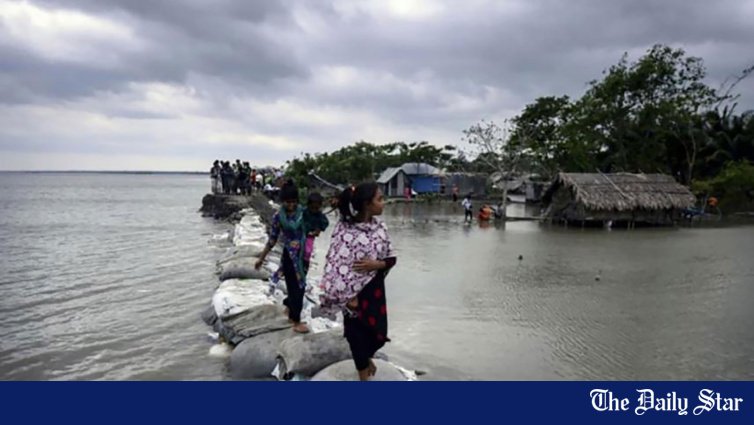
Bangladesh has established a National Committee on Climate Finance at a critical moment, with COP31 approaching and the gap between global climate-finance commitments and actual needs remaining enormous. Chaired by the prime minister, the committee is tasked with setting priorities, mobilising resources, and engaging international climate funds. But its real test goes beyond securing money: can Bangladesh demonstrate what it needs, negotiate effectively, and ensure finance reaches those facing the greatest climate risks?
This challenge involves two interconnected journeys. The first is availing climate finance: building credible evidence of climate impacts and financing needs, negotiating adequate global commitments, and accessing international funding mechanisms. The second is disbursing that finance: allocating resources transparently and equitably according to actual risks and needs.
COP31, scheduled for November 9-20, 2026 in Antalya, Türkiye, offers an opportunity. Its provisional agendas include long-term climate finance, guidance to climate funds, and discussions relating to Article 9.1 of the Paris Agreement on developed countries’ financial obligations. Ahead of COP31, Bangladesh could develop a coordinated negotiating position combining community-reported losses, geospatial vulnerability assessments, quantified adaptation needs, and financing gaps. Such evidence could strengthen collective claims by Least Developed Countries (LDCs) and other climate-vulnerable nations. However, negotiating for finance and accessing it are two separate challenges. International funds require institutional readiness, credible proposals, safeguards, and accountability.
Securing finance is only half the equation. Once resources arrive, where should they go, and to whom? Two communities facing similar floods may suffer different losses because of poverty, livelihoods, infrastructure, and adaptive capacity. Women, persons with disabilities, and landless households may experience the same hazard differently.
Yet finance does not automatically follow this geography of vulnerability. Oxfam’s assessment of the World Bank’s 2017-2023 climate-finance portfolio identified potential differences of $24.28-$41.32 billion between budgeted and actual expenditures, with insufficient information to reliably track climate-specific spending. This does not demonstrate misuse, but highlights a serious transparency gap. Climate justice requires evidence-based allocation and accountability, not simply greater mobilisation.
Satellites can observe floods, erosion, and environmental change. Geospatial analysis can identify where hazards intersect with people and infrastructure. But climate justice cannot be sensed from space alone. Satellite imagery may identify a flooded village, but cannot fully explain how repeated flooding pushes families into debt, disrupts education or destroys livelihoods. Community experience captures these realities, while science helps establish their wider patterns. Connecting these different ways of knowing underpins what I propose as the three senses approach: social-sensing, science-sensing, and common-sensing.
Social-sensing enables climate-affected communities to produce evidence through citizen science, participatory monitoring, local knowledge and accessible digital reporting. It captures lived experiences, losses and needs that conventional datasets frequently overlook. Science-sensing brings together community observations, climate research, satellite imagery, geographical analysis, and socioeconomic data to build a more comprehensive picture of climate impacts. It validates, contextualises, and scales community evidence across locations and time.
Common-sensing translates this combined intelligence into negotiation, policy, and resource-allocation decisions. It helps determine what finance countries should claim, which funding opportunities to pursue, and where resources should flow.
In short, social-sensing tells us what people experience. Science-sensing explains where, why, and to what extent impacts occur. Common-sensing turns evidence into decisions.
Bangladesh’s emerging Loss & Damage Dashboard illustrates the first journey. By combining community-generated loss reports with geolocation, climate information, and Earth observation, it can turn individual experiences into structured evidence. If comparable approaches were adopted across LDCs, evidence could be aggregated from households to communities, countries, and collective international claims, strengthening climate-finance negotiations.
In Bangladesh, Oxfam’s initiative to develop a Climate Risk Index combines hazard, exposure, sensitivity, and adaptive capacity, and could help identify locations and populations facing disproportionate climate risks and support more equitable allocation. Such tools are examples of the approach, not the approach itself: one demonstrates how evidence can travel upwards to strengthen claims, while the other shows how evidence can guide finance back towards vulnerable communities.
The process should not end with disbursement. Did finance reach intended communities? Did vulnerability decline? Were marginalised people included? Answers generate new evidence, strengthening future decisions and negotiations. Climate finance should operate as a continuous cycle connecting community experience, scientific evidence, international claims, access, risk-informed allocation, and accountability.
Bangladesh already possesses many foundations for this approach: community knowledge, climate research, Earth observation capabilities, digital technologies, and decades of climate diplomacy. Its National Committee on Climate Finance offers an opportunity to connect them, ahead of COP31 and beyond.
Success should not be measured only by how much climate finance crosses national borders, but by how credibly needs are established, how effectively resources are accessed, how equitably they are distributed and how transparently results are demonstrated.
Dr Mohammad Emran Hasan is head of climate justice and natural resources rights at Oxfam Bangladesh.
Views expressed in this article are the author’s own.
Follow The Daily Star Opinion on Facebook for the latest opinions, commentaries, and analyses by experts and professionals. To contribute your article or letter to The Daily Star Opinion, see our guidelines for submission.