
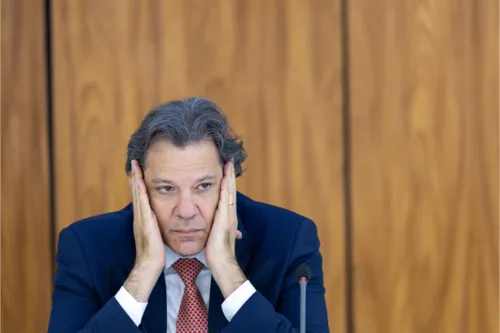
The far right has been flooding social platforms with content to attribute the image of “taxer of the poor” to Brazil’s Minister of Finance Fernando Haddad. “Taxad”, “Margareth Taxxer” and “Zé do Taxão” [referring to a famous Brazilian character in terror movies called Zé do Caixão] are some of the memes that have gone viral criticizing the minister and the federal government’s economic measures.
One of the most attacked financial measures is the so-called “taxa da blusinha” [“top tax”, in a rough translation, referring to the Brazilian habit of buying clothes from Chinese retailers] an amendment to the Green Mobility and Innovation Program (Mover, in Portuguese) that established a 20% tax rate on international purchases of up to US$ 50, which were previously exempt from paying import tax.
The proposal, however, was the subject of criticism from President Luiz Inácio Lula da Silva (Workers’ Party), but was approved by a large majority in the National Congress because it was defended by the president of the Chamber of Deputies, Arthur Lira (Progressive Party) and sectors of the right that sided with large Brazilian retailers who lobbied for the measure.
Political scientist João Feres, a researcher at the Institute of Social and Political Studies at the State University of Rio de Janeiro (Iesp-Uerj, in Portuguese), says that this is a recurring strategy the far right uses on social media to blame the Lula government for the consequences of unpopular measures the far right itself advocates for.
Feres, who coordinates the Media and Public Sphere Studies Laboratory (Lemep, in Portuguese), says that these actions often seek to exploit the contradictions of the government itself, such as having given in to pressure from the Chamber of Deputies to include the taxa da blusinha in the text that created Mover, even though the President of the Republic opposed it.
“The left’s ability to confront the right on social media varies from issue to issue. Particularly in this case, the left’s most influential profiles aren’t going to defend it, because the topic is unpopular,” says Feres.

Memes flooded social media criticizing Brazil’s Finance Minister Fernando Haddad / Social Media Platforms.
1. Taxa Humana: This meme portrays Fernando Haddad as the “Taxa Humana,” a pun on the “Human Torch” from the Fantastic Four. It suggests that Haddad is as relentless with taxes as the superhero is with fire; 2. Taxad: This nickname combines “tax” with Haddad’s name, implying that he is synonymous with taxation. It’s an association with new tax policies; 3. A meia-noite taxarei sua alma: This meme references the famous Brazilian horror film “At Midnight I’ll Take Your Soul” by Zé do Caixão (Coffin Joe). It suggests that Haddad is so focused on taxes that he would even tax your soul at midnight, in a horror movie style.
The coordinated action of these groups has won over progressive sectors, including groups that supported the current government in the last presidential elections. Political scientist Camila Rocha, a researcher at the Brazilian Center for Analysis and Planning (CEBRAP, in Portuguese) and author of the book As Direitas nas redes e nas ruas (“The Right Online and on the Streets,” in a rough translation), says this is a product of people’s reality and the state’s inability to respond to the population’s needs with quality public services.
“These posts spread beyond the right or to people opposing the Workers’ Party. In fact, people, especially the poorest people, don’t feel that public services are being effectively provided for them. Many of them have some kind of frustration with the way public services are provided,” he says.
The role of commercial media
For Rocha, in addition to taking advantage of any failures of the federal administration and the inefficiency of the state, the far right plays on public opinion based on stigmas created about left-wing governments, always associating them – even when it is false – with a supposed defense of increasing taxes.
“These groups can carry out various coordinated actions, but if they don’t have prior beliefs that make people adhere to the content, that content won’t work,” he says.
This is what Feres calls “feedback” between commercial media in Brazil and far-right groups that operate on social media. “The traditional media also run a campaign accusing the government of spending too much and all that, so [the far right] enters into a narrative that feeds back into the traditional media,” says the professor.
The relationship between the commercial media and the liberal discourse on the economy is obvious. On Thursday (17), the Brazilian newspaper Folha de S. Paulo newspaper revealed that excerpts from an exclusive interview with President Lula on TV Record, filmed on Tuesday (16), were leaked to financial market agents. According to the report, the text was shown to the company Capital Advice, whose partners include journalist Renata Varandas, who interviewed Lula.
TV Record broadcast the full interview with the president on Tuesday night, but the markets had already reacted to the information they received. The TV channel issued a statement saying they condemn any leak of information and that appropriate measures will be taken to investigate the facts.
Minister comments on the strategy of opposing groups
During the 19th International Congress of Investigative Journalism, which took place between July 11 and 14 in the city of São Paulo, the Minister of Finance commented on what he called a “disinformation” campaign and pointed to extreme right-wing groups as responsible for the coordinated actions.
“What I see on social media is an overwhelming wave of disinformation. And it’s not coming from media outlets, newspapers, TV channels or radio broadcasters,” he said.
Haddad also said there is a “new type of opposition” in Brazil that “works to undermine the credibility of institutions, official data and the Brazilian state.”
“They act daily on social media platforms. I’ve never seen such a thing. It’s a proto-fascist practice, there’s no other word for it,” said the minister. “The latest investigations bear witness to what kind of gang was in power, and we have to deal with these criminals today,” he said.
What to do?
For João Feres, the government’s communications department has not yet found an effective strategy for dealing with the spreading of disinformation and the extreme right’s attacks on the government’s measures. He argues that more investment is needed to have qualified staff and resources, as well as a strategy that takes into account the complexity of these groups’ activities.
“The government needs a complex communication strategy because the world of communication today is very complex. There is the traditional media, which still influences a lot of opinions. Now, there are influencers, social media platforms, and debates between users on Facebook and Instagram. That’s a complex communication ecosystem that demands a complex policy from the government. I think that, so far, it hasn’t shown itself to be very effective in tackling online disinformation,” he criticizes.
Answers
In the face of the disinformation campaign, Workers’ Party president and federal deputy Gleisi Hoffmann came out to defend the Minister.
“The truth is that the tax burden under the Lula government has not increased. In 2023, the gross tax burden was 32.4% of Brazil’s GDP. By 2022 it was 33.7%. In other words, not only has the tax burden not increased, but actually decreased,” she said in a statement to Brasil de Fato.
Gleisi also said that with the tax reform approved in Congress, the government cut “the tax burden on the poorest by half” and increased “the tax rate on the richest by 20%.”
Brasil de Fato also sent questions to the federal government’s Secretariat of Social Communication (Secom, in Portuguese) about the department’s strategy for tackling disinformation, especially in the case mentioned here, but had not received a response by the time this article was published. BdF remains open to comments.
Edited by: Felipe Mendes
