
Unlock the Editor’s Digest for free
Roula Khalaf, Editor of the FT, selects her favourite stories in this weekly newsletter.
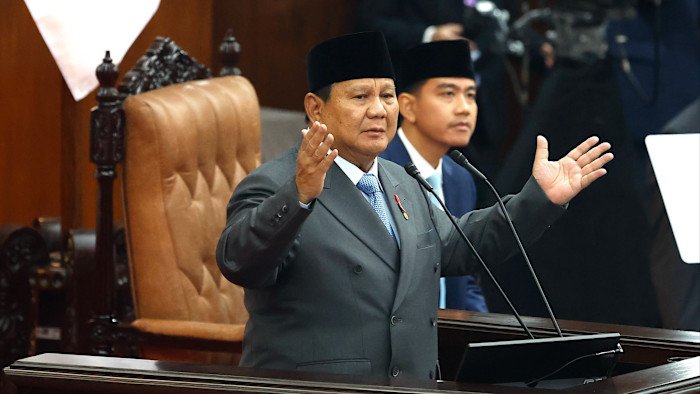
Indonesian President Prabowo Subianto has climbed down on some of his flagship policies that have worried investors amid a market rout that has erased a quarter of value from the country’s stock exchange.
In a wide-ranging address to parliament on Friday, Prabowo said the state-owned commodities export agency that he established in May to control exports of critical resources would just monitor transactions instead of making actual trades.
The export commodity agency, if implemented as originally planned, would have overhauled trade in the world’s largest exporter of nickel, thermal coal and palm oil, and affected global commodities trading houses.
The agency will be “the sole processing point for Indonesian commodity exports”, said Prabowo. “I repeat, the processing, not one company controlling commodities and exporting. But now, we can monitor.”
In a second speech on Friday that set out his government’s 2027 budget plans, Prabowo said Indonesia would set up a commodities exchange by January — a signal that he still wants the country to have tighter control over its rich natural resources.
“We don’t just want to be a global commodity producer, we must also determine global commodity prices,” he said, but did not give details.
Indonesia’s benchmark stock index gained about 1.6 per cent on Friday. Mining companies, including Vale Indonesia, Alamtri Resources and Aneka Tambang, saw some of the biggest gains.
The Jakarta Composite index has declined 26 per cent this year due to concerns over Prabowo’s policies and warnings of a potential downgrade from index providers. The rupiah currency has also lost 6 per cent.
Prabowo said the commodities agency had identified potential savings of $5bn arising from pricing discrepancies. He had cited alleged export fraud and under-invoicing as grounds for establishing it.
“We no longer want the Indonesian people to be cheated,” he said. “The goods belong to us while others determine the price.” The agency would soon expand oversight into all commodities, Prabowo added.
He also vowed improvements to a signature scheme to provide free meals nationwide to combat child malnutrition. The programme has been plagued by allegations of corruption and incidents of food poisoning, and has triggered concerns that its cost — $12.8bn, already cut from an initial figure of $28bn — could undermine Indonesia’s fiscal strength.
“I am determined to continue [the free meals] programme, but with improvements and efficiency,” Prabowo said, adding that “those who commit corruption from children’s meals are barbaric”.
Concerns about Prabowo’s expensive welfare plans, policy unpredictability and state interventionism have hit investor sentiment, with Indonesian assets some of the world’s worst performers this year.
“I cannot yet say that all the nation’s problems have been resolved, or that every promise I made has been fulfilled,” said Prabowo, a former general, who took office in October 2024. “Not yet.”
The discontent has also hit the president’s popularity and sparked protests in parts of the country. A July poll by Saiful Mujani Research and Consulting showed public satisfaction with Prabowo had dropped to 51 per cent, from about 81 per cent late last year.
Prabowo promised to boost growth to about 6 per cent this year and next, above last year’s figure of 5.1 per cent but still below his campaign pledge to lift growth to 8 per cent during his term.
“With the right, rational and sensible policies, I’m confident our economic growth can reach 6 per cent by the end of this year. But for me, growth and investment are not the ultimate goal. Our goal is the wellbeing of our people,” he said.
In the budget speech, Prabowo said the fiscal deficit would be 2.4 per cent next year, lower than the 2.85 per cent forecast for this year and a self-imposed 3 per cent limit that investors and economists feared Indonesia might breach.
The president did not detail how the lower deficit target would be achieved.
Prabowo reiterated his commitment to some of his other policies, including a crackdown on alleged illegal mining and corruption.
He specifically targeted the state-owned sector, where he accused some groups of being “irresponsible” and “unproductive”.
He said 290 state-owned enterprises had been shut down during his term, and more closures were planned. Prabowo said the government had a target of 300 SOEs from the current level of 1,074.