
Has the bitcoin price finally broken away from its four-year cycle pattern, or is this bull market already entering exhaustion? By studying historical growth rates, liquidity data, and macroeconomic correlations, we can better understand whether the current cycle has truly diverged, and what that means for investors in the months ahead.
Bitcoin Price Cycle Duration
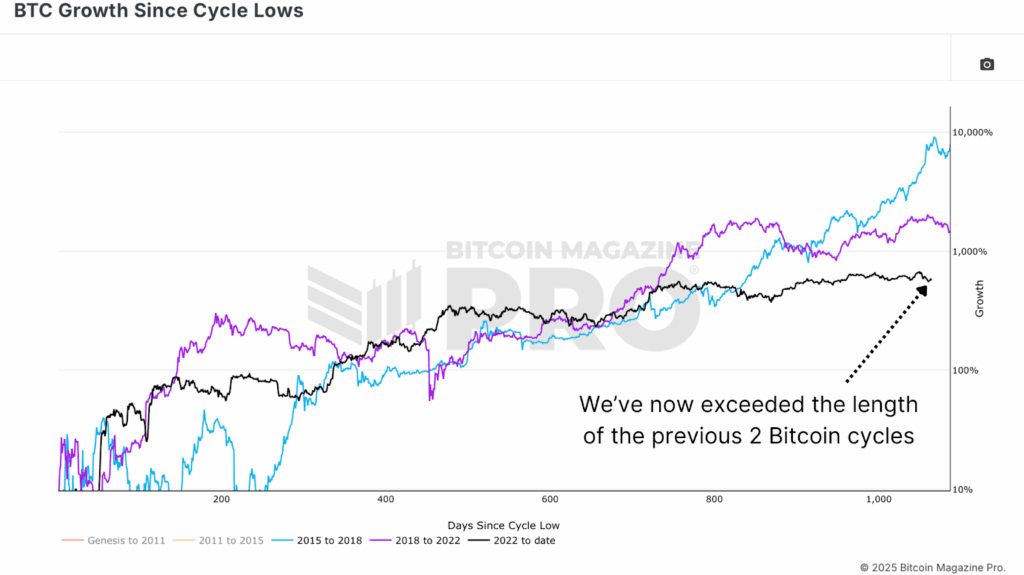
Analyzing BTC Growth Since Cycle Lows, we can see that Bitcoin has now officially surpassed the elapsed time from cycle low to cycle high seen in previous bull markets. The 2018–2022 cycle peaked 1,059 days after its prior bear market low, and the current cycle has now moved beyond that duration. If we average the elapsed time across the last two full market cycles, Bitcoin has already exceeded the historical mean and is on the verge of surpassing even the 2017 cycle length in the coming days.
Diminishing Impact on Bitcoin Price
Historically, Bitcoin’s four-year cycle was rooted in its halving events, where the block reward, and thus the inflation rate, was cut in half. Each halving triggered a sharp supply shock, driving major bull markets. However, this cycle has behaved differently. Following the most recent halving, Bitcoin experienced five months of sideways consolidation rather than the explosive post-halving rallies seen previously. While price has since made notable gains, momentum has been weaker, leading many to ask whether the halving has lost its influence.
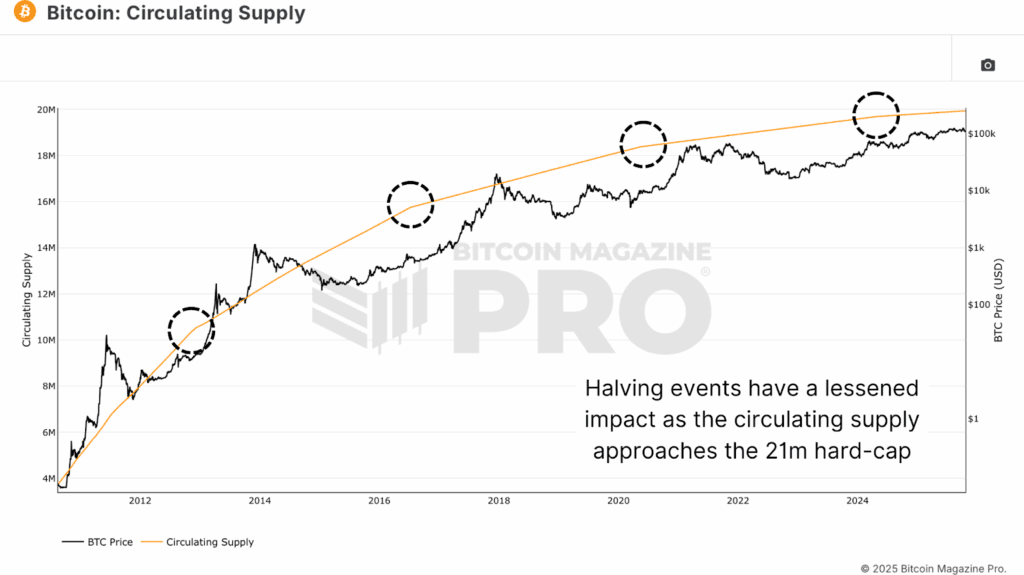
With the current Circulating Supply already exceeding 95% of the 21 million ultimate total supply of Bitcoin, the marginal supply reduction may no longer be as significant. Today, miners distribute roughly 450 newly created BTC per day, an amount easily absorbed by a handful of institutional buyers or ETFs. That means the halving alone may no longer be the dominant driver of Bitcoin’s market cycles.
Global Liquidity Cycles Driving the Bitcoin Price
When we view Global M2 Money Supply versus BTC on a year-on-year basis, a clear pattern emerges. Each major Bitcoin bottom has aligned almost perfectly with the trough of Global M2 liquidity growth.
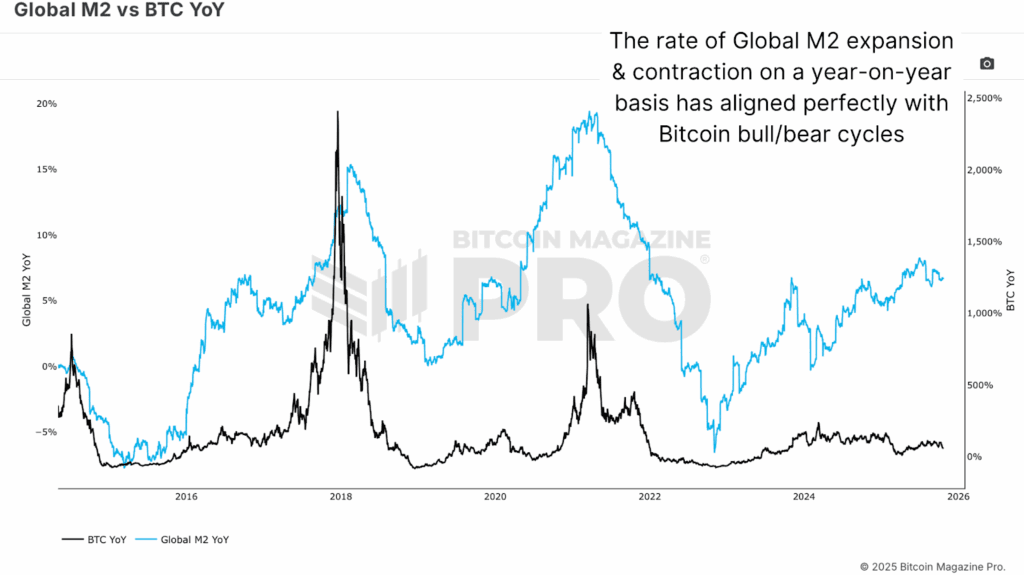
If we map the Bitcoin halvings and the M2 troughs side by side, we see that halvings typically lag the liquidity cycle, suggesting that liquidity expansion, not halving events, may be the true catalyst for Bitcoin’s rallies. This isn’t unique to Bitcoin. Gold has shown the same behavior for decades, with its price performance closely mirroring the rate of Global M2 expansion or contraction.
Inverse Correlations Shaping Bitcoin Price Trends
A key part of this liquidity story lies in the U.S. Dollar Strength Index (DXY). Historically, BTC versus DXY on a year-on-year basis has been almost perfectly inversely correlated. When the dollar strengthens year-on-year, Bitcoin tends to enter bear market conditions. When the dollar weakens, Bitcoin begins a new bull market. This inverse relationship also holds true for Gold and equity markets, underscoring the broader debasement cycle thesis that as fiat currencies lose purchasing power, hard assets rapidly appreciate.
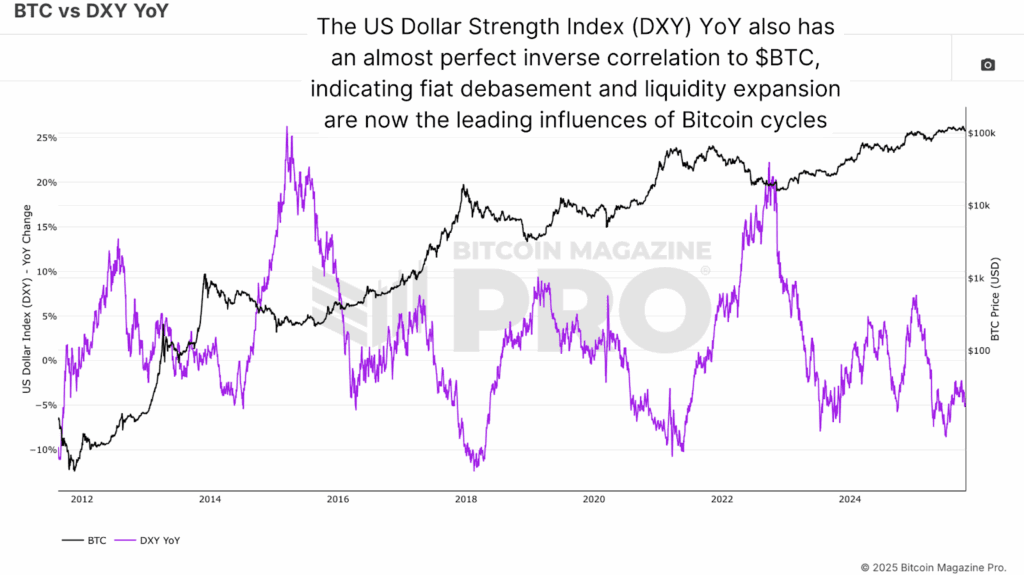
Currently, the DXY has been in a short-term uptrend, coinciding with Bitcoin’s recent consolidation. However, the index is now approaching a key historical resistance zone, one that has previously marked major turning points and preceded prolonged DXY declines. If this pattern holds, the next major drop in dollar strength could trigger a renewed upcycle for Bitcoin.
Quantitative Tightening and the Bitcoin Price
Comments from Federal Reserve Chair Jerome Powell recently hinted that the era of balance sheet contraction (quantitative tightening) may be nearing an end. Looking at the Fed Balance Sheet versus BTC, the start of balance sheet expansion and renewed quantitative easing has historically coincided with major upward moves in Bitcoin and equity markets alike.
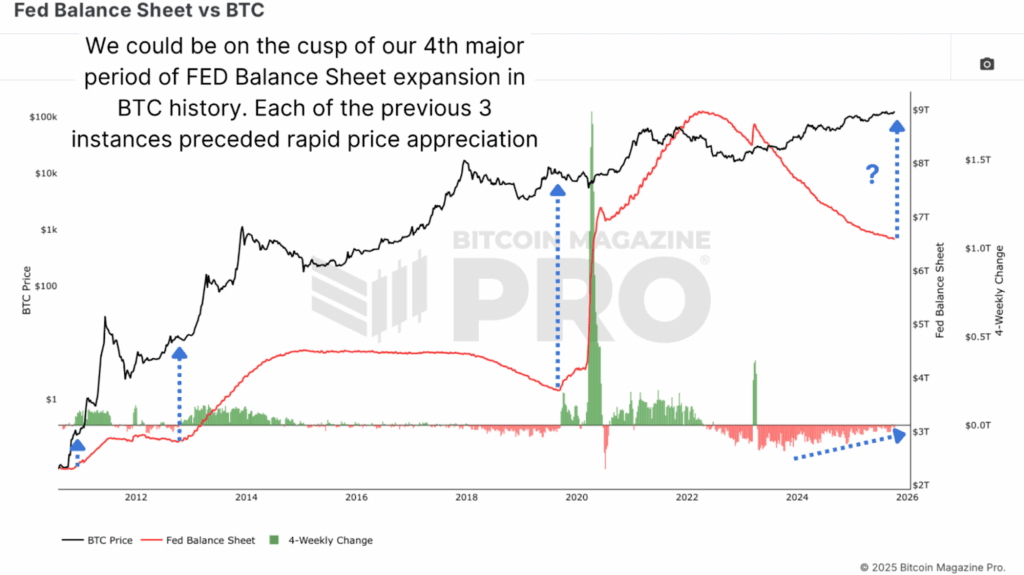
During the two years following previous Fed balance sheet expansions, the S&P 500 averaged a 47% return, more than five times the average two-year performance during neutral periods. If we are indeed entering a new easing phase, it could not only prolong Bitcoin’s current cycle but also set the stage for a liquidity-driven melt-up across risk assets.
Conclusion: The Evolving Bitcoin Price Cycle
Bitcoin has now outlasted the timeframes of its previous two cycles, leading many to question whether the four-year rhythm still applies. But when we step back, a different narrative emerges, one driven not by programmed scarcity, but by Global liquidity, fiat debasement, and macro capital flow. The “four-year cycle” may not be broken, but it may have simply evolved.
If the U.S. Dollar weakens, the Fed pauses tightening, and Global M2 growth accelerates, then Bitcoin likely still has room to run. For now, as always, the best approach remains the same: react, don’t predict. Stay data-driven, stay patient, and keep your eyes on liquidity.
For a more in-depth look into this topic, watch our most recent YouTube video here: Where Are We In This Bitcoin Cycle
For deeper data, charts, and professional insights into bitcoin price trends, visit BitcoinMagazinePro.com.
Subscribe to Bitcoin Magazine Pro on YouTube for more expert market insights and analysis!

Disclaimer: This article is for informational purposes only and should not be considered financial advice. Always do your own research before making any investment decisions.