
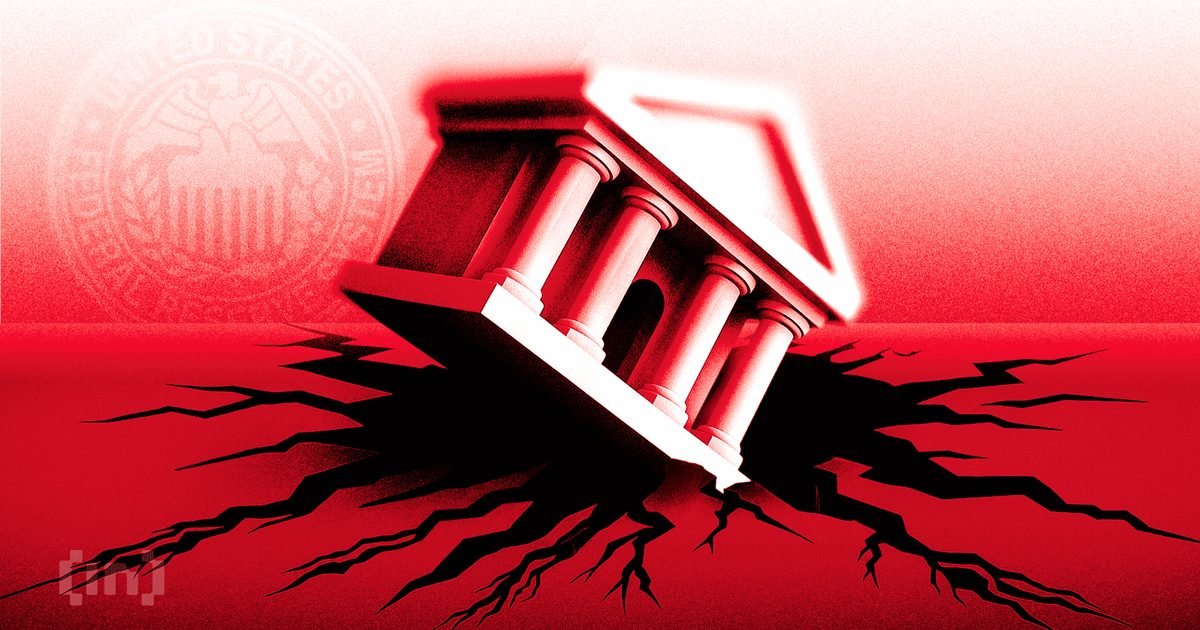
Bitcoin was built for a moment like this. U.S. debt is closing in on $40 trillion. Yet Bitcoin has lost 47% in a year, while gold has gained 34%.
The answer sits in the bond market. After inflation, a 10-year Treasury now pays 2.42%. That is the bar every asset without a yield has to clear.
Why Bonds are Beating Bitcoin
Bitcoin pays no interest. So its real rival is what safe bonds return after inflation. Economists call that the real yield. It is the cleanest measure of what an investor gives up by holding something that yields nothing.
The shift has been sharp. On the day Bitcoin peaked, the 10-year real yield was 1.84%. It closed at 2.42% on Wednesday. That is 58 basis points higher. It also tops the 2025 high of 2.34%.

Bitcoin (BTC) shows the strain. BTC traded near $63,837 as of this writing, down 0.6% in 24 hours. Its record was $126,080, set on October 6, 2025. Bitcoin now sits nearly 50% below that.
Gold tells the other half of the story. Gold trades near $4,480 an ounce, up about 34% over the past year. Bitcoin fell 47% across the same 12 months.

Both are sold as protection against government borrowing. Only one has delivered.
Gold climbed after the July CPI report while Bitcoin did not. Rising Treasury yields also drove the recent crypto market slide.
What the Bond Market Is Pricing
Treasury sold $42 billion of 10-year notes on Wednesday. It paid 4.683%, the highest auction rate since 2007. Demand held up. Bids beat the supply on offer by 2.53 to one.
So this was no failed sale. Investors still want U.S. debt. They simply want more to hold it. The official curve shows how much more. The 10-year closed at 4.68%. The 30-year closed at 5.24%.

That 30-year level carries history. It clears the 2023 peak of 5.04% and the 2025 peak of 4.97%. Yields last sat here in 2007.
Part of the rise is a term premium. In plain terms, it is what lenders charge for waiting longer. That premium is climbing.
Uncertainty is the driver. Fed Chair Kevin Warsh has cut back sharply on forward guidance. Traders price in more risk without those signals.
Warsh knows the era well. He sat on the Fed board from 2006 to 2011, through the financial crisis. Long yields have now returned to the levels he first met as a governor.
The Fed is split too. It held rates at 3.50% to 3.75% on July 29. Beth Hammack, Neel Kashkari and Lorie Logan each wanted a quarter-point hike.
Inflation “remains elevated relative to the Committee’s 2 percent goal,” the statement said. Notably, the Fed’s July hold pushed long yields higher rather than calming them. The pattern is global, with bond yields climbing worldwide to their highest since 2008.
The $40 Trillion Backdrop
The borrowing behind those yields keeps growing. Total debt reached $39.89 trillion on August 10. Only $108 billion remains before $40 trillion.
At July’s pace, Washington covers that in about eight days. The Joint Economic Committee expects the crossing around August 31.
July shows the strain. Receipts came to $334 billion. Outlays hit $766 billion. The month ended $432 billion short.
“July: The Federal Government took in $334 billion and spent $766 billion. That’s a $432 billion deficit in just one month. Don’t try this at home,” wrote Charlie Bilello, chief market strategist at Creative Planning.
Some of that was timing. August 1 fell on a weekend, so roughly $99 billion of August benefits went out early.
The cost of past borrowing now dwarfs other priorities. Interest on the public debt has taken $1.17 trillion since October. Defense took $804 billion.

Inflation keeps real yields elevated. Prices rose 3.4% over the year in July, and core inflation cooled to 2.5%. Energy still costs 14.7% more than a year ago.
Bitcoin’s case rests on that hurdle falling. September’s Fed meeting is the next test. Until real yields drop, the debt figures alone have not been enough.