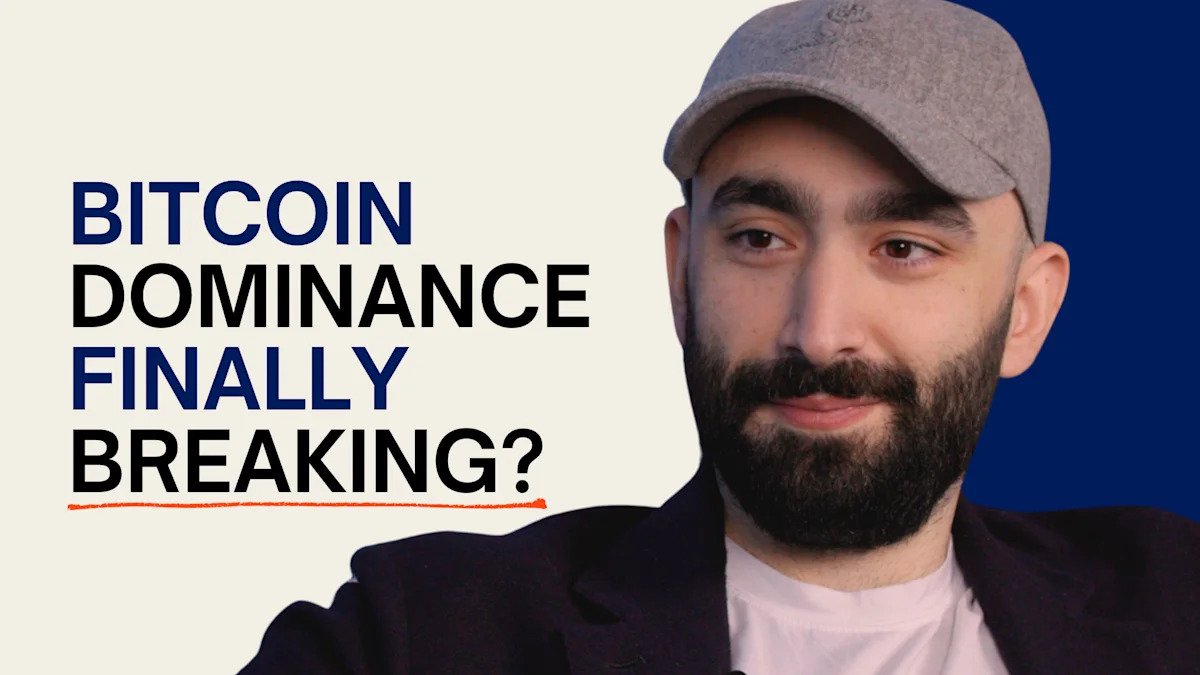
Bitcoin has long dictated the direction of the cryptocurrency market. But as blockchain networks develop businesses that can thrive independently of Bitcoin’s price, Helius CEO Mert Mumtaz believes that relationship may finally be starting to change.
For much of crypto’s history, Bitcoin has served as both the industry’s gateway investment and its gravitational center. When Bitcoin rallies, other cryptocurrencies tend to follow. When it falls, the damage often spreads across the market, regardless of how individual projects are performing.
But that relationship may not hold forever.
“Contrary to what people might believe, Bitcoin is not early,” Helius co-founder and CEO Mert Mumtaz told Coinage in an interview at Solana’s Breakpoint conference. “But everything else is actually rather early.”
It’s a distinction that gets at a potentially significant shift in how investors value cryptocurrencies. While Bitcoin has established itself as the industry’s most recognizable asset, newer blockchain networks are beginning to develop distinct economies, revenue models, and sources of demand that don’t necessarily depend on Bitcoin’s success.
And Mumtaz believes investors may be underestimating just how consequential that evolution could become.
Take Hyperliquid, for example — the breakout perp trading protocol that has seen its token surge 150% in a year where Bitcoin has retraced 31%. Unlike blockchains whose valuations depend heavily on expectations of future adoption, Hyperliquid has built a trading business whose economic activity is tied to demand for its exchange. And that demand doesn’t necessarily disappear when Bitcoin falls.
“I think it’s very obvious that Bitcoin going down isn’t super related to Hyperliquid,” Mumtaz said.
His reasoning is straightforward: A trading platform can generate revenue from market activity regardless of whether the assets being traded are rising or falling.
Read More from Coinage:
As more blockchain applications develop their own economic engines, the traditional assumption that Bitcoin must dictate the fate of every cryptocurrency could become increasingly difficult to defend.
Mumtaz sees early signs of that shift in privacy-focused cryptocurrency Zcash (ZEC), another asset he has championed. He pointed to periods when Zcash’s price performance diverged from Bitcoin’s as evidence that individual cryptocurrencies can begin developing their own market narratives.
“I do think we’ll start to see Bitcoin dominance not be as prevalent,” he said. “I think we already actually kind of saw that with Zcash.”
But perhaps the most ambitious part of Mumtaz’s argument is that investors are still using the wrong framework to understand the value of networks like Solana. For years, much of the debate surrounding Layer 1 blockchains has centered on transaction fees, token issuance, and whether applications built on those networks capture more economic value than the underlying infrastructure.
Hyperliquid’s success has intensified that debate, with some investors increasingly favoring applications that have identifiable revenue streams over the blockchains that support them.
Mumtaz believes that conclusion is too simplistic.
“There’s so many chains out there that said similar things, and they’re all sort of worthless that the other chains that are actually being used every day, like Solana, are suffering from that image,” he said.
His alternative framework is to think of Solana not simply as a technology platform or a decentralized stock exchange, but as an emerging financial economy.
“It’s the API for capitalism. It’s the API for internet markets,” Mumtaz said. “It’s the universal rails for money and programmable finance.”
The analogy goes beyond the idea of processing transactions more efficiently. Mumtaz compared the development of blockchain ecosystems to the growth of historical economies, where trade, commercial activity, and expanding markets eventually created greater demand for the currencies used within them.
“In my view, SOL is money for new capitalism. It’s new money,” he said.
It’s a provocative investment thesis, although the relationship between growing blockchain activity and appreciation of a network’s native token remains an open question. More users and financial transactions don’t automatically translate into higher token prices, particularly when fee structures, token issuance, and competition can complicate how economic value is captured.
Still, Mumtaz believes the market is too focused on short-term valuations to appreciate what could emerge over a longer period.
“So much of crypto and crypto Twitter is dominated by emotional reaction and tiny time horizons,” he said.
Mumtaz recalled Solana’s collapse to roughly $8 during the depths of the last crypto downturn, when confidence in the network’s future had deteriorated dramatically. For investors and developers willing to look beyond immediate market conditions, he argued, the opportunity was to recognize the network’s longer-term potential rather than abandon it.
“If you look at the greatest entrepreneurs and investors, they’re all long-term bets,” he said.
Subscribe to the free Coinage newsletter to stay up-to-date on all things crypto and finance.