

In May 2025, Olumayowa Ogunnusi was at a wedding in the United Kingdom when a conversation with a friend gave him an idea. After two decades working in oil and gas, he started looking closely at Bitcoin, the most popular blockchain-based digital currency, and its biggest operating cost: electricity.
“I was realising that the problem the industry faces is power. I’m getting cheap power, and I know where to find this power,” Ogunnusi told TechCabal in an interview.
He started thinking about oil fields the way he would think about a Bitcoin mine: what does it cost to produce something, and can you sell it for more than it costs to make?
That question became Terrahex, a high-performance computing company founded in 2025 and initially focused on Bitcoin mining in Nigeria. The company wants to use the country’s stranded energy to mine Bitcoin and sell to institutional buyers.
Nigeria’s power problem is not only a shortage of electricity generation; much of its installed capacity is also unavailable or cannot be fully used. In 2025, an average of about 5,398.33 megawatts (MW) of the country’s 13,625MW installed generation capacity was available for dispatch, according to the Nigerian Electricity Regulatory Commission (NERC).
In Q1 2025 alone, that figure was 5,366.88MW. By Q1 2026, it had fallen 16.9% to 4,458MW year-on-year.
Even when electricity is available, grid constraints can leave some of it without a reliable buyer. Terrahex sees a future where it can turn some of that otherwise underused electricity into revenue through Bitcoin mining, while using the business as a foothold for a broader high-performance computing market.
It’s a bet already being tested elsewhere on the continent, from flare-gas mining in Bayelsa, southern Nigeria, to Ethiopia’s hydroelectricity-powered Bitcoin mining, and its outcome could determine whether energy-rich but grid-poor parts of Africa get to participate in the global crypto compute boom, or keep exporting the opportunity elsewhere.
Terrahex is now preparing its first Nigerian mining site, a 9MW facility, which Ogunnusi called “Node One.” It will host about 2,400 Bitcoin miners across six containerised units, with the first phase expected to go live in December 2026 and become fully operational by the end of Q1 2027, according to Ogunnusi.
Bitcoin miners are computers that use large amounts of electricity to perform the calculations needed to secure the Bitcoin network and earn newly issued Bitcoin tokens.
Most of Terrahex’s machines will be application-specific integrated circuits (ASICs), Ogunnusi said. These are computers built specifically for Bitcoin mining, making them more efficient at the task than general-purpose computers.
Node One is Terrahex’s first Nigerian site, with up to 9MW of mining capacity, Ogunnusi said. The company is working with other energy partners to develop additional sites across its network, each built as a separate modular operation.
Turning spare power into money
Terrahex wants to work with downstream and midstream energy companies that have excess capacity at existing facilities.
“If your generator at home is probably 50 kVA [kilovolt-ampere], 45 kVA, or whatever it is, but your load at home is 30 kVA. Every day you turn on that generator,” he said. “You are wasting that [power], whether you like it or not. What we do is tell partners, ‘Give [us] that 15 kVA that you have.’”
Terrahex proposes to take that unused capacity to run Bitcoin mining. The energy partner keeps its existing operation while getting a new revenue stream from power that would otherwise go unused.
In this power-for-equity exchange, partners receive a share of the company’s profits after deducting operating costs, alongside a minimum guaranteed payment, according to Ogunnusi. He did not disclose the specific revenue split with Terrahex’s energy partners. The company is still pre-revenue.
Terrahex is targeting mining sites across Nigeria’s oil and gas belt, from the western and southern Niger Delta to eastern Nigeria and Imo State in southeastern Nigeria. He said one of those sites requires a three-hour drive from Port Harcourt, a city in southern Nigeria, followed by a canoe trip and another hour on the road. It can supply 7MW, with the nearest residential community about 45 minutes away.
Ogunnusi said building these ASIC mining sites away from residential areas was a deliberate choice due to the noise and environmental pollution.
He added that the company explored other sources of electricity generation. However, it ultimately chose to avoid them due to regulatory constraints; one solution it backed away from was flare gas, one of Nigeria’s brownfield opportunities for energy.
Other companies are converting flared gas into electricity for mining. Terrahex said its model avoids the additional steps and regulatory complications in taking gas, generating electricity from it, and then powering computing equipment.
The company wants to optimise electricity that has already been generated, which means fewer steps between the energy source and the computers. But the economics of stranded power can change as electricity demand grows. Power that looks underused today may become valuable to households, businesses, and other industries as more Nigerians gain access to electricity and existing consumers use more of it.
Large computing facilities could eventually compete for that capacity if their demand grows faster than new generation and transmission infrastructure.
The money behind the bet
Bitcoin mining at this scale is a capital-intensive operation, requiring technology and physical infrastructure that run at low costs compared to the tokens the facility generates. Otherwise, it will struggle to make profits.
Ogunnusi estimated that deploying 1MW of mining capacity costs about $2.5 million to $3 million. Terrahex wants to reach 100MW within 24 months.
He added that the company has also seen strong commitment from institutional investors that have backed Terrahex, providing the runway it needs to go live commercially in December. While he did not disclose the total amount raised, Ogunnusi said the investment tickets are at least about $500,000. He has also invested money from his other businesses.
Terrahex is spending on mining hardware and its infrastructure. It has also invested in a facility in Florida, in the United States, where miners are tested, repaired, and prepared for Nigeria’s heat and humidity before shipment, according to Ogunnusi.
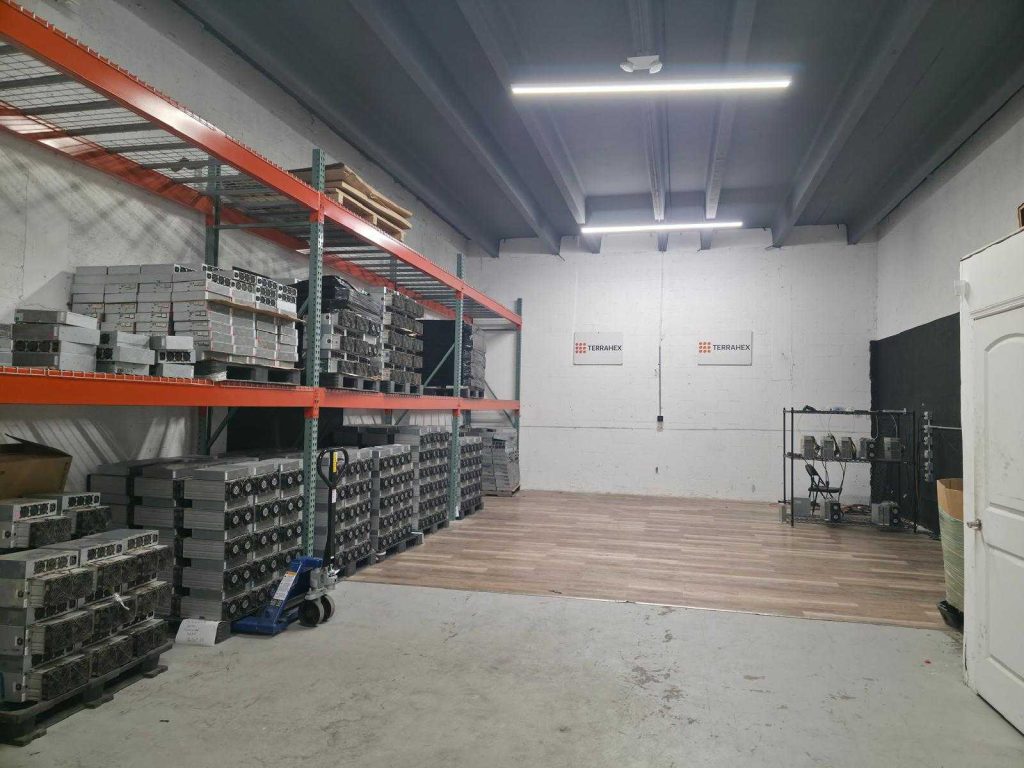
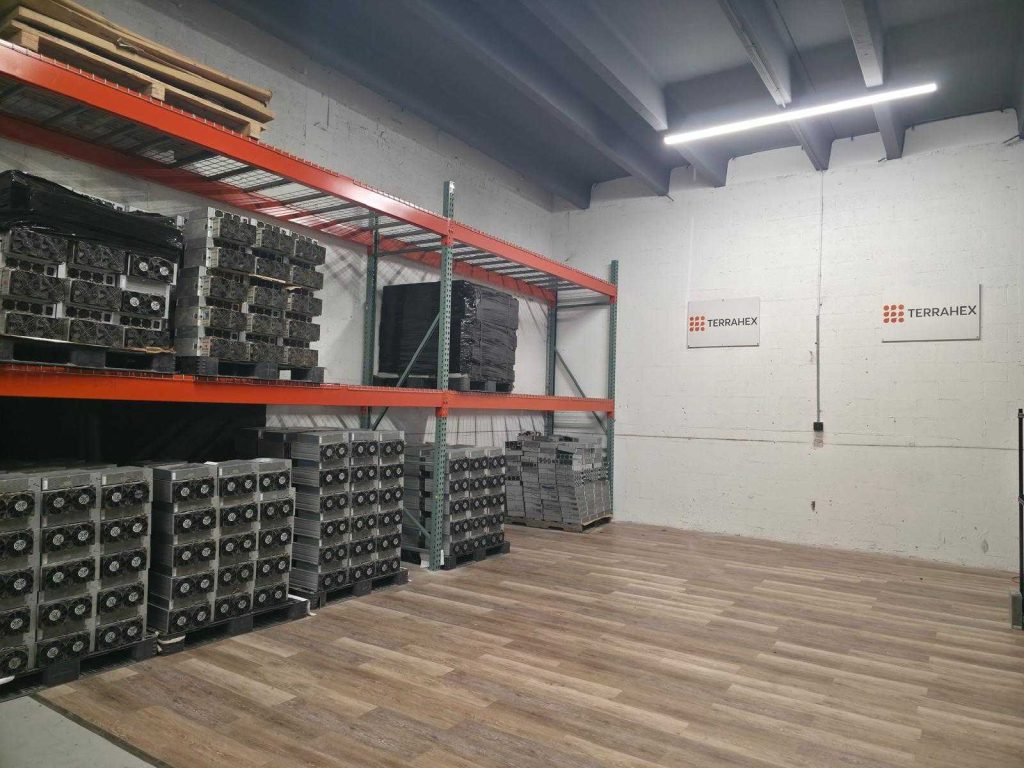
Once the miners produce Bitcoin, Terrahex plans to sell between 60% and 80% of the tokens it mines, depending on market conditions. Its buyers could include digital asset treasuries and customers on exchanges. A treasury reserve can hold the rest to help fund its expansion.
Terrahex is not yet producing Bitcoin commercially, so Node One, its first site, will test whether the model works at scale.
The business still carries certain Bitcoin mining risks. Bitcoin’s price, known to be highly volatile, can fall and diminish returns. It is trading above $76,000 as of Tuesday afternoon, but that could easily change. The reward miners receive is also cut roughly every four years, reducing the amount of Bitcoin they earn for the same mining activity.
Yet, the attraction is the gap between its cost of production and Bitcoin’s market price. Ogunnusi said Terrahex expects its cost per Bitcoin to sit in the lowest 30% of the global industry.
Ogunnusi argued that the business is built to survive those pressures. He also sees Bitcoin mining as a starting point, not the company’s final destination—hence why it describes itself as a high-performance computing startup, rather than a Bitcoin mining company.
Bitcoin is the first workload
Bitcoin has a hard supply cap of 21 million coins, meaning only 21 million Bitcoins can be mined, according to the token’s programmability. As of March 2026, about 20 million Bitcoins have been mined.
Yet, every four years, Bitcoin cuts the reward miners receive for adding new blocks to the network by half. This is called a Bitcoin halving.
The last halving was in 2024. A miner that earned 6.25 Bitcoins (BTC) per block before the last halving now earns 3.125 BTC for doing the same work. The next halving will cut that reward to 1.5625 BTC.
Each halving slows the rate at which new Bitcoin is mined, pushing the network closer to its 21 million supply cap more slowly. Researchers estimate that the final Bitcoin will be mined around 2140.
Ogunnusi still sees an opportunity to mine Bitcoin because Terrahex can keep its costs low by using power that would otherwise go unused. Due to Bitcoin’s halving, he expects Bitcoin mining to remain a viable business for decades, even as the reward miners receive for adding new blocks continues to fall.
However, Terrahex does not plan to depend on Bitcoin mining forever, Ogunnusi said.
“We think that Terrahex is a high-performance computing business,” he said. “We’re not a Bitcoin [miner]. Bitcoin is a baseline or a pillar of what we do.”
The company is already testing six graphics processing units (GPUs) with engineering labs and universities to explore whether it can run lower-level AI inference at its sites, according to Ogunnusi. GPUs are general-purpose computing chips that can handle workloads such as AI models.
The logic is that the same cheap power infrastructure could eventually support other computing workloads. AI data centres, however, need reliable connectivity, cooling, and low latency, which are harder to provide at remote oil and gas facilities.
Bitcoin mining can work with less reliable power. The machines can switch off when power drops without affecting a customer. That makes Bitcoin a good first use case for Terrahex’s power, Ogunnusi said.
The broader opportunity is still being tested elsewhere in Africa. NRG Bloom, a Nigerian off-grid Bitcoin mining company, has been operating a 1MW site in Bayelsa since February 2025, using power generated from flared gas, and is also building toward AI computing.
Ethiopia has attracted much larger mining operations because of its cheap hydropower, including projects by Bitdeer, a US-based company, which completed a 50MW facility in Ethiopia in May. However, the country has also moved to restrict new mining power deals as domestic electricity demand grows.
Terrahex is taking a different route. It wants to stay modular, putting smaller computing units wherever excess power exists rather than building one giant data centre. Node One is the proof of that model.
“The goal behind Node One is not just to show [energy] partners that there’s other income that exists that you’ve not thought of,” Ogunnusi said. “It is by being able to prove that our relationship is symbiotic and there is zero risk to your existing business.”
True scale demands moving beyond surface-level integrations to robust execution. We’ve filtered the noise out of Moonshot 2026, optimising the conference strictly for high-calibre connections between startup founders, global financial operators, enterprise leaders and individuals rewiring Africa’s technical frameworks. Get 20% off Early Bird tickets for a limited time.
