

Bitcoin (BTC 0.06%) has a market capitalization of $1.2 trillion, which accounts for more than half of the total value of all cryptocurrencies in circulation. Therefore, its performance has a big influence over investor sentiment toward the entire industry, and it’s having a very bad year.
Many of the bullish catalysts that drove blistering gains in Bitcoin over the last decade or so have failed to materialize. For example, some investors believed Bitcoin would transform the entire financial system, but it has garnered almost no traction as a payment mechanism. Other investors considered Bitcoin to be a legitimate store of value, like a digital version of gold, but that thesis has also fallen apart (and I’ll explain why).
A single Bitcoin trades for $61,600 as I write this, a 50% decline from last year’s record high of $126,200. Here’s why buying it at the current price probably won’t make you rich in the long run.

Image source: Getty Images.
Some believers are still betting big on Bitcoin
Despite its sluggish performance of late, some prominent investors still believe in Bitcoin’s long-term potential. Michael Saylor, who co-founded software-turned-Bitcoin treasury company Strategy (MSTR 3.54%), predicts the cryptocurrency will soar to $21 million per coin by 2045, representing a staggering 34,000% return from where it currently trades.
Since Bitcoin is fully decentralized, it can’t be controlled by any person, company, or government. It also has a capped total supply of 21 million coins, so unlike fiat currency, it can’t be printed in perpetuity. For these reasons, Saylor believes Bitcoin could become the world’s reserve currency, with the transaction records of all real-world assets eventually migrating onto the blockchain.
Saylor’s price target would give Bitcoin a market cap of $441 trillion, making it over 6 times as valuable as all 500 companies in the S&P 500 index combined. That doesn’t sound realistic to me, but he has a vested interest in making outlandish forecasts, given that Strategy owns roughly $52 billion worth of Bitcoin.
Ark Investment Management, which is run by tech investor Cathie Wood, is also quite bullish. The firm believes Bitcoin could amass a $16 trillion market cap by 2030 (translating to a price per coin of $761,904) based on six catalysts. The main catalyst involves Bitcoin capturing around 40% of the market cap of real gold, which currently stands at $27.9 trillion. Ark thinks a growing number of investors will treat Bitcoin as a digital version of the precious metal, because of its scarcity and portability.
Investors might be tempted to look to the past to justify the plausibility of the price targets issued by Saylor and Ark. After all, despite its recent losses, Bitcoin is still sitting on a return of 9,640% over the last decade, so it has outperformed every other major asset class, whether it be stocks, real estate, or actual gold. But in a moment, I’ll explain why past performance isn’t a reliable indicator of future results.
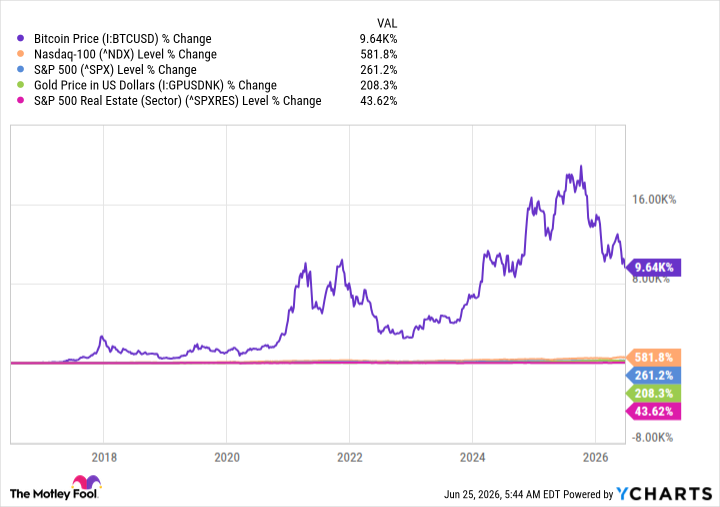
Bitcoin Price data by YCharts
Bitcoin could make history for the wrong reasons in 2026
Global governments are rapidly debasing their fiat currencies, so it’s only rational that investors and consumers would find an alternative like Bitcoin highly appealing. However, it isn’t even close to achieving mainstream adoption; according to crypto directory Cryptwerk, fewer than 7,000 businesses worldwide accept it as payment for goods and services. That is a drop in the bucket compared to the 358 million active businesses around the globe.
Since Bitcoin can’t even build traction as a payment solution, I find it highly unlikely that it will suddenly become the world’s reserve currency, as Saylor suggests.

Today’s Change
(-0.06%) $-34.31
Current Price
$59964.00
Key Data Points
Market Cap
$1.2T
Day’s Range
$59839.00 – $60784.00
52wk Range
$58188.67 – $126079.89
Volume
15.6B
In my opinion, Bitcoin has also failed as a digital alternative to gold. Last year, in the face of soaring government debt and heightened economic uncertainty triggered by the Trump administration’s “Liberation Day” tariffs, Bitcoin declined by 5%, while actual gold rocketed higher by 64%. In other words, when it was time for investors to choose a safe-haven asset, they flocked to the shiny yellow metal and shunned the cryptocurrency.
There is still a lot of time left in 2026, but Bitcoin is currently on track for its second-straight year of losses, an event that has never happened before. Therefore, investors who are relying on its incredible past performance to support ambitious future forecasts should keep in mind that historical trends aren’t always reliable.
In summary, it has never been harder to make a bullish case for owning Bitcoin, so I don’t think investors should buy it right now.