
Ever since the unveiling of Bitcoin on Halloween 2008, the true inventor behind the revolutionary digital currency has been shrouded in mystery.
Its creator adopted the mysterious pseudonym Satoshi Nakamoto, but no individual had so far been decisively identified as Satoshi, now undoubtedly one of the world’s richest people.
But after an extensive investigation involving artificial intelligence and forensic linguistics experts, the New York Times has claimed to uncover the anonymous architect of Bitcoin, who has hidden his identity for 17 years.
That man is Adam Back, a 55-year-old British computer scientist who the newspaper says pioneered the decentralised digital currency, used for encrypted, peer-to-peer transactions without needing a central bank.
If true, the University of Exeter–educated cryptographer has generated a vast fortune: as per Bitcoin lore, Satoshi mined 1.1 million coins in the digital currency’s nascency, a cache that is worth $70 billion today.
On Wednesday, he took to X to deny the allegations, telling his followers decisively, ‘I’m not Satoshi’ before adding in a follow-up tweet: ‘I also don’t know who Satoshi is, and I think it is good for Bitcoin that this is the case, as it helps Bitcoin be viewed a new asset class, the mathematically scarce digital commodity.’
Nevertheless, the New York Times’ conclusion was drawn from over a year of trawling through thousands of decades-old internet postings, revealing a trail of opaque clues that weaved together point towards Back.
Over the years, the encryption expert used extraordinary methods to conceal his identity – allegedly even sending emails in his own name to the mysterious Satoshi, playing both roles at once in a Mr Ripley-esque charade to cover his tracks.
But try as he might to conceal his identity, a series of extensive linguistic analyses have uncovered persuasive similarities between Back and Satoshi’s writing styles, leading to the conclusion that they are, and always have been, the same man.

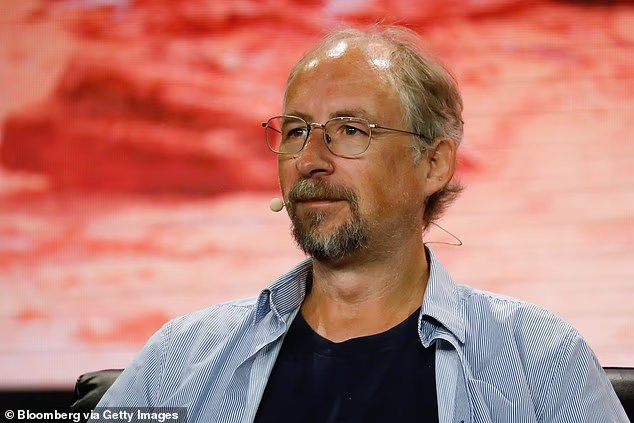
Adam Back, chief executive officer of Blockstream, during the Bitcoin 2022 conference in Miami, Florida

The University of Exeter–educated cryptographer has been unmasked as the true inventor of Bitcoin, according to a New York Times investigation

Bitcoin is decentralised digital currency, used for encrypted, peer-to-peer transactions without needing a central bank
When confronted originally by the New York Times, Back resolutely denied that he was in fact Satoshi, telling the outlet in a sharp and defensive tone: ‘Ultimately, it doesn’t prove anything. And I will reassure you, it’s really not me.’
But his body language revealed something else, from his blushing cheeks to him shifting uncomfortably in his seat when bombarded with a cascade of questions.
This is not the first time Back has been linked to the shadowy Satoshi. The makers of a 2024 HBO documentary, ‘Money Electric: The Bitcoin Mystery’, cornered him sat on a park bench in Riga, Latvia, his shirt untucked under a brown coat.
When the leading figure in the Bitcoin movement was asked if he was actually the cryptocurrency’s inventor, his body language was again illuminating: he tensed up, vehemently denied he was Satoshi, and insisted the interview be kept off the record.
But if he claims he’s not the father of the digital currency, then who is Adam Back?
The 55-year-old is the CEO of Blockstream, a blockchain technology company he founded in 2014 ‘to create the financial infrastructure of the future’, which builds products and services for the storage and transfer of cryptocurrency.
He also invented Hashcash in 1997, the proof-of-work algorithm cited by Satoshi in the Bitcoin whitepaper, as the future basis for its mining function.
The grey-haired, spectacle wearing computer scientist – who taught himself how to code on a Timex Sinclair personal computer at age 11 – has built a mini empire of Bitcoin-related businesses and become one of the community’s most prominent thinkers.
Back was an early member of the Cypherpunks, a movement of anarchists formed in the early 1990s who wanted to use cryptography – the art of securing communications through code – to liberate private individuals from government scrutiny and censorship.
But a rigorous analysis of his correspondences and posts in the Cypherpunks mailing list from the 1990s shows that he inadvertently left a number of previously undetected signs behind, linking him to the mystifying Satoshi.

When confronted by the New York Times, Back resolutely denied that he was in fact Satoshi
The overwhelming evidence linking the two figures is grounded in their digital footprints, with both men sharing a plethora of linguistic similarities.
After poring through Satoshi’s body of writing from the 1990s onwards at the dawn of the Cypherpunks movement, the New York Times uncovered a series of more than a hundred words which stood out.
The list of words captured an idiosyncratic dialect, that peculiarly seemed to alter between British and American at different times.
Words that caught the outlet’s eye included: ‘dang’; ‘backup,’ used as a verb in one word; ‘human friendly’; ‘on principle’; ‘burning the money’; ‘abandonware’; ‘hand tuned’; and ‘partial pre-image.’
One phrase – ‘a menace to the network’ – stood out because of its similarity to the language you’d find in a science fiction film.
Using an advanced search function on X, the newspaper did a search to ascertain whether any of the dozen or so people most often suspected of being Satoshi used the highlighted phrases.
The conclusion was startling: only one person was a match for nearly all of the words, and that person was Back.
From that starting point, more evidence began to unravel.
Despite the fact that Back tended to make a lot of typos online in his rambling posts while Satoshi’s writing was generally crisp and eloquent, the two men shared a number of unique, linguistic quirks, including their distinctive spelling and grammar.
For instance, Back often confused ‘it’s’ and ‘its,’ and he had a habit of inserting ‘also’ at the end of sentences. There were five examples of each in Satoshi’s own writing.
Both figures also seemed ‘pathologically incapable’ of using hyphens correctly, alternated arbitrarily between British and American spellings, and sometimes wrote ‘backup’ and ‘bugfix’ as one word instead of two.
Robert Leonard, a forensic linguistics expert at Hofstra University, confirmed that such patterns are exactly the sort of evidence he homed in on when trying to identify an author,.
He called the linguistic and grammatical habits ‘markers of sociolinguistic variation’ – syntactical fingerprints that help pinpoint a writer’s social background, geographical origin or occupational training.

Ever since the unveiling of Bitcoin on Halloween 2008, the true inventor behind the revolutionary digital currency has been shrouded in mystery
As the investigation continued, other linguistic and grammatical similarities between the two computer geniuses abounded.
The outlet focused on two cryptographic concepts that Satoshi spelled a particular way – ‘proof of work’ and ‘partial pre-image’ – both phrases to describe how Bitcoin’s Hashcash-like mining function actually worked.
When Satoshi used these unique phrases, he’d always hyphenate them, just like Back did.
While such similarities in grammar may seem inconsequential, there were so few individuals regularly using such language at the same, so any similarities are immediately telling.
Reacting to the accusations this morning, Back insisted to his 800 thousand X followers that the investigation had drawn the incorrect conclusion, writing: ‘I’m not Satoshi, but I was early in laser focus on the positive societal implications of cryptography, online privacy and electronic cash, hence my ~1992 onwards active interest in applied research on eCash, privacy tech on Cypherpunks list which led to Hashcash and other ideas.’
He then linked to an earlier post of his from March 2023, within which he mysteriously wrote: ‘We are all Satoshi.’