
Investing in Bitcoin can feel risky due to its sharp price swings, but historical data suggests that patience may be the key to success. Market analysis shows that investors who hold Bitcoin for at least three years significantly increase their chances of turning a profit, even if they initially buy near market peaks.
Bitcoin is well known for experiencing major drawdowns that often scare off new investors. However, long-term data reveals that many of these losses eventually turn into gains if the investment horizon extends beyond a few years.
Bitcoin’s historical price cycles highlight how entry timing and holding duration affect returns. Investors who bought BTC near the 2017 market peak experienced a loss of nearly 48.6% after two years during the following bear market. When that same position was held for three years, the loss transformed into a 108.7% profit.
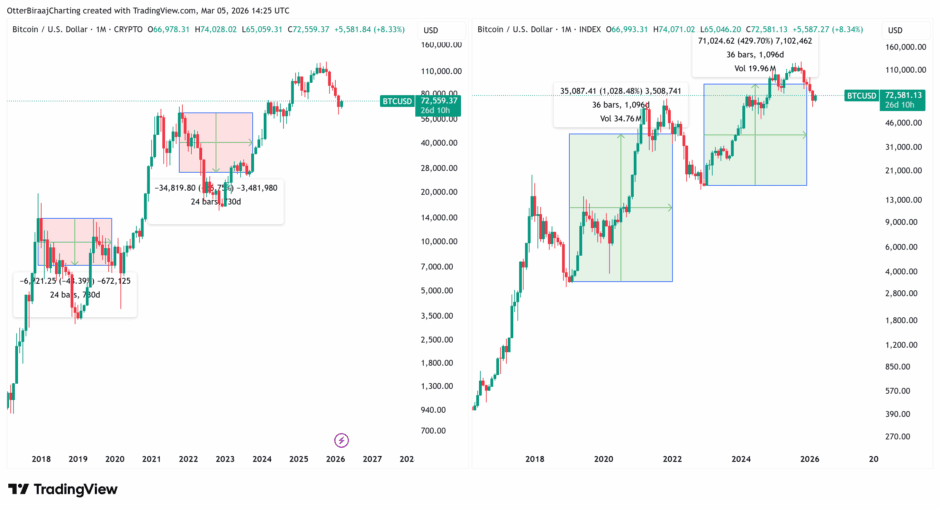
A similar pattern appeared during the next cycle. Investors who entered the market near the 2021 all-time high saw their holdings drop by 43.5% after two years. Extending the holding period to three years eventually turned that investment into a 14.5% gain.
These examples demonstrate how Bitcoin’s volatility can punish short-term investors while rewarding those willing to wait through market cycles.
Historical data shows that investors who accumulate Bitcoin during bear markets tend to see the largest returns. For example, buying near the 2019 market bottom produced gains of around 871% after two years and more than 1,000% after three years.
A similar scenario occurred after the 2022 cycle low, where investments made during that period generated returns of roughly 465% within two years and over 429% within three years.
These patterns suggest that accumulation during downturns often sets the stage for substantial gains during the next bull market.
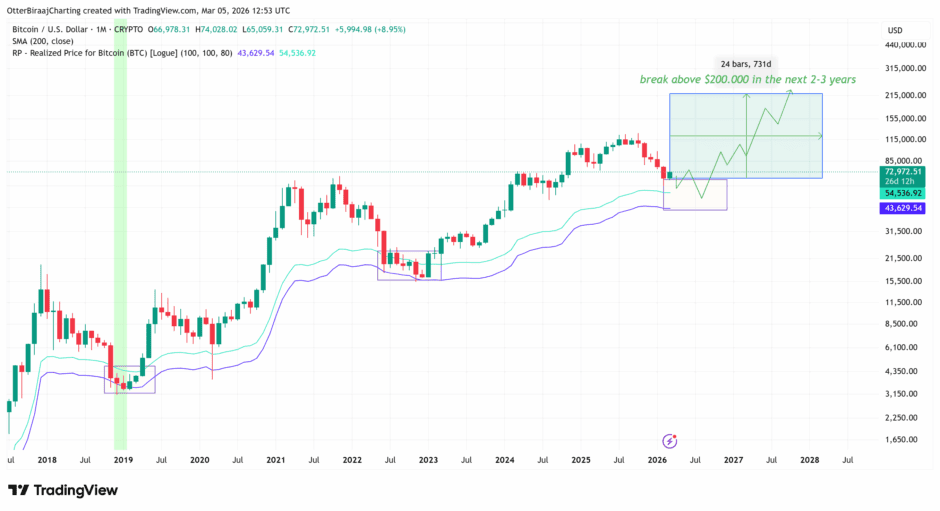
Onchain data can help investors identify potential accumulation zones where long-term returns tend to be stronger. One commonly used metric is the realized price, which represents the average price at which Bitcoin was last moved on the blockchain.
Historically, Bitcoin’s deepest drawdowns often approach or fall below this realized price level. These zones have repeatedly coincided with major market bottoms since 2015 and have frequently preceded multi-year rallies.
Currently, Bitcoin’s realized price is estimated to be near $55,000, while the shifted realized price a longer-term valuation indicator sits around $42,000.
Institutional research also supports the long-term investment approach. According to data cited by Bitwise Asset Management, adding Bitcoin to a traditional investment portfolio improved both cumulative and risk-adjusted returns across most three-year periods.
The same research indicates that the probability of losing money on Bitcoin falls dramatically with time. Investors holding BTC for three years historically faced only a 0.7% chance of loss. The risk dropped to 0.2% over five years, and over a ten-year period, historical data showed no recorded losses.
Short-term trading tells a very different story. Day traders historically experienced nearly a 47% chance of losses, while one-year investment horizons still carried a 24% probability of being underwater.
Bitcoin’s volatility often discourages new investors, but long-term data suggests that patience can significantly improve investment outcomes. While short-term price swings can produce steep losses, holding Bitcoin for three years or more has historically increased the likelihood of strong returns.
For many investors, this highlights a key principle of crypto markets: timing the exact bottom may be difficult, but maintaining a long-term perspective has often proven to be the more reliable strategy.