Monday’s Bitfinex Alpha set a base case for bitcoin to trade between $56,800 and $64,900 this week, with risks skewed towards a retest of the 21 November cycle low of $55,501 and below that the realised price near $53,200. In the last two days, BTC has traded across almost the entirety of that range. It reached a high of $64,673 on 23 November, 16.5 percent above the cycle low, before falling to a low of $59,312 on 24 November.
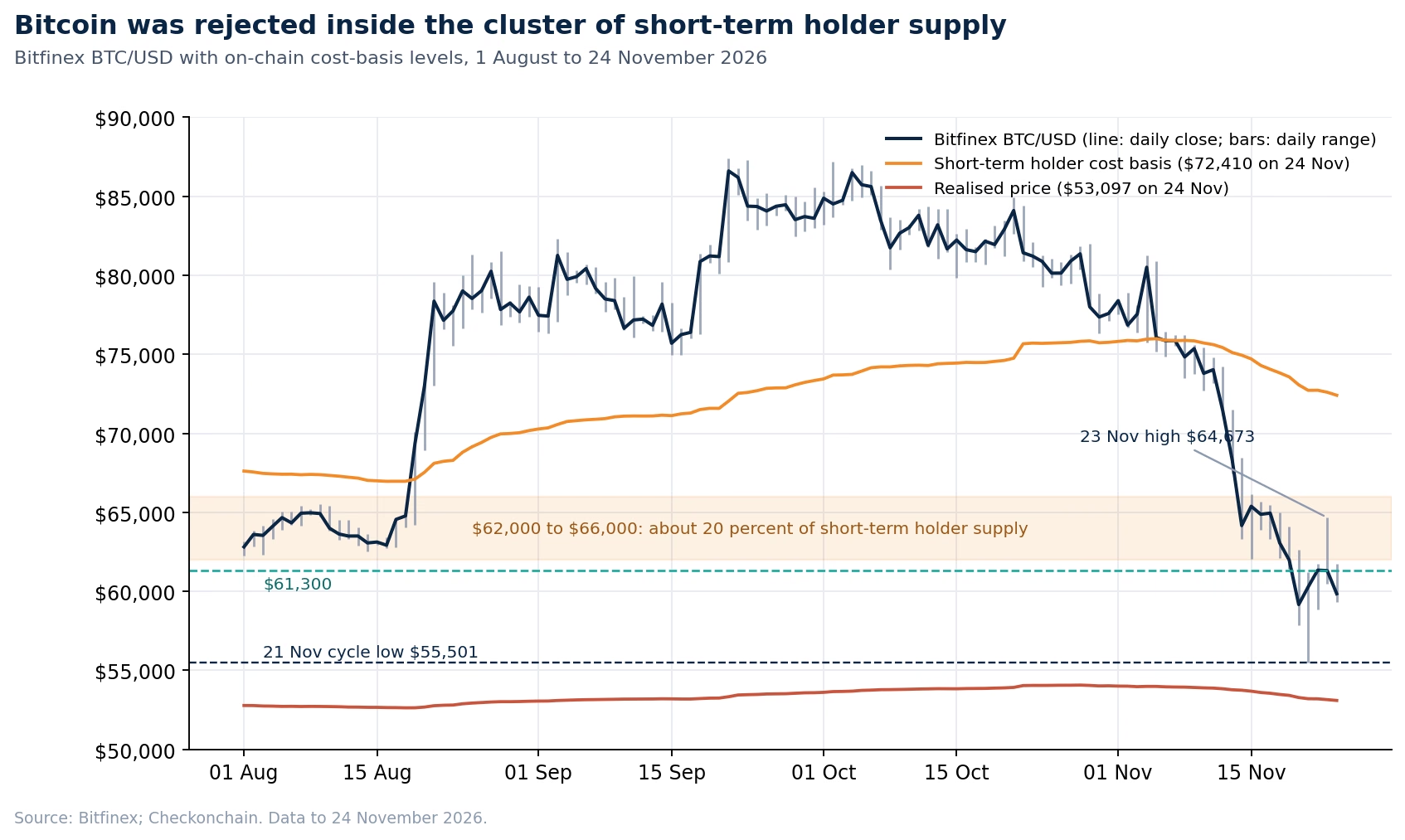
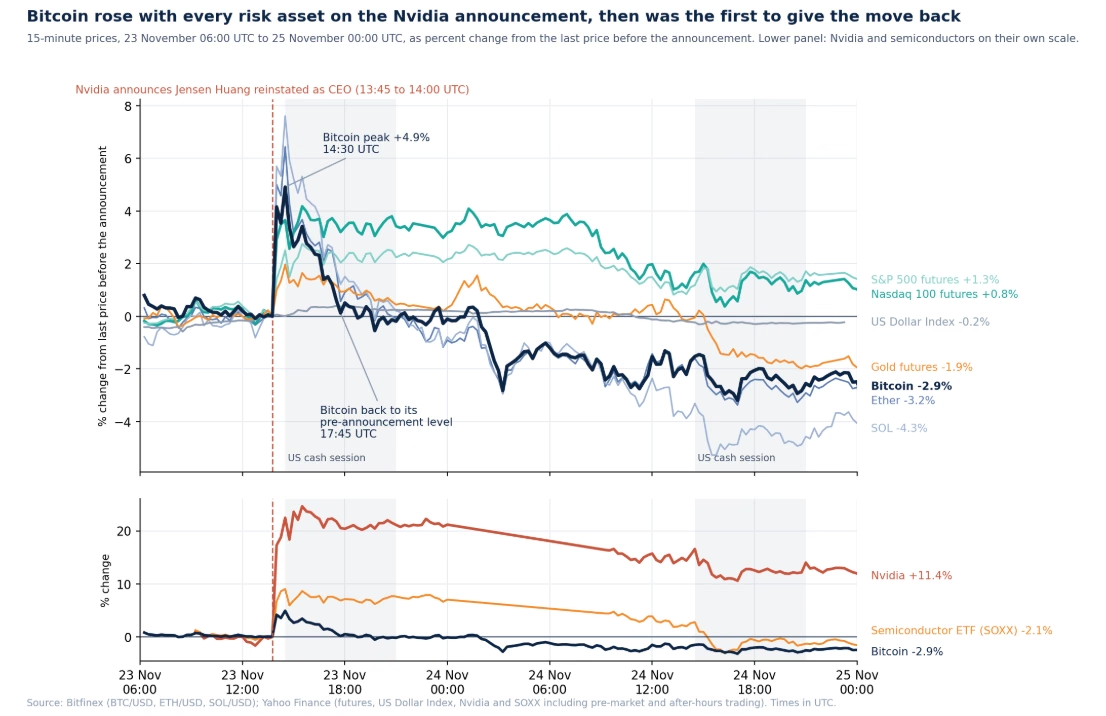
The rebound was driven primarily by a rally in equities after Nvidia reinstated Jensen Huang as CEO on 23 November, less than two weeks after his resignation. The Nasdaq Composite subsequently gained 6.5 percent, its best session since 9 April 2025. Bitcoin followed, rising 5.4 percent from the day’s open to the $64,673 high, but gave back the whole move within the session and ended the day at $61,300, which is also the lower boundary of the July Base and the level Monday’s report identified as resistance on rebounds.
In this week’s Intelligence Update, we examine why bitcoin failed to hold its gains despite such a strong rally in equities and what would be needed for a strong recovery.
Monday’s Bitfinex Alpha attributed bitcoin’s decline to equity sentiment rather than interest rates. It was therefore unsurprising to see bitcoin rise with equities on 23 November. In our view, gains were short-lived because the catalyst was specific to one company and its sector. It reversed a shock to Nvidia, but it did not change the conditions weighing on bitcoin: a December rate hike remains fully priced in, ETFs continue to record outflows and doubts about returns on AI investment persist, as indicated by the 7.9 percent fall in the Philadelphia Semiconductor Index on 24 November.
BTC gained 4.9 percent within an hour of the Nvidia announcement, outperforming Nasdaq 100 futures. Six hours later, BTC was back at its pre-announcement level, while Nasdaq 100 futures still held a gain of 3.1 percent. With BTC ETFs recording $569.7 million of outflows that day, this suggests holders used the rally to sell.
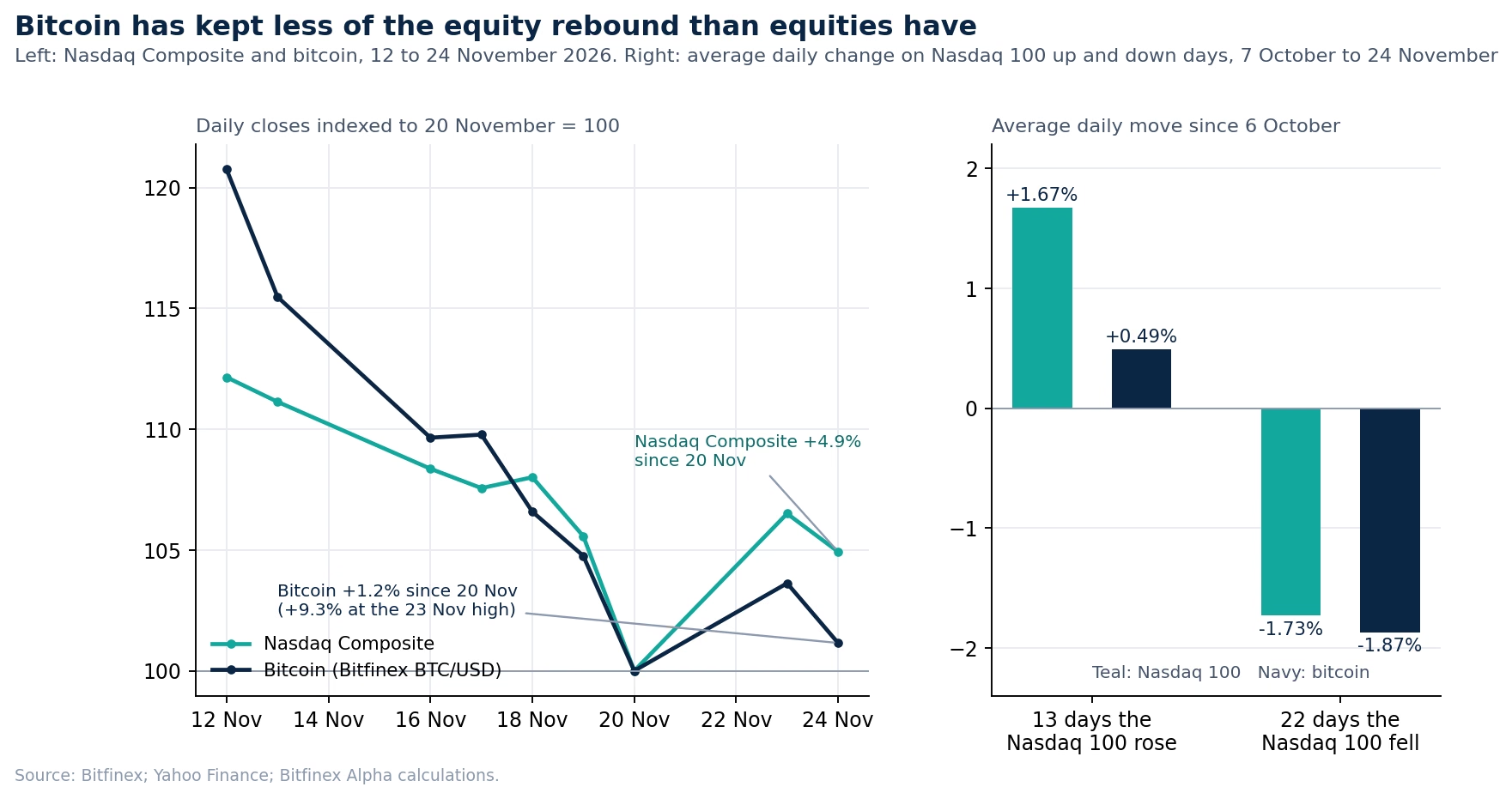
This fits a pattern that has persisted since equities peaked. The Nasdaq 100 reached its all-time high on 6 October, and in the 35 trading days since, bitcoin has gained an average of just 0.49 percent on days when the index rose, compared with 1.67 percent for the index itself. On days when the index fell, bitcoin’s average loss was slightly greater: 1.87 percent against 1.73 percent. Our reading is that holders of BTC are using strength in equity markets to exit positions at a loss or near breakeven.
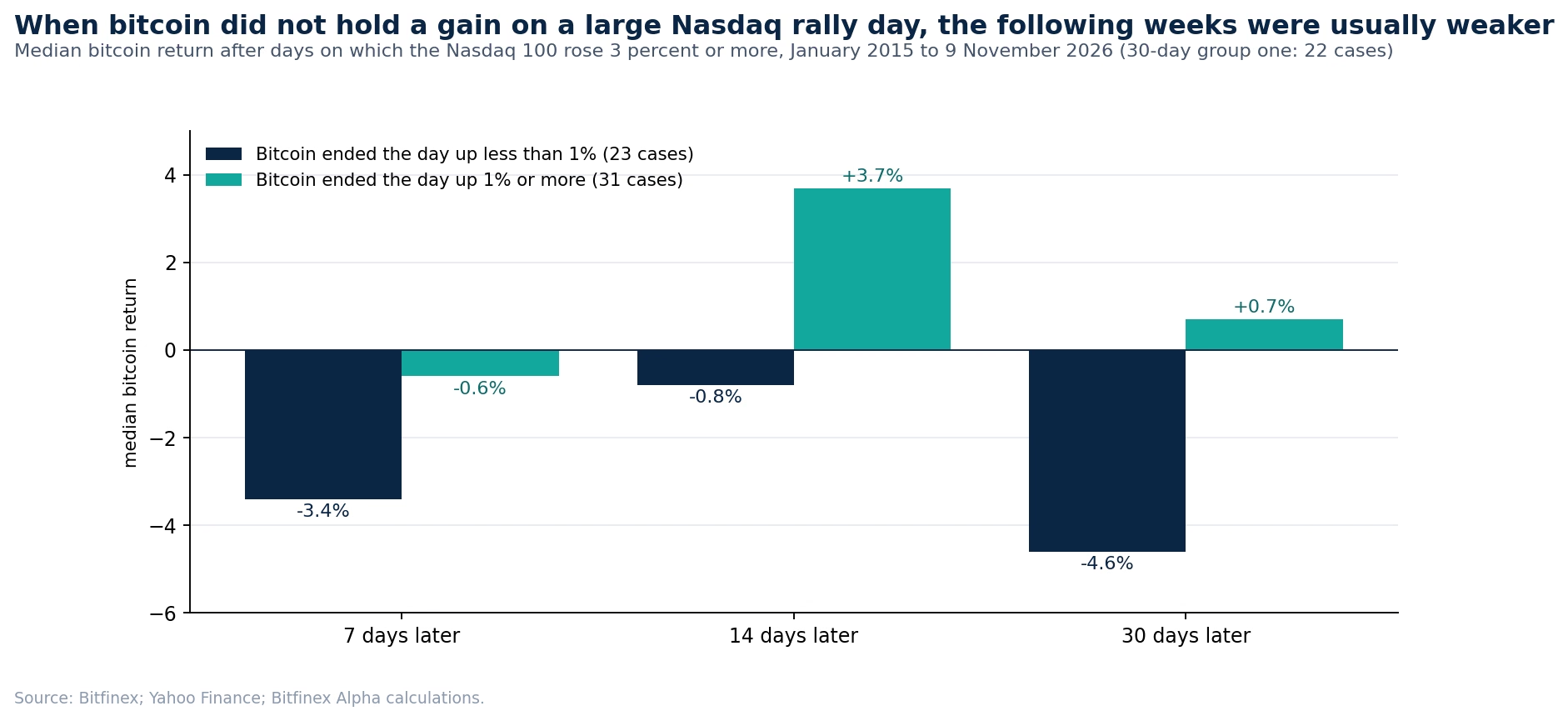
Since January 15, there have been 54 instances in which the Nasdaq 100 rose three percent or more in a single session. On those days:
- Where bitcoin ended the day up less than one percent (23 cases), the median return over the following seven days was negative 3.4 percent, and bitcoin was higher in only seven cases. Over 30 days, the median was negative 4.6 percent.
- Where bitcoin ended the day up one percent or more (31 cases), the median return was negative 0.6 percent over seven days and positive 0.7 percent over 30 days.
On 23 November, the Nasdaq 100 rose 6.9 percent and bitcoin ended the day 0.1 percent lower. This was the largest index gain in our sample for which bitcoin’s return was less than one percent. Many of the cases cluster in 2018, 2020 and 2022, when markets were already under stress, so the sample is too small and too concentrated to provide a reliable forecast. The findings are, however, consistent with the view that a failure to hold gains on a strong day for equities has more often preceded further weakness than a recovery.
ETF outflows help explain this asymmetry. US spot bitcoin ETFs recorded net outflows of $569.7 million on 23 November, the day equities rebounded, and $231.4 million on 24 November. Two points stand out:
- Outflows exceeded $500 million on 19, 20 and 23 November. Three consecutive sessions of that magnitude have been recorded only once before, from 24 to 26 February 2025.
- Net outflows for November as of Tuesday 24 November stand at $4.94 billion, exceeding the $4.51 billion recorded in June 2026. IBIT accounts for 84 percent of the total.
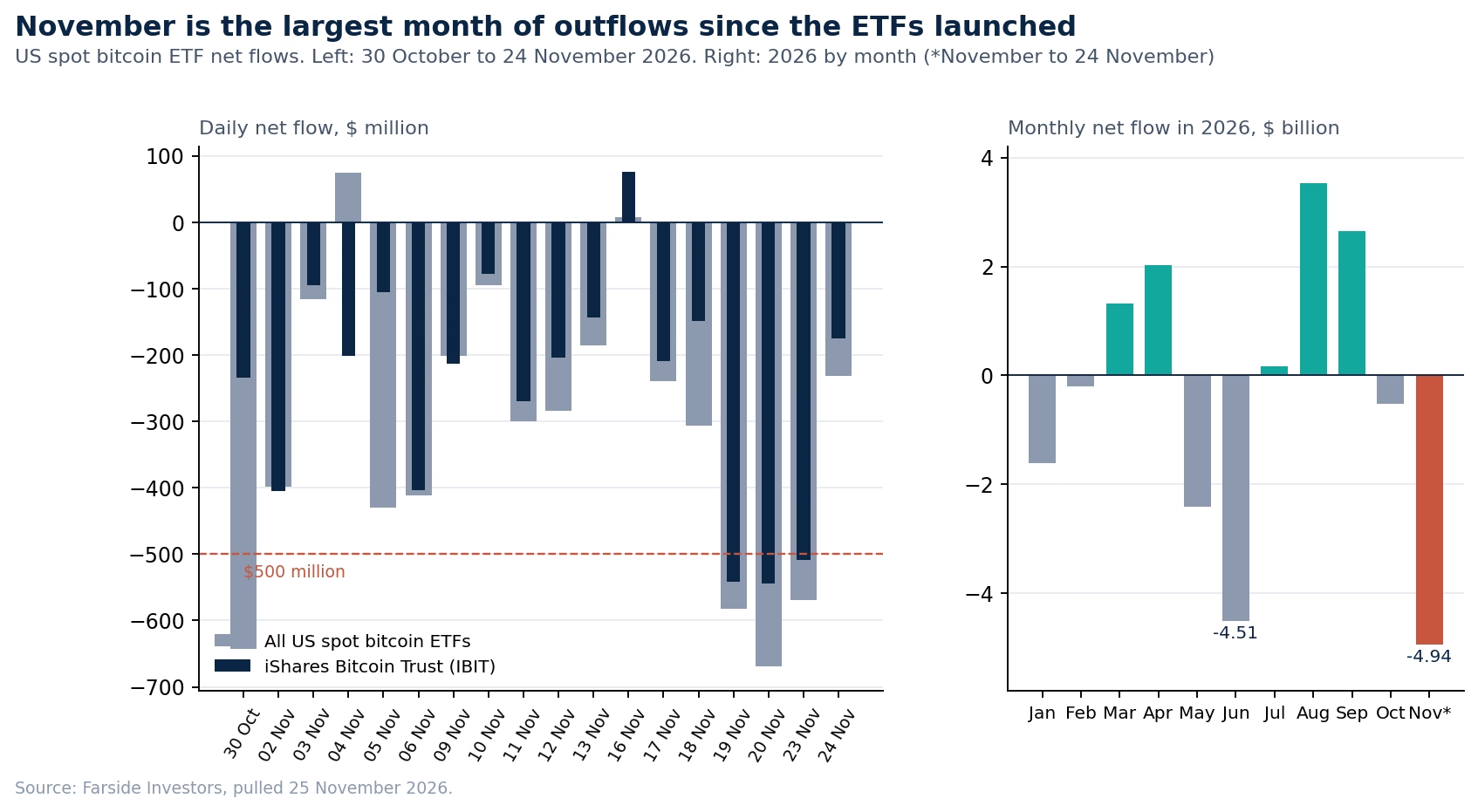
ETF holdings are now close to their lowest level in 17 months. The funds hold about 1,220 million BTC currently, only 1,800 BTC above their 13 July 2026 low, and they lost about 3,900 BTC on 24 November alone. One more session of that size would therefore take holdings to their lowest since June 2025, erasing all of the net buying since.
There is one early sign of easing. The $231.4 million outflow on 24 November was the first below $300 million since 17 November, a threshold we identified on Monday as an early indication that selling pressure may be subsiding. A single smaller outflow is not evidence of a demand rebound. With US markets closed on 26 November, it may take until 30 November or later to establish whether flows are improving on a sustained basis.
Bitcoin corporate treasury companies are not filling the gap. Strategy bought 457 BTC for $29.6 million in the week to 22 November, according to its 23 November filing, while spending $211.8 million on repurchases of its STRC preferred stock and raising its broader preferred stock repurchase programme from $3 billion to $4 billion.
With both sources of spot demand weak, the buying since the cycle low appears to have come largely from futures. Aggregate open interest (OI) has moved as follows (snapshots at 00:00 UTC):
- 22 November: 638,400 BTC, after the rebound from $55,501
- 24 November: 632,100 BTC
- 25 November: 645,300 BTC
OI rose by 13,200 BTC on 24 November even as price fell 2.4 percent, which indicates that traders were opening new positions into the decline. Funding rates were positive at six to eight percent annualised on the largest venues. This suggests the new positions were predominantly long, meaning traders were buying the decline with leverage.
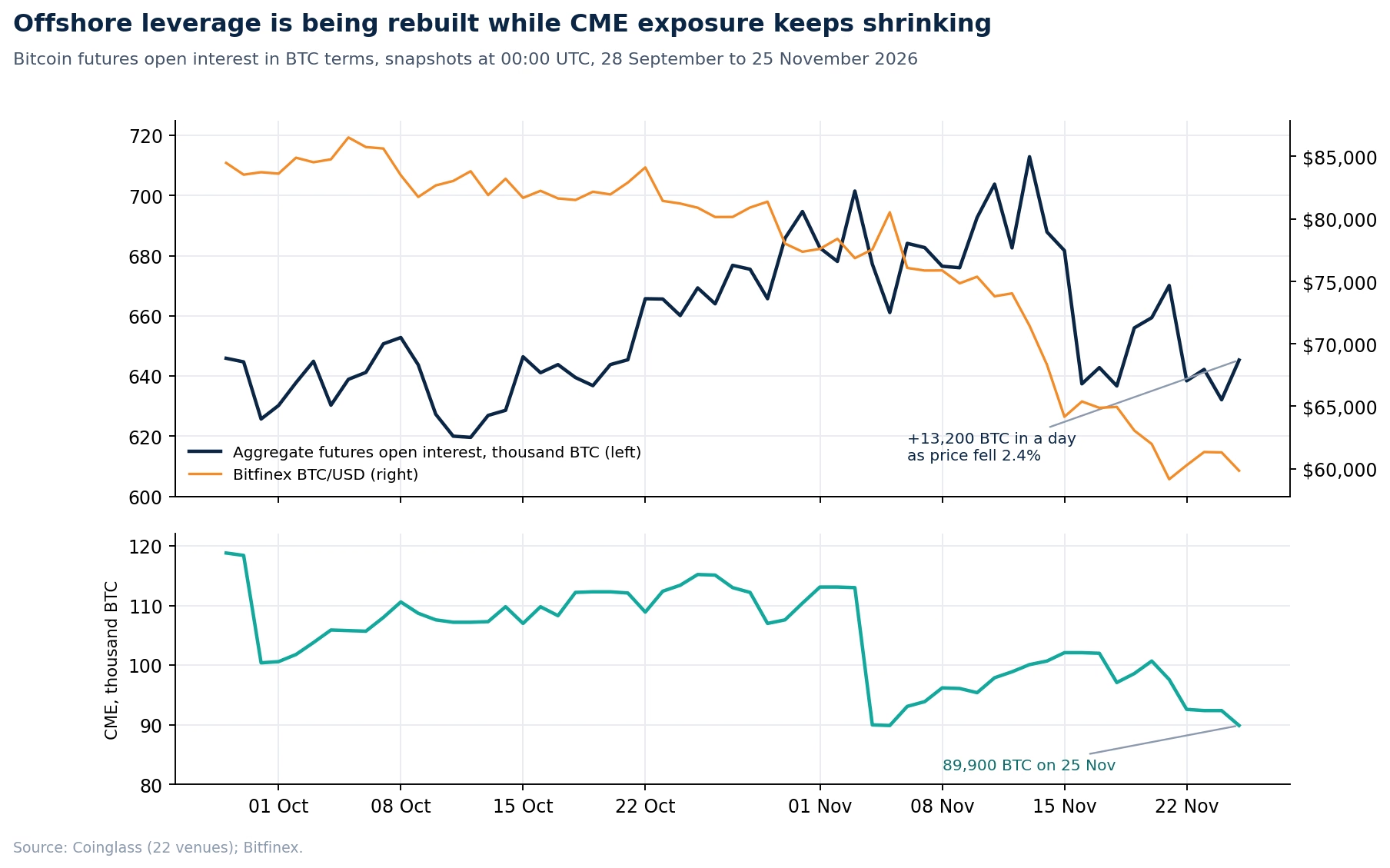
Leveraged buying into a decline has not been a good sign in recent weeks. On 13 November OI reached its monthly high of 712,900 BTC with funding positive, and $531 million of long positions were liquidated the next day. The current build up is much smaller, but it carries the same risk of forced selling if price falls further.
US institutions appear to be moving the other way. Open interest on the Chicago Mercantile Exchange (CME), the venue they use most, has fallen from 102,100 BTC on 16 November to 89,900 BTC on 25 November, partly because the November contract expires on 27 November.
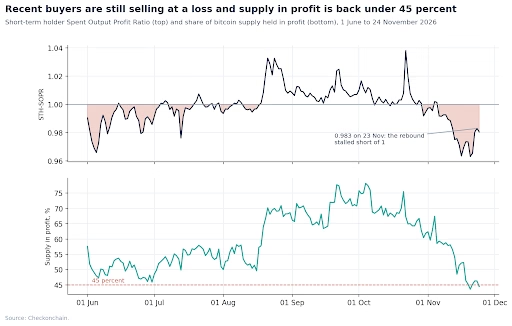
On-chain data indicates that recent buyers are still selling at a loss, although those losses have become less severe. The short-term holder Spent Output Profit Ratio (STH-SOPR) is below 1 when coins younger than 155 days are sold for less than they cost. It rose from 0.963 on 20 November to 0.983 on 23 November and was 0.981 on 24 November, its 19th consecutive day below 1.
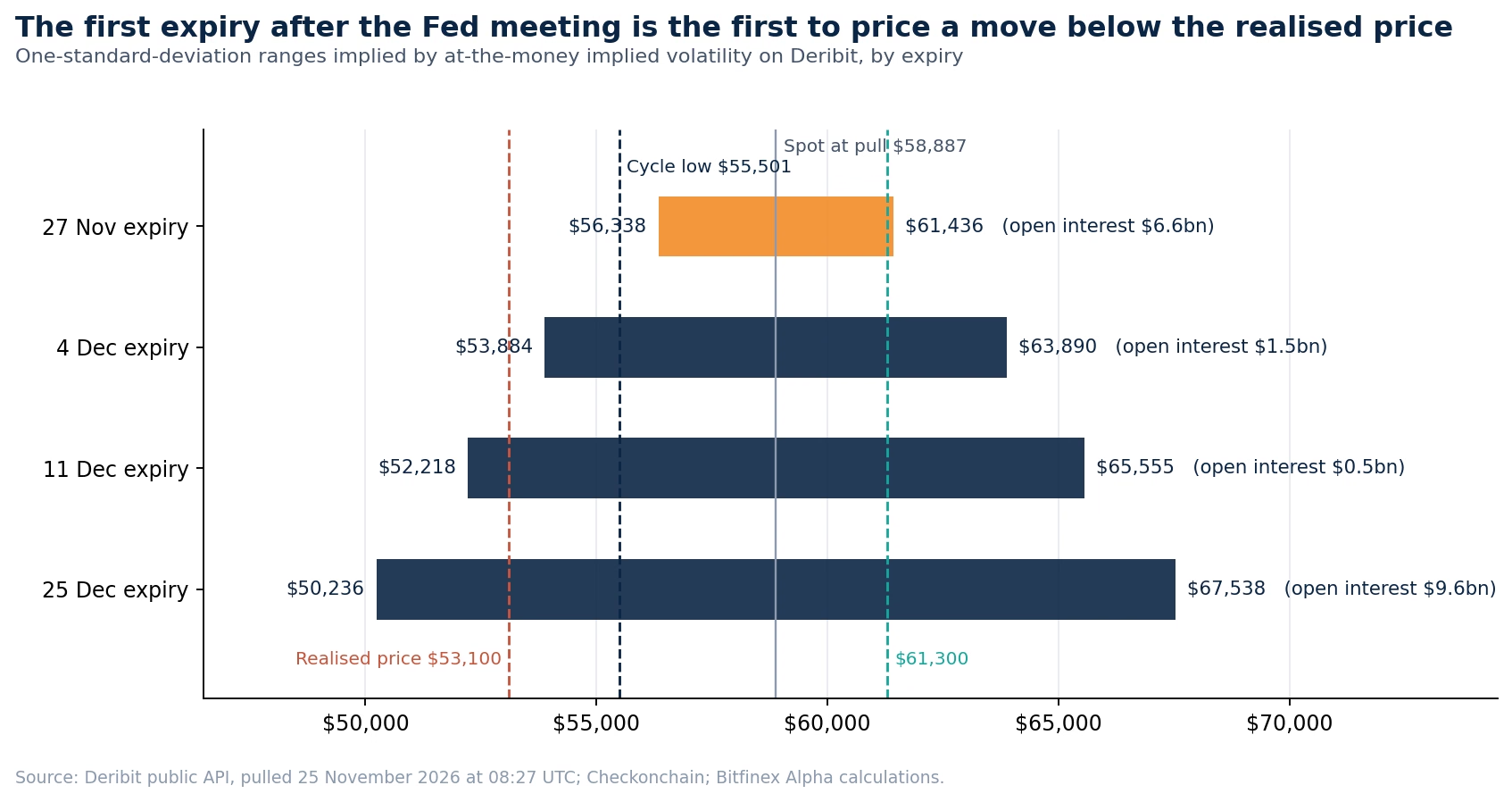
The options market provides an indication of when traders expect greater volatility. Implied volatility (IV), an annualised measure of expected price movement, is 59 percent for the 27 November expiry, 54 percent for 4 and 11 December expiries and 51 percent for 25 December expiry. Near-dated options remain more expensive than longer-dated ones, although aggregated volatility index has eased from its 21 November high of 68 to about 54.
The ranges implied by these readings are $56,300 to $61,400 for 27 November, $53,900 to $63,900 for 4 December and $52,200 to $65,600 for 11 December. The last of these will follow the Federal Open Market Committee (FOMC) decision on interest rates on 9 December and is the first expiry currently indicating a range below the current realised price of $53,200.
Dealer hedging adds to the risk near current levels. Current dealer positioning suggests that hedging flows would amplify moves between $58,000 and $64,000 and dampen them between $56,000 and $58,000. As a result, a decline that begins near current levels would be expected to accelerate before it slows under $58,000.
The US Personal Consumption Expenditures (PCE) price index for October is due at 13:30 UTC on 25 November. Monday’s Bitfinex Alpha identified a core PCE reading of 0.2 percent or lower, alongside a fall in the probability of a December hike to below 90 percent as a condition that would challenge our outlook. December rate hike probabilities stood at 100 percent on 24 November, according to CME FedWatch. We would therefore expect equity sentiment to remain the principal driver of bitcoin this week.
Base case. We expect Bitcoin to trade between $56,300 and $61,400 into 27 November expiry, with risks skewed towards a retest of $55,501 and then the realised price near $53,100. Bitcoin’s failure to sustain its gains despite the rally in equities has reinforced that view. Smaller ETF outflows on 24 November and a higher STH-SOPR are, however, tentative signs that selling pressure is easing. Any sustained advance would therefore need to be backed by spot demand.
What would confirm it? Further ETF outflows on 25 and 27 November, with OI rising while funding stays positive, would indicate that leverage and not spot demand is supporting price. A core PCE reading of 0.3 percent or higher and a fall in the Nasdaq Composite back towards its 20 November close of 22,617 would remove the one external support of the past two sessions.
What would invalidate it? To the upside, three consecutive sessions of ETF inflows with price holding above $61,300 and STH-SOPR returning to 1 would suggest spot buyers have returned, bringing the $62,000 to $66,000 supply cluster and then the short-term holder cost basis (STH-CB) near $72,400 into view. Bitcoin holding its ground on a day the Nasdaq falls two percent or more would point the same way. To the downside, a sustained break below the realised price with ETF outflows above $300 million a day would turn attention to the long-term holder cost basis near $48,300.
What to watch. ETF flows for 25 and 27 November and whether OI continues to rise with positive funding carry the most weight. The PCE report on 25 November, the $6.6 billion options expiry at 08:00 UTC on 27 November in thin holiday trading, CME open interest after the November contract expires and Strategy’s next filing, expected on 30 November, are secondary.