
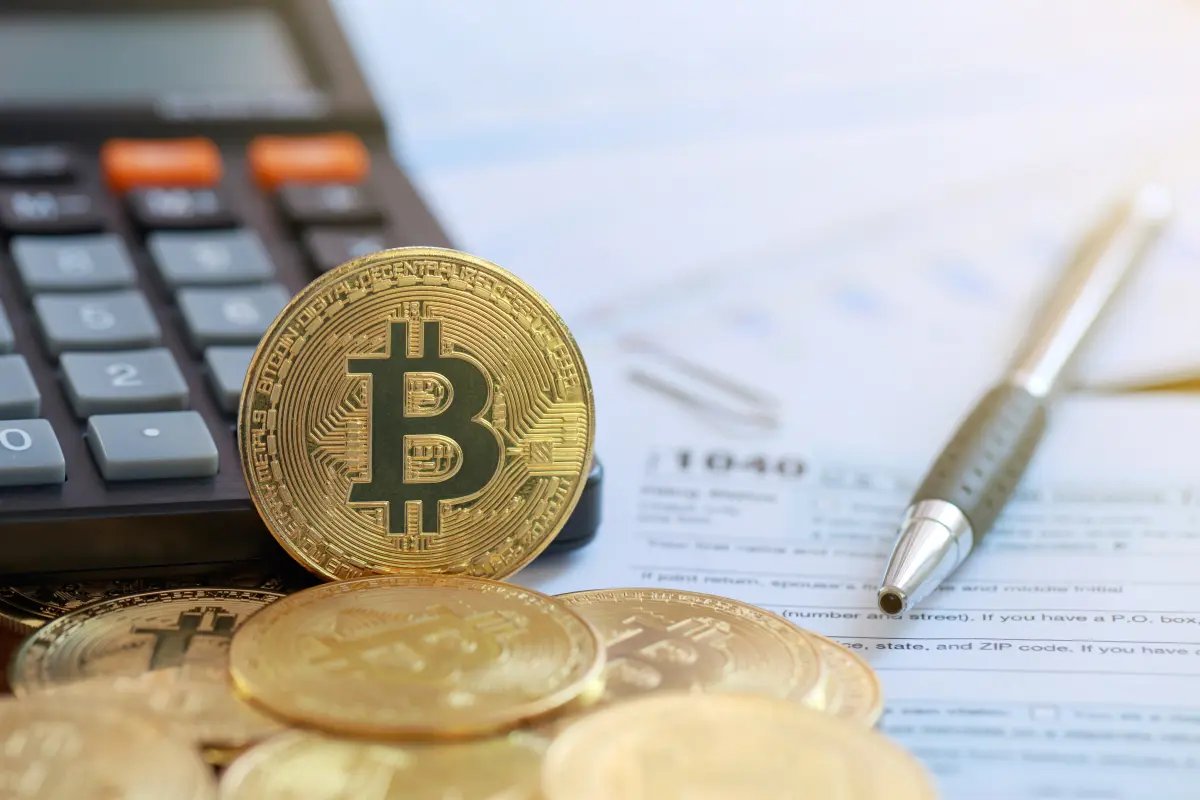
If you own a cryptocurrency like Bitcoin, and you’re ready to sell it, you need to know how that might affect your yearly taxes.
The selling part is easy. If you have an account with a major exchange or a bank like SoFi, you have many options for how you want to execute a trade and what to do with the proceeds. These apps will also generate your year-end tax forms (generally a Form 1099-DA) to make it easy to calculate exactly what you owe.
Bitcoin and other cryptocurrencies are treated as digital assets, which the IRS describes as “any digital representation of value that is recorded on a cryptographically secured distributed ledger, or any similar technology.”
As assets, selling them makes them subject to capital gains taxes, rather than adding to your taxable income.
How Bitcoin capital gains taxes work
Capital gains tax is, as the name implies, a tax on the gain in value between when you bought an asset and when you sold it. (For simplicity’s sake, we’re going to focus on Federal taxes, though many of these insights apply to state taxes as well.)
Let’s say you bought some Bitcoin for $1,000. That amount of crypto doubled in value, and you decide to sell the entire stake for $2,000. You will only pay taxes on the gain of $1,000. The other $1,000 you paid for the Bitcoin is your cost basis.
In the U.S., capital gains are taxed differently from income depending on how long you own the asset.
If you held that Bitcoin for less than a year, your gain is considered short-term, and the $1,000 profit will be taxed as part of your income for the year. If you also happen to have a lot of income from other sources, you will also be subject to the Net Investment Income Tax, which adds another 3.8% onto your tax bill.
If you have owned your Bitcoin for 366 days or longer, however, you pay long-term capital gains, which is between 0%, 15% and 20%, depending on your income level. Of that $1,000 profit, you might own nothing, or at most $200.
What happens if you bought Bitcoin for $1,000 and, by the time you’re ready to sell, the price has fallen to $500? In that case, you have incurred a capital loss, which you can use to deduct against your tax bill.
According to the IRS, you can deduct up to $3,000 per year in losses against your income tax bill, and if the loss exceeds $3,000, you can carry that loss forward into future years. If you bought $10,000 worth of Bitcoin and the price crashed so that you sold your holdings for $1,000, you could write $3,000 off your income taxes for the year you made the sale and the two years following.
| Holding Period | Tax Type | Federal Tax Rate (2026) |
|---|---|---|
| Less than 1 year | Short-Term Capital Gain | Same as your income tax bracket (10%–37%) |
| 1 year or longer | Long-Term Capital Gain | 0%, 15%, or 20% (based on income) |
Beware Bitcoin tax any time you “dispose” of the crypto
Because Bitcoin is also a currency, you can use it to buy stuff, and that presents a twist to how your taxes are calculated.
The IRS explains, “If you pay for services using digital assets, then you have disposed of the digital assets in exchange for the services provided and will have capital gain or loss on the disposition.”
So, in plain English, this means if you use your Bitcoin to buy a Lamborghini, you have to pay capital gains on the difference between the amount of money you paid for Bitcoin and how much more it was worth when you paid for the Lambo.
Example: The “Disposition” Rule
- Step 1: You buy $10,000 of Bitcoin.
- Step 2: Bitcoin value rises to $200,000.
- Step 3: You trade that Bitcoin directly for a car.
- Result: Even though you didn’t “cash out” to a bank account, the IRS views this as a sale. You owe capital gains tax on the $190,000 profit.
When you’re a buy-and-hold investor, your tax situation will likely be fairly straightforward. But if you trade often, or if you use the Bitcoin in your wallet to buy stuff, you will need to keep careful records of all your transactions.
If you do not specifically identify which units (also known as lots) you sold, the IRS generally defaults to treating the earliest units in that wallet or account as sold first, which could significantly increase your cost basis.
To track your gains, it’s important to keep detailed records of every transaction, including the date, amount of crypto, its U.S. dollar value at the time of the transaction and what wallet or exchange you used for each purchase, sale or exchange. Be sure to keep your accounts at reputable custodians like SoFi for the best customer service.
The more information you have about your Bitcoin transactions, the better prepared you will be to reduce your end-of-the-year tax hit.

To track your gains accurately, maintain records of:
- Transaction Date: When the buy, sale or exchange occurred.
- Asset Amount: The specific amount of crypto (e.g., 0.05 BTC).
- Cost Basis: The U.S. dollar value at the time of purchase.
- Fair Market Value: The U.S. dollar value at the time of sale or “disposition.”
- Platform Details: Which wallet or exchange was used for the trade.
FAQ: Bitcoin taxes
Does the IRS know if you buy Bitcoin?
Yes. Every U.S.-based crypto exchange that operates legally, which includes all the majors from Coinbase to SoFi, are required by the SEC and FinCEN to collect KYC (Know Your Customer) information. As of the 2025 tax year, this now happens via IRS Form 1099-DA, which reports gross proceeds from digital asset transactions.
What happens if I don’t report Bitcoin on my taxes?
Contrary to popular belief, it is relatively easy for governments to track Bitcoin transactions, especially if you’ve traded on an exchange regulated in the U.S. If you don’t pay your taxes, you can be subject to an audit by the IRS, back taxes, fines and even jail time.
How many Bitcoins are left?
So far, over 19.99 million Bitcoin are in circulation. There is an upper limit of 21 million Bitcoins that will ever be in circulation based on how its program is written. As the number of available Bitcoins left to mine decreases, the difficulty of mining them increases, so it takes longer for new Bitcoins to enter circulation. Experts estimate the last Bitcoin will be mined sometime before the year 2140.