
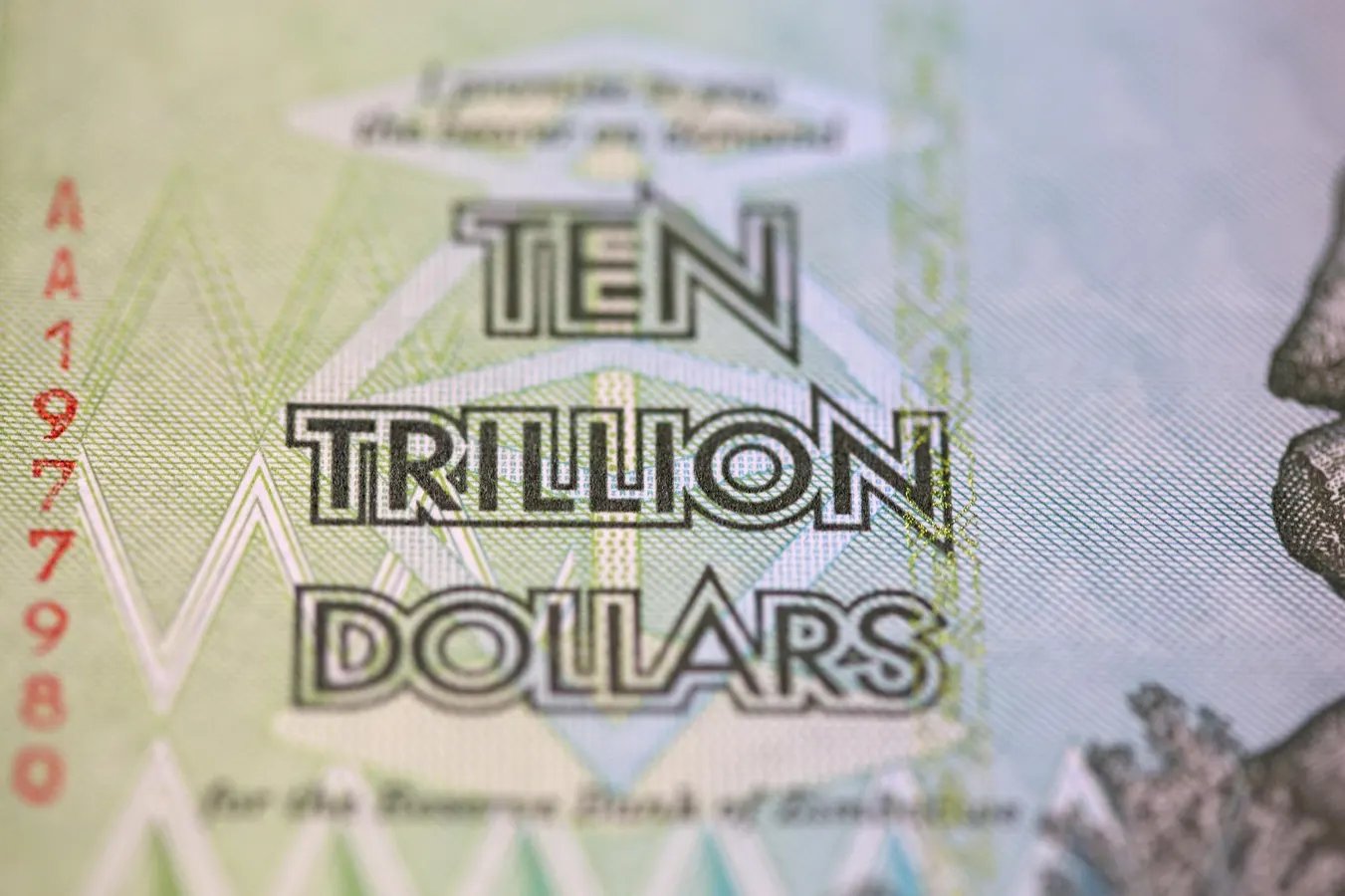

Banknotes of Zimbabwe after hyperinflation
getty
In modern times we are familiar with federal debt being counted in trillions, but it was nonetheless sobering to see it surpass $40 trillion this week. To spend $40 trillion, you would need to spend $1 every second for about 1.27 million years.
Economist Peter C. Earle says we have entered “Trillionistan,” a place where numbers that once belonged to astronomy now appear in financial headlines. At least a dozen American companies have valuations that exceed a trillion dollars, and AI infrastructure buildout plans reach into the trillions before real estate has even been acquired for them.
Bitcoin lives there, too. As I write, roughly 20.1 million bitcoin trade at about $77,355 each, giving the asset a market capitalization near $1.54 trillion. That figure sounds enormous. How could a digital asset possibly command such a price?
Bitcoin’s trillion combines three forces: real growth in its monetary network, expectations about its future use, and depreciation in the dollar used to measure it.
Its supply side is unusually honest because the issuance schedule is public and resistant to political forces, while its price is constantly being distorted by the fiat nature of the dollar. Understanding bitcoin’s value therefore requires a better question than “How high can the price go?” We should ask what kind of trillion the market is pricing.
A Trillion Here, A Trillion There…
In 1901, J.P. Morgan assembled U.S. Steel into the world’s first billion-dollar corporation. The number was so shocking that the company became a symbol of industrial power and financial concentration.
Last decade, a billion-dollar startup was called a “unicorn,” but now they are so common that perhaps we should start calling them workhorses instead. The reason these high numbers are common now is partially to do with increased productivity and efficiency, but mostly to do with how the dollar measuring the value of these companies lost purchasing power.
Earle’s useful distinction is between trillions created through entrepreneurial discovery and trillions created through monetary expansion and debt. Most large economic figures contain some of each – a technology company can serve billions of customers and generate extraordinary profits while its valuation also rises faster than it otherwise would because abundant liquidity pushes investors to buy their stocks. A government can borrow a trillion dollars to build productive infrastructure, which is dubious enough on its own given the lack of market signal propelling those choices, or it can use debt to postpone a financial reckoning.
That distinction matters more as the numbers grow. Setting price records becomes easier when the measuring unit shrinks. The U.S. money supply has expanded from billions to tens of trillions over the past century. The same house, company, or ounce of gold can command a higher dollar price without becoming any more useful. That is, prices carry useful information about the highest, best use of an asset, mixed with changes in the unit of account. A key role of financial professionals is doing research and building models in the hopes of discerning which is which.
Bitcoin gives this problem an unusual twist. Its quantity is measured by a protocol with fixed rules, while its value is usually expressed in currencies whose quantity changes according to policy and credit conditions. One side of the ratio (the supply) is predictable, but the other side (the demand) moves with interest rates, market liquidity, and politics.
What Bitcoin’s Market Cap Actually Measures
Market capitalization is calculated by multiplying the latest market price by the circulating supply. However, bitcoin’s current market cap being about 1.5 trillion doesn’t mean investors deposited $1.3 trillion of pre-existing capital into bitcoin. Rather, the price is set at the margin by the next willing buyer and seller, then assumed to apply to every unit in circulation.
A relatively small transaction can therefore reprice a much larger stock of assets. Market cap tells us the value currently assigned to the whole supply, but it says little about the money required to create that valuation or whether it is durable.
The price of one bitcoin creates a second confusion called unit bias. People see a five-figure price and conclude that they arrived too late, as though a bitcoin were a share that must be purchased whole. On the contrary, each bitcoin divides into 100 million units, called satoshis. The protocol could have displayed the same total supply as 2.1 quadrillion smaller units without changing the network’s scarcity at all. A $75,000 bitcoin and a 0.075-cent satoshi describe the same amount of purchasing power of bitcoin in a dollar-denominated pricing system.
In contrast to unit price, the trillion+ market cap is informative because it describes the value assigned to the entire network. Still, even that number needs context. In 2024, when bitcoin’s market cap was around $1.3 trillion, I wrote that its financial infrastructure and institutional ownership were beginning to reshape public markets. Two years later, custody, ETFs, corporate adoption, and sovereign interest have continued developing, while the nominal valuation has returned to roughly the same place. Price can stand still while the asset underneath it changes.
Three Ingredients Of Bitcoin’s Trillion Dollar Valuation
The first ingredient in the valuation of the bitcoin network is monetary dilution. When governments issue more currency and credit, scarce assets tend to absorb part of the increase. Stocks, houses, art, gold, and bitcoin all become release valves for people trying to preserve purchasing power. A rising bitcoin price can therefore describe growing demand for the asset, a weakening dollar, or both.
The second ingredient is important to understand, especially for skeptics who do not understand why bitcoin has value at all – its network utility. Bitcoin moves value globally without requiring banks or institutions of any kind, provides final settlement without an issuer, and allows anyone to verify its supply. Miners spend energy to secure the bitcoin ledger that everyone shares and everyone can see, while individual people who run “nodes” (small computer programs) enforce the rules of the network. You can think of bitcoin as a whole as a provider of financial services, though not through any one institution or intermediary. A monetary network creates value through liquidity, credibility, settlement, and the number of people (and agents) willing to accept it as payment.
The third ingredient is the capitalization of future monetary demand – what detractors might call speculation, but is really just the way investment works. Investors buy bitcoin today because they expect more individuals, companies, funds, and governments to hold it tomorrow. In that sense, bitcoin’s market cap resembles the valuation of a growing network. Its valuation reflects demand for a scarce monetary good, but confers no claim on future corporate profits. This can be hard for traditional investors to wrap their head around, as they would usually say that the price of an asset can be estimated with future cash flows discounted to the present. That’s why bitcoin is a new asset class that shares resemblance to currencies and commodities more than it does to equities.
This is also why bitcoin is sometimes viewed as “digital gold.” Gold’s value comes primarily from the accumulated judgment that it can preserve wealth across time and political regimes. Bitcoin is competing for part of that monetary premium, but differentiates itself from gold by being much easier to divide into pieces, easier to verify that it is not counterfeit, and faster and cheaper to transfer. Gold still has deeper institutional trust and a much larger sovereign buyer base, which helps explain why gold can rally while bitcoin stalls. Different marginal buyers can produce very different prices even when the long-term monetary thesis remains intact.
Energy Becomes A Monetary Network
Bitcoin also belongs in Trillionistan’s larger story about energy. Bitcoin miners convert electricity and specialized computation into network security, earning newly issued bitcoins and transaction fees in return. Because bitcoin mines can operate near remote generation and pare back their consumption when power is needed elsewhere, it can monetize energy that is stranded, intermittent, or difficult to transport.
The process has parallels with the current AI buildout. In fact, with the current regulatory environment increasingly hostile to the construction of new data centers, many DCs are placed within or adjacent to bitcoin mining facilities. Like bitcoin converting electricity into security, data centers convert electricity into intelligence. The robotics revolution, just around the corner, will convert electricity into physical work. Each system gives energy a new economic pathway, a convergence I examined in Bitcoin, AI, And The 4 Forces Shaping The New Economy. Electricity has been the bedrock of economic value for decades, but an AI-driven economy is finally making that easier to see. Bitcoin, being likewise based on the ability to produce and consume energy, is perfectly suited to this new era.
The Road To Quadrillionistan
A quadrillion-dollar bitcoin market sounds silly today. Assuming 20 million coins in circulation, this would imply that one bitcoin would be priced at approximately $50 million. But that number alone tells us almost nothing about what the world would have to look like in order for it to be priced as such.
If the dollar retained roughly its present purchasing power, a quadrillion-dollar valuation would mean bitcoin had absorbed a significant portion of global capital. (which could happen). On the other hand, severe inflation could produce the same nominal milestone while bitcoin purchased far less than enthusiasts imagine. Japan’s government debt crossed one quadrillion yen in 2013, demonstrating how little a large numeral reveals without its currency and context.
Better measures would ask how much energy, housing, land, corporate equity, or human time a bitcoin can purchase. They would also examine the network’s share of global savings, settlement volume, liquidity, and ownership.
Bitcoin’s current trillion is partly productive achievement, partly a bet on future adoption, and partly an artifact of the dollar measuring it. Unlike other assets, the bitcoin protocol makes those ingredients easier to separate because its own supply schedule is transparent. If the market capitalization of bitcoin reaches ten trillion or a hundred trillion dollars, the crucial question will remain unchanged: how much did the network grow, and how much did the measuring stick shrink?