

Before rushing to buy the dip, investors should understand what comes with crypto: extreme volatility, uncertain price cycles and a tax regime that is far less favourable than mutual funds or stocks.
Why crypto fell
The latest correction from $80,000 levels in May 2026 is being driven by a mix of geopolitical tensions, concerns over interest rates, institutional fund outflows and a broader shift away from riskier assets. According to Prateek Gupta, Head of Business, Mudrex, Bitcoin has traditionally behaved like a risk-on asset. As uncertainty rises, investors tend to move towards safer investments and reduce exposure to volatile assets like crypto.
“Interest rate concerns have added to the pressure. Investors are worried that central banks could keep rates elevated for longer, limiting liquidity in financial markets,”he says.
Institutional flows have also weakened. Bitcoin exchange-traded funds (ETFs), which had become a major source of demand over the past two years, have witnessed outflows as capital rotates towards other opportunities. Over the last month, crypto ETF outflows amounted to around $4 billion in a market which is estimated at $118 billion.
Sumit Gupta, Co-Founder of CoinDCX, says, “The correction appears to be the result of profitbooking after a strong rally, cautious investor positioning and short-term fluctuations in institutional flows. Investors are closely tracking interest rate expectations, global liquidity conditions and geopolitical developments, all of which influence appetite for risk assets.”

What’s the outlook?
The question is whether the current decline represents a normal correction or the beginning of a deeper bear market. Views remain divided.
Prateek Gupta believes the market is already in a downtrend but does not expect Bitcoin to fall substantially further. He identifies $60,000 and $55,000 as important support levels and says a fall below $55,000 could theoretically push prices towards $40,000, although he does not consider that a likely outcome.
He believes there are signs of a reversal emerging after Bitcoin successfully held around the $60,000 mark.
Vikram Subburaj, CEO of Giottus, also sees macroeconomic concerns as the primary driver of the correction rather than a deterioration in crypto-specific fundamentals. He notes that institutional adoption remains intact and expects investor confidence to improve if macroeconomic conditions stabilise.
Gracy Chen, CEO of Bitget, has a cautious view. While she remains positive on Bitcoin over the long term, she warns that cryptocurrency could still witness a steep decline towards the $50,000 range in the near term. “The growing presence of institutional capital has made market behaviour less predictable than in earlier cycles,” she argues. The bullish camp focuses on longer-term adoption trends. CoinDCX’s Sumit Gupta argues that the broader fundamentals remain intact, citing continued institutional participation, increasing corporate adoption and growing recognition of Bitcoin as a digital store of value.
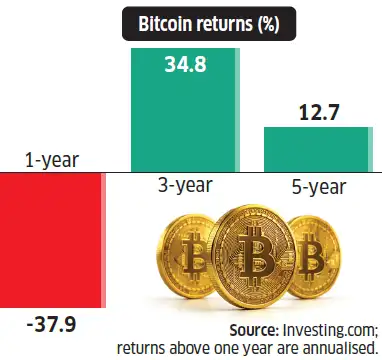
Existing investors: Stay calm
For those who already own crypto, the appropriate response depends on how large that exposure has become relative to the rest of your portfolio. A survey of over 6,000 active Indian crypto traders and investors by Mudrex found that nine in 10 avoid panic trading during sharp market movements. Nearly half allocate less than 10% of their total portfolio to crypto, with over 70% keeping their allocation under 25%.
An encouraging sign is the improved composition of retail portfolios. “In 2023, meme tokens made up a worrying 20 to 25% of customer holdings,” says Subburaj. “Now that figure is down to 2-3%. Customers have moved back to Bitcoin, Ethereum, Solana, and Ripple tokens where you can have some theory around why the price will increase.”
If crypto is already less than 5 to 10% of your overall portfolio, the advice is straightforward: stay disciplined and avoid panic selling. If, however, Bitcoin’s rally over the past few years pushed your crypto holdings to 20 to 30% of your wealth, this is the moment to rebalance, book partial profits, bring the allocation back to your original target, and resist the temptation to hold on in expectation of an immediate return to $125,000.
New investors: Start small
For those considering entering for the first time, the experts are broadly aligned on approach, if not on enthusiasm.
“ I would suggest starting with the large caps of crypto, Bitcoin and Ethereum,” says Subburaj. “Stick to that, invest there, and when you understand crypto better, decide if you want to invest further. Crypto is still an unregulated space. It is not illegal, but there are a lot of scammers. Whatever amount you can invest and manage yourself, that is what you should be doing. And crypto and multi-level marketing (MLM) structures do not go together. Whenever you hear a pyramid structure, just stay away.”
Prateek Gupta says, “You should invest through a Systematic Investment Plan (SIP), follow a dollar-cost averaging approach, and keep investing every week or every month at a fixed frequency. That makes you largely immune to price movements.” Mudrex platform data supports this: crypto SIP openings grew over 220% through 2025, with average monthly contributions reaching Rs.4,000 to Rs.6,000 by December. Over five years, a Rs.10,000 monthly SIP in Bitcoin would have grown to Rs.16.9 lakh, outperforming a lump-sum investment by an additional Rs.2.3 lakh.
On portfolio sizing, Sumit Gupta is clear: “If you understand the asset class, a 5-10% allocation is reasonable. If you’re just starting out, begin with 2 to 5%. New investors should preferably go for blue chip tokens such as Bitcoin and Ethereum, through a regulated platform. Don’t go beyond what you understand,” he says.
Chen offers the clearest summary of the risk profile: “It is best to only invest what you risk losing. For the long term, it is a hedge against macro uncertainty. In the short term, it may not be the best quick fix.”
Proceed carefully
Bitcoin’s 50% correction may prove to be a temporary setback, or it could become part of a longer and deeper downturn. What investors must know is that crypto remains one of the riskiest assets available to retail investors. Unlike equity mutual funds, which are regulated by the Securities and Exchange Board of India (SEBI) and benefit from a lower long-term capital gains tax rate of 12.5%, crypto assets in India are taxed at a flat 30% on all gains. Further, one can’t set off losses from one cryptocurrency against gains from another. Every trade is a taxable event. The tax structure alone significantly raises the bar for crypto to deliver competitive after-tax returns compared to mainstream financial products.
There is also no investor protection framework. If an exchange fails or a token collapses, there is no regulator, no compensation fund, and no grievance redressal mechanism comparable to what exists in regulated markets. Therefore, proceed with caution, and only after understanding what you are getting into.