

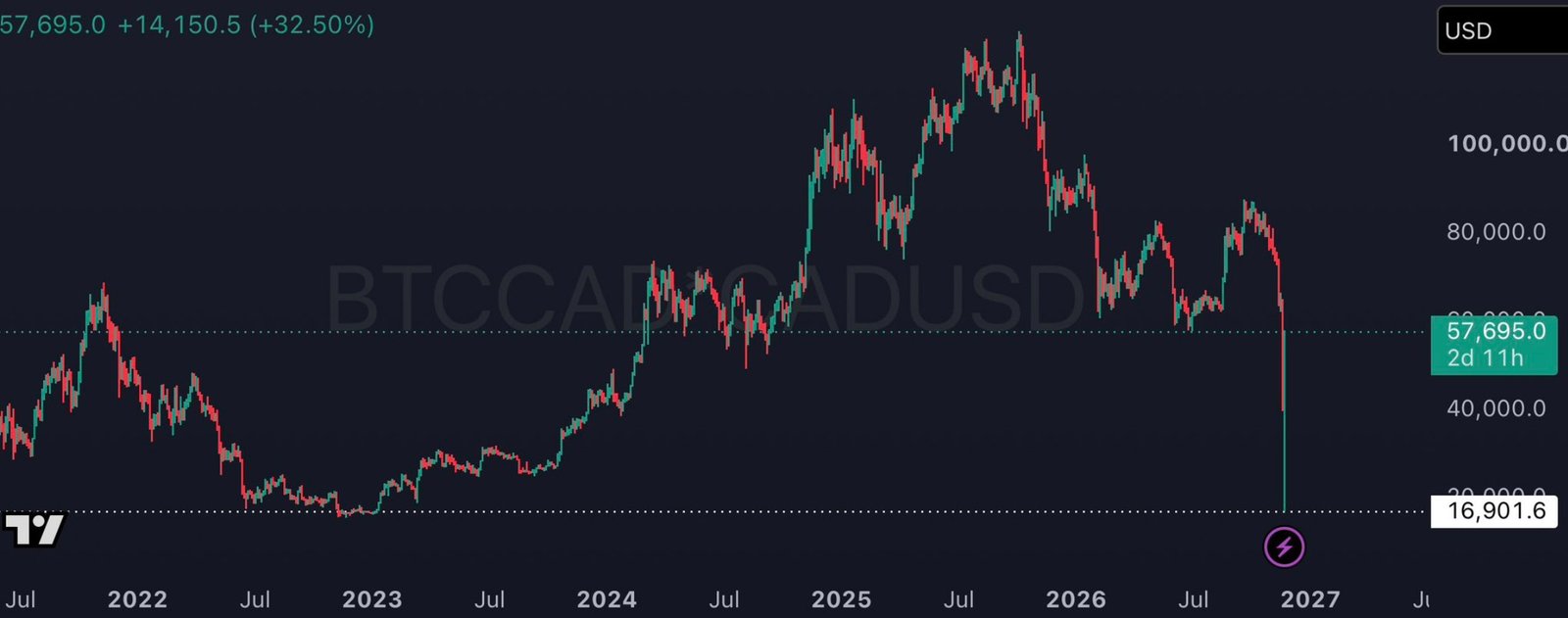
For a few minutes on Saturday morning, you could buy bitcoin for less than a third of its price. On November 21, 2026, bitcoin’s Canadian dollar market on Kraken, one of the oldest US crypto exchanges, traded as low as C$24,250. At that day’s exchange rate, that’s about $16,900, a level bitcoin hasn’t traded at since early 2023.
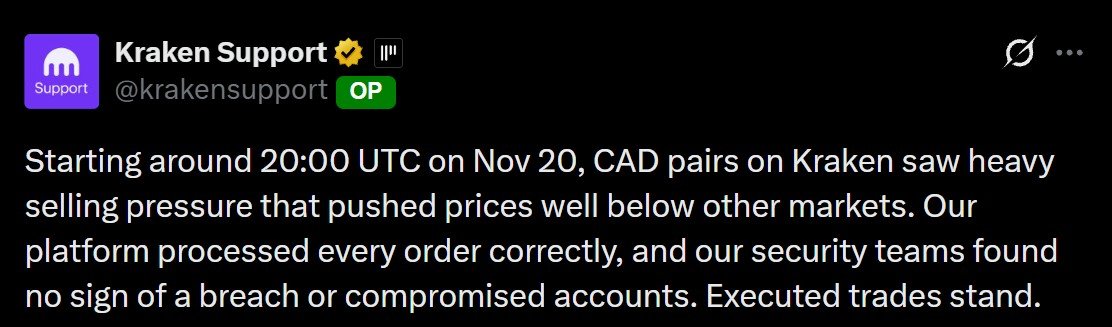
Bitcoin itself didn’t actually crash. It was already in a rough patch, having dropped below $60,000 on November 20 for the first time since July, but on Kraken’s own US dollar market it traded near $57,700 at the same moment. The Kraken bitcoin crash was confined to the exchange’s Canadian dollar trading, and Kraken says those trades will stand. Here’s how a problem with one currency made bitcoin look like it lost 71% of its value, who won and lost, and what you can learn from it.

Binance Referral Code
$100 Sign-Up Bonus
20% Lifetime Discount on Trading Fees
Code Valid: November 2026
BINANCEMB
The Kraken Bitcoin Crash in Four Points
- What happened: heavy selling hit Kraken’s Canadian dollar (CAD) markets starting around 20:00 UTC on Friday, November 20. BTC/CAD hit its low in the 15 minutes from 08:00 UTC on Saturday.
- What didn’t happen: Bitcoin’s price elsewhere, and on Kraken’s US dollar market, stayed far higher.
- What Kraken said: every order was processed correctly, its security teams found no breach or compromised accounts, and, in its words, “Executed trades stand.”
- The likely cause: Blockstream CEO Adam Back says a market maker on Kraken’s USD/CAD market ran out of money. Kraken hasn’t confirmed a cause.
The Numbers, Converted
Here’s what the prices looked like, converted at the Bank of Canada’s November 20 rate of C$1.4325 per US dollar. The math is ours.
| Market on Kraken | Price | In US dollars | vs normal value |
| BTC/CAD low (Nov. 21, 08:00–08:15 UTC) | C$24,250 | About $16,930 | About 71% lower |
| BTC/USD, same window | About 57,650–57,775 | — | Normal |
| USD/CAD low | C$0.30 per US dollar | — | About 79% below C$1.4325 |
| USDC/CAD low | C$0.4868 per USDC | — | About 66% below C$1.4325 |
| BTC/CAD at 13:06 UTC | C$82,099 | About $57,310 | Back to normal |
Read the USD/CAD line carefully, because it explains everything. On Kraken’s own market, one US dollar briefly traded for just 30 Canadian cents, when banks valued it at more than C$1.43. In other words, the Canadian dollar on Kraken suddenly looked about 4.8 times more valuable than it really was. If Canadian dollars look that expensive, anything priced in them, including bitcoin, looks cheap.
Divide the bitcoin low by Kraken’s US dollar price, and you get an implied rate of about C$0.42 per US dollar, by our math. That sits between the USD/CAD and USDC/CAD lows, which tells you the whole CAD side of Kraken’s order books had come loose from the real world at once.
How a Currency Glitch Became a Bitcoin “Crash”
To see how this happens, you need two ideas.
An order book is the list of every open offer to buy and sell on an exchange, at every price. The price you see is simply where the latest buyer and seller met. A market maker is a trading firm that keeps the book full by constantly posting offers to buy and sell, earning a small spread. Without one, books get thin, and a big order can push the price a long way.
Here’s the chain of events, as Back described it and as the prices suggest:
- The currency market breaks. A market maker providing USD/CAD prices on Kraken runs out of funds, according to Back. With no one offering fair prices, USD/CAD drifts far from the real rate of about 1.43.
- Arbitrage spreads the problem. Arbitrage means buying something where it’s cheap and selling it where it’s dear. Traders and bots notice that Canadian dollars are “expensive” on Kraken compared with everywhere else, and they trade across Kraken’s other CAD pairs to profit.
- CAD crypto prices fall in lockstep. As arbitrage pressure flows through BTC/CAD, ETH/CAD, USDC/CAD and others, each of those markets reprices to the broken exchange rate. Back said it was more accurate to say you could buy Canadian dollars at a discount than to say bitcoin crashed.
- Orders get filled at strange prices. Any automatic sell orders sitting in those books, like stop-losses, trigger and fill at the distorted prices.
- Liquidity returns. Once fresh money and market makers come back, prices snap back toward normal. By early afternoon UTC, BTC/CAD was over C$80,000 again.
This wasn’t a hack, and it wasn’t a bitcoin story. It was a plumbing failure in one currency on one exchange, and automated trading spread it across every market that touched that currency.
Why Kraken Won’t Reverse the Trades
Kraken’s position is that its systems worked as designed: orders matched at the prices people were willing to trade at, and nothing was compromised. Reversing trades would mean deciding after the fact which deals were “fair,” which would undermine trust in every trade on the platform. That’s why exchanges almost always let trades stand unless there’s a clear technical error or a hack.
That’s cold comfort if you were on the losing side. But it’s also the standard most major exchanges follow, and it’s spelled out in their terms of service.
Who Came Out Ahead, and Who Got Hurt
Winners: anyone who had Canadian dollars on Kraken and buy orders sitting at very low prices. At C24,250,abitcoinboughtatthelowandsoldlaterthatdayatC82,099 would have been worth about 3.4 times as much, by our math, before fees. In practice, very little bitcoin traded at the bottom. One analysis of the trade data found the lowest fill covered only about 0.077 BTC.
There was a catch for arbitrage traders. Buying cheap bitcoin in CAD and selling it in US dollars is only half the trade. To lock in a profit in Canadian dollars, you had to convert back, and the CAD exchange rate on Kraken was broken too. Depending on which rate you used, the same round trip could have produced a gain, a break-even or a loss.
Losers: anyone who sold bitcoin or other crypto for Canadian dollars during the dislocation, especially with market orders (sell at whatever the best price is right now) or stop-loss orders that turned into market orders when triggered. Those sellers received a fraction of what their crypto was worth elsewhere.
Not affected: anyone trading in US dollars, holding bitcoin without selling, or using other exchanges. If you saw a scary headline but didn’t trade on Kraken’s CAD markets that morning, your bitcoin’s value didn’t change because of this.
Kraken’s Canadian Market Has Done This Before
This isn’t the first time. In late May 2019, Kraken’s BTC/CAD pair briefly fell from about C$11,300 to C$101.20, a drop of more than 99%, before bouncing back within minutes. At the time, traders blamed a huge sell order hitting a thin order book.
The pattern is the same: smaller fiat markets on big exchanges have far less trading than the main BTC/USD market, so one failure can move prices dramatically. Canadian dollar trading is also much smaller than US dollar trading worldwide, even though Canadians trade billions in Bitcoin in Canadian dollars on a busy day across all platforms.
How to Protect Yourself on Thin Markets
If you trade crypto in a currency other than US dollars, a few habits reduce the risk of getting caught in a glitch like this:
- Use limit orders, not market orders. A limit order only fills at the price you set or better. It might not fill during a crash, but it won’t sell your bitcoin for a third of its value.
- Be careful with stop-loss orders. A basic stop-loss becomes a market order once triggered. On a thin market, that can fill far below your stop. A stop-limit order sets a floor instead.
- Check the real rate before you trade. Compare the price you see with the main BTC/USD market and the official exchange rate from the Bank of Canada. A big gap is a warning sign.
- Avoid leverage on small markets. Borrowed money magnifies losses, and a brief price spike can wipe out a position before prices recover.
- Know whether you’re on spot or futures. This glitch hit Kraken’s spot markets, where you trade actual coins.
The bigger lesson: a crypto “price” is always a price on a specific market, in a specific currency, at a specific moment. Headlines about bitcoin crashing to $17K were technically true for a few minutes on one Kraken market, and misleading everywhere else. As of 13:06 UTC on November 21, bitcoin on Kraken’s CAD market was back above C$82,000, roughly where the rest of the world had it all along.

Binance Wallet Referral Code
100 USDT Sign-Up Bonus
20% Lifetime Discount on Trading Fees
Code Valid: November 2026
VU790NKG
This article is for information only and is not financial advice.
FAQs
What is a flash crash?
A flash crash is a very fast, deep price drop that recovers within minutes or hours. It usually happens when large sell orders hit a thin order book, or when automated trading systems react to each other. Flash crashes have happened in stocks, currencies, and crypto, often at night or on weekends, when trading is lighter.
Why do crypto exchanges have different prices for the same coin?
Each exchange runs its own order book, so prices depend on who’s buying and selling there. Arbitrage traders usually keep prices close by buying where it’s cheap and selling where it’s expensive. Gaps appear when moving money between exchanges is slow, limited, or expensive, which is common with smaller currencies.
Is it safer to keep bitcoin on an exchange or in a wallet?
Exchanges are convenient for trading, but you rely on the company to secure your coins. A hardware wallet stores your keys offline, so you control them yourself, though you’re responsible for backups. Many people keep trading money on exchanges and savings offline.
How do I start buying bitcoin safely?
Start with a regulated, well-known exchange, use strong security like two-factor authentication, and buy small amounts while you learn. Use limit orders and avoid leverage at first.
Why has bitcoin been falling in November 2026?
Several pressures hit at once, including a stronger US dollar, rising expectations of higher interest rates, and outflows from bitcoin funds.