

1. Introduction
The end of October in the U.S. stock market might be called a ‘Halloween Shock.’ AI semiconductors and high-tech stocks plummeted, with companies like Intel falling about 29% in a single day, marking a historic crash. In such a situation, it is important to first look at the big picture. If you only look at the U.S. stock market, you may misjudge the situation. It is necessary to grasp the essence of the problem while taking a bird’s-eye view of various financial markets and global stock markets. I would like to start from there.
2. Conclusion
・The financial market in October was not in a state of total risk-off. While crude oil stood out with gains, the stock market showed a clear divergence between regions and sectors.
-
No serious stress is confirmed in the U.S. financial market. Long-term interest rates are falling, and credit spreads are generally stable. The market is not pricing in a financial crisis or recession.
-
A strong sector rotation is underway in U.S. stocks. While semiconductor stocks plummeted, 9 out of the 11 S&P 500 sectors rose in October. Buying demand for the market as a whole remains intact.
-
U.S. corporate earnings remain extremely strong. The S&P 500’s third-quarter earnings grew by approximately 32%. Double-digit growth is expected for 2027 as well, and the forward P/E ratio has fallen to 17.8x.
-
The AI growth story has not collapsed, but new anxieties have emerged. Two concerns are overshadowing the market: the delay in recovering massive capital expenditures and the destruction of existing business models by AI.
-
The three conditions for a U.S. stock recovery have not yet been fully met. While the ‘transfer of wealth’ to AI-related industries and the penetration of AI into real society continue, credit anxiety and geopolitical risks are actually becoming prolonged.
-
Global stock markets also show clear contrasts. European stocks are firm, but Asian stocks such as China, Japan, and South Korea have undergone significant adjustments. In emerging countries, independent declines due to political and fiscal risks are also notable.
-
The focus going forward is whether the adjustment in high-tech stocks will subside or spread to other sectors. I remain bullish, but a full-scale recovery requires a new catalyst to dispel market anxiety.
-
We are in a ‘stay-at-home’ mode, but excessive pessimism is unnecessary. Investors cannot move until the U.S. midterm elections and President Trump’s judgment on the situation in Iran become clear. Let’s watch for changes in the situation.
3. Financial Market Trends
The U.S. stock market on the last day of October was chaotic. Intel’s stock price suffered a 29% crash, the worst on record. Should we call it a Halloween Shock? The recent plunge in U.S. high-tech stocks is due to complex factors, but in such a bear mood, it is important to first grasp the big picture. What is the situation in other financial markets? What about global stock markets? Unless we analyze the U.S. stock market after first grasping the overall situation, we will inevitably be distracted by individual bad news. Therefore, this time, let’s first take a bird’s-eye view of the October market.
October Market Overview
The table below shows the performance of various assets.
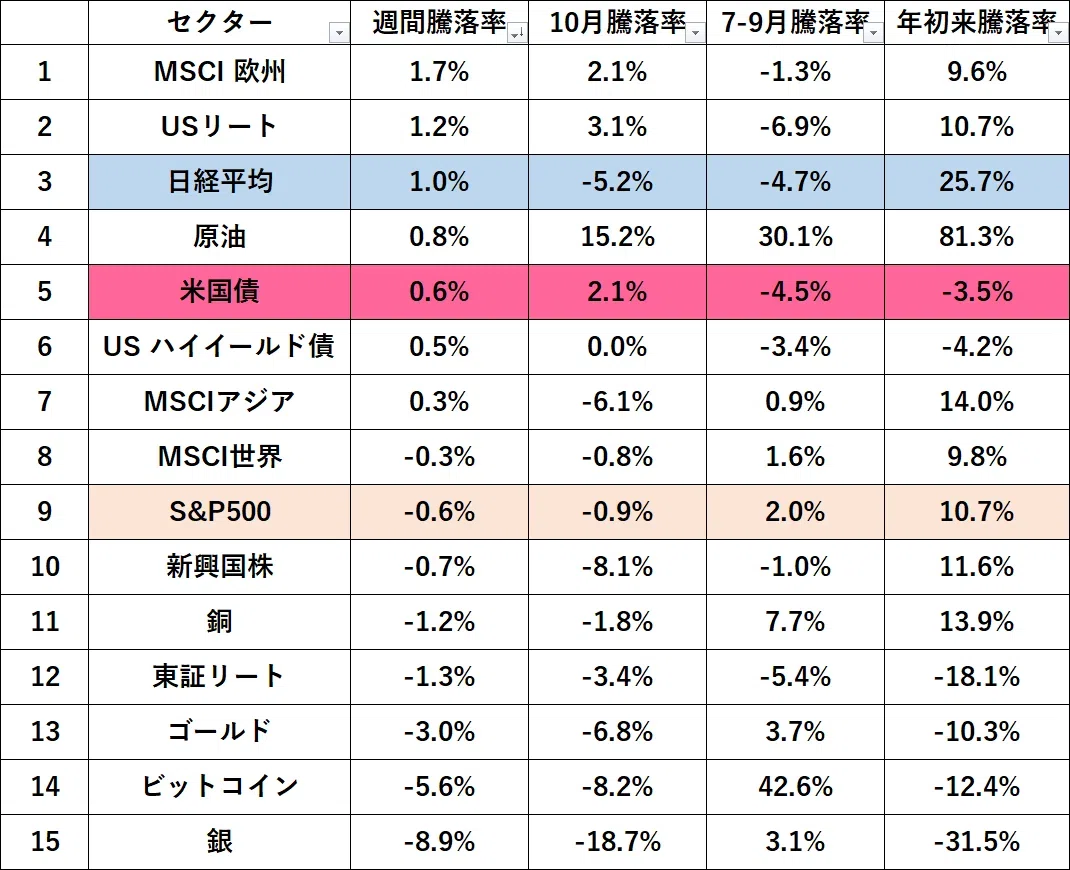
In the October financial market, crude oil prices stood out with a 15.2% gain, while a wide range of risk assets such as Asian stocks, emerging market stocks, precious metals, and crypto assets fell, creating a market of contrasts. U.S. Treasuries are being bought, but high-yield bonds are also stable, so it is not a total risk-off. The characteristic is that the selection by asset and region has become clear.
First, the strongest was crude oil. It rose significantly by 15.2% in October, reaching 81.3% year-to-date. While geopolitical supply concerns are supporting the oil market, copper fell by 1.8%, so the commodity market as a whole was not strong. It is interesting that gold, considered a traditional safe asset, fell significantly by 6.8%, and silver by 18.7%. Bitcoin was also weak at 8.2%. The declines in silver and Bitcoin, in particular, are largely a reaction to their gains from July to September.
In the stock market, regional disparities were notable. While MSCI Europe was firm at +2.1%, the S&P 500 was down 0.9%, the Nikkei 225 down 5.2%, MSCI Asia down 6.1%, and emerging market stocks down 8.1%. In particular, the adjustments in Asian and Japanese stocks were significant, and the MSCI World Index also fell by 0.8%. However, the Nikkei 225 still maintains a high year-to-date gain of 25.7%, and global stock markets are also positive in all regions year-to-date, making this a very good year for the stock market so far.