

Price pass-through and profit growth trends indicated by the Tankan survey, the AI semiconductor rally reignited by Micron’s strong earnings, and the full-scale start of the autumn market
1. Weekly Market Overview: Entering the October market with resilient fundamentals after a turbulent end to September
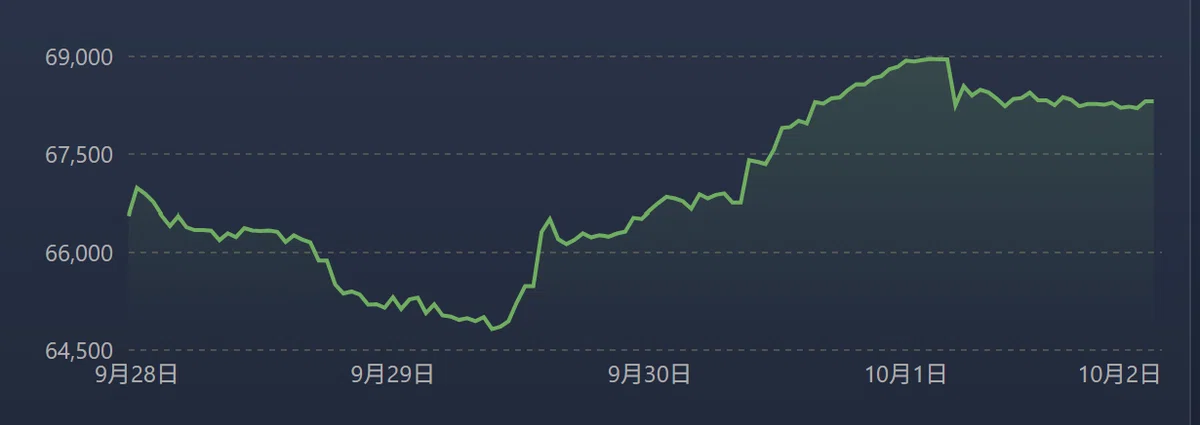
The stock market from the fifth week of September to the first week of October 2026 (September 28 to October 2) began amid multiple uncertainties, including volatility due to supply and demand factors surrounding the ex-dividend date at the end of September, fluctuations in oil prices due to escalating tensions in the Middle East, and rising global interest rates. However, as the market entered the October trading period and the second half of the fiscal year in both name and reality during the latter half of the week, the market atmosphere changed completely, and the Nikkei Stock Average showed a powerful rebound, briefly approaching the 69,000 yen mark.
The biggest positive factors that defined this week’s market were the confirmation of improved business sentiment and the establishment of price pass-through capabilities among Japanese companies in the September Tankan survey released on October 1, and the fact that the AI semiconductor market was powerfully reignited by the strong earnings of major US semiconductor company Micron Technology.
Although the Nikkei Stock Average trended downward in the first half of the week due to the impact of the ex-dividend date, it rebounded sharply on the 30th (Wednesday), the final trading day of September, led by overseas investors buying stock index futures. On a monthly basis for September, it rose by 441 yen, securing a positive monthly candle for the second consecutive month. Furthermore, on Thursday, it performed strongly due to the surge in semiconductor stocks following Micron’s earnings, and although it was pressured by position adjustments and profit-taking ahead of the US employment statistics release on the weekend (Friday), it finished the week firmly maintaining its high range.
2. In-depth analysis of the weekly Japanese and US stock market movements and the macro environment
This week’s market development was an extremely dense week where the calendar-based ‘end-of-period/start-of-period factors’ intersected with the ‘fundamental confirmation work’ in Japan and the US.
[Supply and demand trends in the first half of the week] Sharp rebound from the turbulence of the ex-dividend date due to futures buying by overseas investors
Monday the 28th, the start of the week, was the final trading day with dividend rights for the end of September, and buying for rights acquisition centered on high-dividend stocks came in. However, when the ex-dividend date arrived on the following Tuesday the 29th, in addition to the mechanical downward pressure on the index due to the dividend drop, profit-taking sales against the recent rise took precedence, and the upside of the entire market became heavy.
The turning point was Wednesday the 30th, the final trading day of September. Overseas institutional investors, who strengthened their bullish sentiment on the immediate market, intermittently placed large buy orders for stock index futures, causing the Nikkei Stock Average to rapidly expand its gains. As a result, the September market, which had seen rough price movements throughout the month, finished in the positive (up 441 yen from the previous month), successfully building a good foundation for entering the second half of the year.
[Entering the October market and the impact of the Tankan survey] Large manufacturing companies improve for the 6th consecutive quarter
The September Tankan (Short-Term Economic Survey of Enterprises in Japan) released on October 1st (Thursday), the first day of the second half of the fiscal year, proved once again how solid the fundamentals of Japanese stocks are.
The most noteworthy point is the Business Conditions DI for large manufacturing companies (the index obtained by subtracting the percentage of companies that answered ‘bad’ from the percentage of companies that answered ‘good’). This exceeded market expectations and recorded an ‘improvement for the 6th consecutive quarter.’ Currently, the Bank of Japan is in the middle of a ‘rate hike cycle’ of raising policy interest rates. Generally, in a rising interest rate environment, there is concern about worsening corporate financing and downward performance, but there were no noticeable signs of deterioration in the ‘Financial Position DI’ in this Tankan survey. Furthermore, regarding the ordinary profit plan for fiscal year 2026, it was revised upward from the previous June survey, mainly in the manufacturing sector, and it was clearly shown that the expansion trend of corporate earnings is continuing.
Even more important is the trend of the ‘Price DI’. The input price DI and output price DI for large manufacturing companies are both trending at historically high levels. This confirms the reality that while facing rising raw material and energy costs, companies are appropriately passing on (raising prices) those cost increases to final sales prices.
In the Tankan data, this trend of the Price DI has an extremely high correlation with the year-on-year change rate of TOPIX’s expected EPS (earnings per share). If companies can maintain profit margins through price increases, the ‘nominal amount’ of sales and profits will certainly increase even if sales volume remains constant. Since corporate performance is recorded in nominal values, the establishment of price pass-through practices domestically will be a powerful driving force that will continue to structurally boost the performance and stock prices of Japanese companies in the future.
[Overseas markets and the depths of the Middle East situation] Relaxation of oil supply concerns and progress in alternative routes
In overseas markets, the biggest focus that has swayed inflation trends and the future of monetary policy has been the Middle East situation and crude oil prices. This week, it was reported that US President Trump showed a hardline stance in negotiations with Iran, and there was a scene where WTI crude oil futures prices jumped temporarily. However, beyond the political headlines surrounding the negotiations, it is necessary to calmly assess the physical supply and demand trends of crude oil and changes on the supply side.
Looking at the relationship between the crude oil market and global crude oil production, the main cause of the recent rise in crude oil prices was ‘supply-side constraints’ due to production decreases in Middle Eastern oil-producing countries. Under such circumstances, extremely important signs of improvement on the supply side were confirmed this week. It was reported that Saudi Arabia’s ‘East-West Pipeline,’ which had suspended operations after being attacked last week, has been restored, raising expectations for the resumption of crude oil supply. Furthermore, looking at the estimated data for crude oil exports from the Middle East region, the use of ‘land transport and alternative pipeline routes’ that do not pass through the Strait of Hormuz, where tanker navigation safety is a concern, is progressing rapidly, and crude oil exports from the Middle East are gradually recovering. Although the best scenario is for direct negotiations between the US and Iran to progress, if physical supply recovery proceeds through the securing of alternative routes, it is analyzed that there is a high possibility that crude oil prices will gradually return to past stable trends.
3. Thorough explanation of major materials that moved the market and notable individual stocks
This week, there was an extremely rich array of material for individual stocks, including the ripple effects of US semiconductor earnings, partnerships and competition among major electronic component manufacturers, sharp drops due to governance risks, large-scale regional bank restructuring, and unique factors affecting retail companies.
1. Key Players in AI and Memory Semiconductors: Micron, Kioxia, and Advantest
On Thursday, as the market entered October, semiconductor-related stocks on the Tokyo Stock Exchange surged in unison, pushing up the entire market. The biggest trigger for this was the strong earnings report from major US semiconductor company Micron Technology (MU) released the previous day. Micron not only significantly exceeded market expectations with its current performance results but also provided an extremely bullish outlook (guidance) for the overall AI memory market. Following this announcement, explosive capital flowed into related domestic stocks.
-
Kioxia Holdings: Kioxia was the biggest beneficiary of Micron’s strong earnings. While Micron’s stock was trading near its year-to-date high, only about 10% below it, Kioxia’s stock had been left at a significantly adjusted level, roughly ‘half the price (50% level)’ of its year-to-date high. In addition to the strong sense that it was lagging behind, the implementation of a stock split and other factors were seen as positive, leading to intense buying interest.
-
Advantest: Advantest, a world-leading manufacturer of semiconductor testing equipment, strongly updated its ‘all-time high’ for the first time since August 14th on Friday, the 2nd. The reaffirmation of robust demand for AI-related businesses in the Bank of Japan’s Tankan survey also acted as a tailwind, once again proving that the company is a symbol of Japan’s AI rally.
2. Crustal Shifts in the Electronic Components Sector: Sumitomo Electric & TDK Agreement vs. Murata Manufacturing’s Sharp Drop
In the electronic components industry, a major partnership that could redraw the future power map was announced, leading to a clear divergence in performance between stocks.
-
Sumitomo Electric Industries & TDK: Both companies announced a basic agreement to jointly develop next-generation electronic components. Buying interest was driven by expectations that combining Sumitomo Electric’s advanced material technology with TDK’s sophisticated circuit and magnetic technology would lead to the development of high-value-added components for next-generation communications, automotive, and AI equipment, ultimately boosting future earnings.
-
Murata Manufacturing: In contrast, Murata Manufacturing was heavily sold off. The company is the absolute leader in multi-layer ceramic capacitors (MLCCs), which are essential for smartphones and electronic devices, holding a global market share of approximately 40%. However, with two powerful companies like Sumitomo Electric and TDK teaming up to develop next-generation electronic components, concerns about future market share erosion and intensified price competition led to increased selling by institutional investors.
3. Governance Failure and Listing Maintenance Risk: The Sharp Drop of Nidec
This week, the market was shocked by the sharp drop of comprehensive motor manufacturer Nidec. Since the resignation of its president, the company has been plagued by reports of potential massive impairment losses, leading to growing market distrust. This was compounded by the fact that in the submitted securities report for the fiscal year ending March 2026, the auditing firm issued a ‘disclaimer of opinion.’ Following this abnormal situation where the auditor could not express an opinion on the fairness of the financial statements, concerns spread rapidly that the ‘difficulty of maintaining the listing’ under Tokyo Stock Exchange rules had become extremely high, leading to a wave of panic selling. This has become a symbolic event that once again calls into question the importance of corporate governance.
4. Wide-Area Restructuring Plan by Three Tohoku Regional Banks: Procrea, Iwate Bank, and Akita Bank
In the financial sector, news of a historic restructuring of regional banks emerged. It was reported that Aomori Michinoku Bank under Procrea Holdings, Iwate Bank, and Akita Bank would begin discussions toward a management integration. Until now, regional bank restructuring has mainly involved integrations within the same prefecture or between two adjacent prefectures, but the birth of a ‘wide-area regional bank group spanning the three northern Tohoku prefectures’ (Aomori, Iwate, and Akita) is an extremely unusual initiative. Buying interest in the related banks was driven by expectations of synergy effects such as system standardization, optimization of branch networks, and significant reduction of overlapping costs in regions facing population decline. The focus of the market will now be on the integration schedule and the specific organizational structure.
5. Selection of Consumer and Retail Stocks: Takara Tomy’s 11-Day Winning Streak and Shimamura’s Product Strength
In personal consumption-related sectors, companies with unique strengths showed intense upward momentum.
-
Takara Tomy: Recorded a staggering ’11 consecutive trading days of gains’ through Wednesday, updating its year-to-date high day after day. In addition to strong summer holiday sales, the explosion in demand for ‘oshi-katsu’ (supporting favorite characters) centered on anime and characters, and expectations for the upcoming year-end and New Year shopping season, continuously invited buying.
-
Shimamura: Announced its interim financial results after the close on September 28th. This summer, nationwide unseasonable weather continued, raising strong concerns about the negative impact on the sales of clothing and retail companies. However, Shimamura’s sales of private brand (PB) products that combine high functionality with low prices, as well as collaboration products with popular characters, remained extremely strong, and its operating profit for the first half landed solidly in line with market expectations. In the upcoming full-scale earnings announcements for retail companies, whether a company has the product strength and planning ability to overcome temporary external headwinds like unseasonable weather on its own will be the decisive condition for stock selection.
4. Important Events and Indicators to Watch Next Week
Next week, the start of Japan’s political schedule, the full-scale release of major autumn corporate earnings, the publication of minutes regarding US monetary policy, and indicators reflecting real domestic business sentiment will be announced.
[Main Schedule for Next Week]
-
Beginning of the week: Japan: Extraordinary Diet session convened, Prime Minister Takaichi delivers policy speech.
-
Wednesday, October 7: USA: Release of the September FOMC (Federal Open Market Committee) minutes.
-
Thursday, October 8: Japan: September Economy Watchers Survey released, Fast Retailing earnings announcement.
-
Friday, October 9: Japan: Yaskawa Electric earnings announcement.
-
Weekly events: Nobel Prize Week (announcements for Physiology or Medicine, Physics, Chemistry, etc. Expectations for a third consecutive year of Japanese winners).
Key Point 1: Full-scale earnings announcements for manufacturing and retail sectors (Yaskawa Electric and Fast Retailing)
From the latter half of next week, earnings announcements for companies with February/August fiscal year-ends will begin in earnest. In particular, the earnings of Yaskawa Electric, to be announced on Friday the 9th, will attract market-wide attention as a “canary in the coal mine” for the outlook of Japan’s manufacturing sector and the global capital expenditure cycle. Whether order trends for industrial robots and servo motors in the Chinese market and for semiconductor plants are bottoming out and recovering will influence the stock prices of the entire manufacturing sector. Also, the Fast Retailing earnings on Thursday the 8th will be closely scrutinized for the resilience of domestic Uniqlo under unfavorable weather conditions and the profitability of its global expansion in Europe, the US, and Asia.
Key Point 2: Convocation of the Extraordinary Diet and Prime Minister Takaichi’s policy speech
At the beginning of the week, an extraordinary Diet session will be convened, and Prime Minister Takaichi will deliver a policy speech. Market interest will focus on the specifics of the administration’s economic policies, particularly national support for the AI and semiconductor industries, increases in defense spending, infrastructure resilience, and the scale and direction of the supplementary budget to support growth strategies. This may stimulate interest in related stocks that align with national policy.
Key Point 3: Japan’s September Economy Watchers Survey (to be released October 8)
As an indicator that quickly captures real-world economic sentiment, the “September Economy Watchers Survey” to be released on the 8th is extremely important. In this survey, which targets people on the front lines who are highly sensitive to the economy, such as supermarket clerks and taxi drivers, the current economic conditions DI is below the neutral level of 50, but it has been following a clear recovery trend over the past few months. As discussed later, if an improvement in household sentiment is confirmed while real wages have turned positive, confidence in a domestic demand-led recovery of the Japanese economy will increase.
5. Market Outlook and Investment Strategy
I will present a unique market outlook based on data analysis regarding the “fundamental relationship between long-term interest rates and stock prices.”
The truth about rising long-term interest rates and ‘yield spread contraction’
Currently, with long-term interest rates rising both domestically and internationally, the view has emerged in the market that “the relative attractiveness of stocks has declined because the yields on bonds and savings have risen.” In fact, looking at the “yield spread,” which is the equity yield (the inverse of the PER) minus the long-term interest rate, the gap has recently narrowed (decreased), and formally, stocks appear to be increasingly overvalued.
However, I can assert that “this yield spread contraction is by no means a clear headwind for the stock market.” The reason lies in the decisive difference from historical situations in the past.
When examining past periods where the yield spread contracted sharply in a similar way (after the 2009 Lehman Shock or during the 2020 Corona Shock), the equity yield declined at that time because the “expected EPS of the TOPIX dropped sharply” due to a serious economic downturn, and as a result, the spread contracted and stock price adjustments occurred.
In contrast, the yield spread contraction in the current phase is the exact opposite phenomenon. It is occurring “while the expected EPS of the TOPIX is growing strongly.” In other words, the current spread contraction is due to the decline in equity yield accompanying the rise in stock prices themselves and the rise in interest rates, and the fundamental earning power of companies continues to expand strongly. Even in a high-interest-rate environment, corporate earnings are growing at a speed that exceeds it, so it serves as a solid support for the stock market.
Interest rate decline scenario: Market over-discounting and the shedding of risk premiums
Furthermore, as a contrarian idea, there is “a scenario where domestic long-term interest rates turn downward in the future.” Currently, the future terminal rate of the Bank of Japan’s policy interest rate discounted by interest rate futures in the bond market has reached an extremely high level of “about 2.5%.” This excessive market pricing of rate hikes has pushed up Japan’s long-term interest rates. However, looking at the average forecast for the policy interest rate by major economists, it remains at “about 2.0%.” Excessive uncertainty and caution regarding inflation have unjustifiably pushed up market rate hike expectations. If inflation concerns gradually ease in the future and the Bank of Japan’s stance of not carrying out unreasonable consecutive rate hikes becomes established, the excessively added “risk premium” will be shed, and long-term interest rates will head toward a decline. A decline in interest rates would be a direct tailwind for the stock market, and a scenario where it supports a further rise in the market is anticipated.
Re-evaluating Tech Stocks: A Shift in Leadership from P/E Expansion to ‘EPS Growth’
We must fundamentally update our market perspective, even for high-tech growth stocks, which are considered the most susceptible to rising interest rates. When we break down the factors behind the stock price increases since April for the Nasdaq 100, the representative U.S. high-tech index, a surprising fact emerges. The rise in stock prices was not brought about by valuation expansion (P/E ratio increase) due to low interest rates, but was driven almost entirely by a robust upward revision in expected EPS. The strong demand for AI-related semiconductors and data center equipment is no longer just a future expectation, but has come to fruition in the actual revenue and net income of related companies. Although the upside of the P/E ratio is being suppressed by high interest rates, the overwhelming earnings growth, which more than compensates for this, is pushing stock prices higher. Therefore, there is no need to be overly fearful of interest rate levels for tech stocks, and a stance that emphasizes earnings growth rates backed by actual demand is extremely effective.
A Virtuous Cycle Between Companies and Households: The Strength of Domestic Demand Brought About by the Establishment of Positive Real Wages
Another decisive factor supporting Japanese stocks is the solid recovery of the household sector. Although the Japanese economy continues to face high prices, the growth rate of ‘real wages,’ which accounts for the impact of inflation, is clearly establishing itself in positive territory year-on-year. With the dual pillars of ‘extremely favorable business sentiment and robust profitability in the corporate sector’ indicated by the Tankan survey, and the ‘recovery in household sentiment’ accompanying the rise in real wages, the Japanese economy has acquired the resilience to sufficiently absorb the burden of rising interest rates. It can be concluded that the underlying bullish trend of the Japanese stock market, supported by favorable macro and micro fundamentals, will continue without wavering.
6. Summary
The stock market from the last week of September 2026 to the first week of October skillfully digested the supply-demand events peculiar to the end of the fiscal period, and with the powerful tailwinds of the positive Tankan survey results and Micron’s strong earnings, it has solidified its footing for an even more robust upward trend.
The noise from the Middle East situation and rising interest rates that temporarily shook the market is being steadily neutralized by the securing of alternative routes for Middle Eastern crude oil and the strong price-pass-through capability and EPS growth of companies. There is no need to fear a contraction in the yield spread; domestic demand supported by the establishment of positive real wages and external demand driven by the AI mega-trend are operating powerfully as the two major engines of Japanese stocks.
While checking the major corporate earnings that will begin in earnest next week, such as Yaskawa Electric and Fast Retailing, steadily allocating funds to ‘excellent companies with solid earnings growth and pricing power’ that go beyond mere thematic trends should be the best strategy for reaping certain rewards in a stock market entering a full-fledged autumn harvest.