
Saudi-listed Acwa has
reached the Project Commercial Operation Date (PCOD) for the utility systems
serving The Red Sea destination, marking the first time a giga-project in Saudi
Arabia has brought its entire utility infrastructure into commercial operation
using only renewable energy and without support from the national grid.
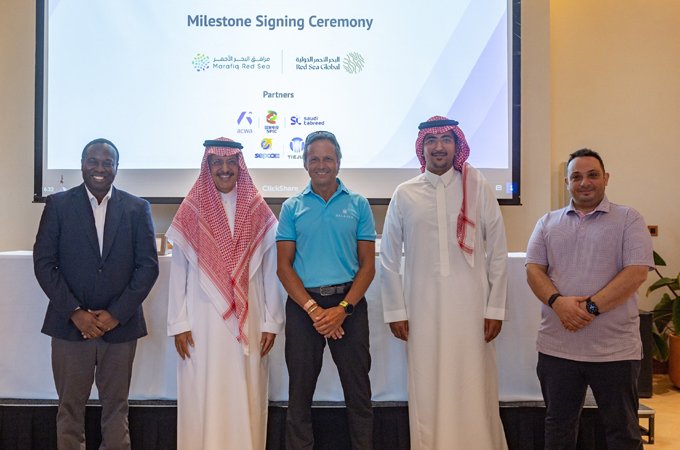
The certificate was
signed by Marafiq Red Sea for Energy Company, formed by Acwa, SPIC Huanghe
Hydropower and Saudi Tabreed, and The Red Sea Utilities Company, a subsidiary
of Red Sea Global.
The consortium
provides renewable power, potable water, wastewater treatment, district cooling
and waste management under a 25-year concession.
The project received
financial close in February 2022, with approximately $1.33 billion in senior
debt facilities and total investment of around $1.84 billion.
Power is generated by
a 340 MWac solar photovoltaic plant paired with a 1,227 MWh battery energy
storage system, described as the world’s largest off-grid battery installation.
The system can supply
the destination overnight and generate up to 760,000 MWh of clean electricity
annually, avoiding about 600,000 tonnes of carbon dioxide emissions each year.
The project also
includes three seawater reverse osmosis plants, a waste management centre and a
sewage treatment plant capable of treating 16,000 cubic metres of wastewater
per day.
District cooling
capacity of 32,500 refrigeration tons serves hotels and the airport.
Environmental
protection was a key requirement throughout development, with utility services
undergoing Environmental and Social Impact Assessments and receiving permits
from Saudi Arabia’s National Center for Environmental Compliance.
Continuous
environmental monitoring will continue during operations.
The construction phase
achieved 30 million safe working hours without a lost-time injury, highlighting
the safety performance of the large-scale project in a remote coastal
environment.
Local content has also
been integrated into construction and operations, with Saudi suppliers
providing equipment, materials and services where specifications allowed. Saudi
engineers and technicians have worked across the solar, storage, desalination
and cooling facilities, while the long-term operation and maintenance workforce
will continue to be developed within the Kingdom.
Mohammad Abunayyan, Founder and Chairman of
Acwa, said: “The Red Sea project embodies the ambition of Saudi Vision 2030 and
the vision of His Royal Highness Prince Mohammed bin Salman bin Abdulaziz Al
Saud, Crown Prince and Prime Minister, to deliver pioneering projects that
redefine modern infrastructure and reinforce the Kingdom’s position as a global
leader. As the world’s largest integrated off-grid utilities system, and the
first of its kind at this scale, the project sets a new global benchmark for
sustainable development.
He added: “By bringing renewable energy,
water, and environmental services together within one integrated platform, the
project demonstrates that infrastructure at this scale can enable economic
growth while protecting natural resources and the environment for future
generations. It also provides a world-leading model for delivering utilities as
one cohesive system, enhancing efficiency, resilience, and long-term
reliability.”
Abunayyan concluded: “This achievement
demonstrates the power of public-private partnership to translate the Kingdom’s
ambitions into reality by combining clear vision with private-sector expertise,
innovation and execution capabilities. Our 25-year concession reflects the
long-term nature of this partnership, with Acwa and its partners developing,
operating and maintaining the utilities that will serve the destination for the
life of the concession. At Acwa, we are proud to have contributed capabilities
developed in Saudi Arabia to a project that demonstrates what the Kingdom can
achieve and provides a model with relevance for future developments at home and
around the world.”
John Pagano, Group CEO at Red Sea Global,
said: “This milestone brings our vision for a new
model of regenerative tourism to life at full scale. By operating without a
connection to the national grid and powering the destination entirely through
renewable energy, we are demonstrating how sustainable infrastructure can
support tourism that gives back to the natural environment and communities on
which it depends.”
The project supports
Saudi Vision 2030 by combining private-sector investment, renewable energy and
sustainable infrastructure.
Its integrated design
brings power, water, cooling, waste management and environmental protection
under a single concession, supporting the long-term development of The Red Sea
destination while maintaining its environmental objectives. -OGN/TradeArabia News Service