
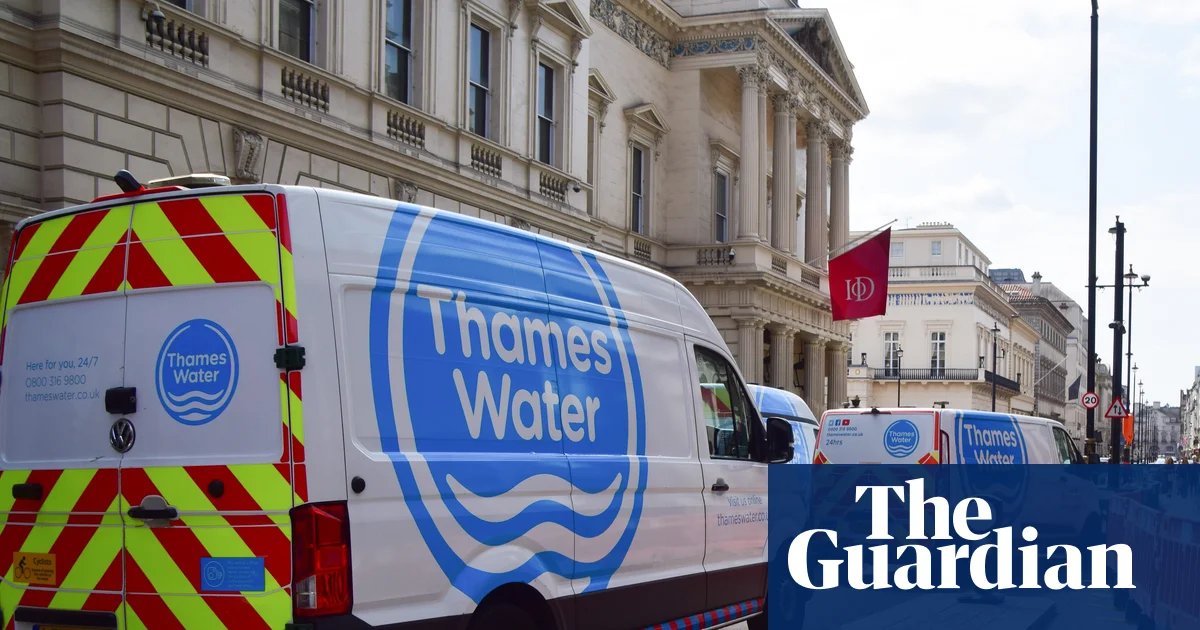
Andy Burnham is considering ripping up the country’s insolvency laws to make it easier to bring key utilities such as Thames Water under public control.
Sources have told the Guardian the prime minister is considering a range of options as he seeks ways of delivering on his promise to radically reshape the way England’s water and Britain’s energy companies are run.
One possibility, according to those briefed on his thinking, is to change the so-called special administration regime (SAR) to make it easier to put companies such as Thames Water into insolvency proceedings, and then take control of them afterwards.
The move could pave the way for what Burnham has promised will be a 10-year project to take public control of utilities, but could trigger a legal challenge from creditors to Thames Water, who have promised to fight any attempt to change insolvency laws.
One person briefed on the plans said: “Andy is completely committed to putting utilities such as energy and water companies into public control, and is looking at every option for how to achieve that. The special administration regime is one potential roadblock and his team is examining how they might have to change it to deliver on their promises.”
A government source said: “Our water industry has not been working for people for far too long. That’s why this government is looking at how we can give the public more control and help keep bills as low as possible.”
Burnham promised in his first speech as prime minister to “build a new economy where we put life’s essentials back under stronger public control to make them affordable to you again”.
In June, he told the Guardian he favoured public ownership for Thames Water, which is struggling with a £20bn debt. Emma Reynolds, the former environment secretary, said earlier this year she was opposed to a planned £10bn bailout by existing creditors because it did not offer value for money.
Burnham was expected to make a speech on the water industry in his first few weeks in power, but was briefed by Downing Street officials on how expensive and legally fraught it could be to take public control of companies such as Thames Water.
Ministers denied reports on Tuesday that Burnham had shelved plans to take Thames into administration, but officials said that they were now taking their time to look at every possible route for doing so – including legislative change.
Matthew Pennycook, the housing minister, said on Tuesday: “We are taking no options off the table when it comes to Thames Water … The water industry has been failing people for too long. We’ve seen rising bills while the number of serious pollution incidents are off the scale. We’ve got to do more.”
While Burnham has been clear on his desire to take Thames into public ownership, officials say there are two big problems with the special administration regime as it stands.
The first is that companies can only be taken into administration if they are insolvent or unable to provide a basic level of service. Owing to continued support from a group of creditors hoping to take ownership of the company, neither of these are the case.
The second is that once a company enters administration, the administrator is under a legal duty to maximise returns to the creditors, meaning that it will be difficult for the government to take ownership without paying a significant price.
The process is likely to be legally difficult because many of the creditors are US-based hedge funds with a history of taking an aggressive legal approach to protecting their investments.
One possible solution is to use the upcoming water bill to change the terms of the special administration regime altogether.
The plan has been put together by a group of Labour backbenchers, including the former environment committee members Helena Dollimore and Andrew Pakes, alongside the Good Growth Foundation thinktank.
They are suggesting amending the water bill to introduce new triggers for special administration, including lower financial ones and new environmental metrics.
They have also suggested a “bail in” mechanism, similar to that imposed on the banks after the financial crisis. This would force shareholders and creditors to be fully exposed to losses first, thus protecting taxpayers, and give ministers the power to impose losses on shareholders and haircuts on creditors. The process would also be run by regulators rather than the courts, to speed it up.
Praful Nargund, the director of the Good Growth Foundation, said: “By putting emergency legislation in place now we can avoid litigation and ensure the special administration regime protects taxpayers, employees and customers from paying the price for shareholder failure.”
Pakes said: “The challenge is stopping Thames driving the cost of a SAR up through legal challenges and making sure the costs are fairly represented. The difficulty of the SAR process highlights the failure of regulation to create the incentive for water companies to act faithfully.”
However, this approach could still bring legal challenges, with the Thames creditors promising to bring a judicial review against any attempt to change the way the special administration process works.
A source close to the creditors said: “Rejecting a fully funded £10bn turnaround plan and using legislation to force Thames Water into special administration and a new unfinanceable ownership model would be unprecedented and have an extremely negative read across to other struggling water companies.
“It will only result in litigation and the transfer of huge costs and risk to customers and taxpayers, while irretrievably damaging investor confidence in UK-regulated sectors,” said the source.