
Even for the rollercoaster world of AI, last week was particularly volatile as investors scrambled to keep up with developments that threatened the dominance of the largest western chipmakers.
It began with a double whammy. On Monday, the Chinese memory chipmaker CXMT floated on the Shanghai stock market, soaring by 466% in value to 3.3tn yuan (£365bn).
That same day, it was reported that China had developed its own tools to carry out deep-ultraviolet lithography, a technique essential to the computer chip supply chain over which the Dutch company ASML had held a monopoly.
AI-linked shares, particularly chipmakers, dropped around the world, sending many indices sliding. South Korea’s main share index, the Kospi, fell 11.5% on Tuesday and a further 6% on Wednesday, dragged down by its two biggest companies – the semiconductor maker SK Hynix and Samsung Electronics.
On Thursday, the main US tech index, the Nasdaq, fell into correction territory at one point after dropping more than 10% from its recent high, before easing back. Nvidia lost more than 5% by Thursday evening, by which time it had been overtaken by Apple as the world’s largest listed company.
The next day there was a big rebound, when strong financial results from Amazon and Microsoft calmed traders’ nerves. The Kospi jumped nearly 20% – although the week’s slump still means it recorded its worst month since the height of the global financial crisis in October 2008.
So, what exactly do these advances mean, and why have they got western investors so jittery?
CXMT’s debut is impressive. But the company is arguably more of a boon to the global AI economy than a threat. It makes dynamic random-access memory (Dram) chips, which store the data that other AI chips draw on for their calculations.
There is a global shortage of Dram chips, which is why phones and computers are expected to get far more expensive. Crucially, they are not graphics processing units (GPUs) – which are the key chips and the “brains” in an AI system.
This means, put simply, that CXMT is not a threat to GPU maker Nvidia, the biggest company in the AI economy and the only one making a profit on AI. They produce complementary, not competing goods.
The Chinese company could be a threat to SK Hynix and Micron, which do make memory chips. However, Alvin Nguyen, an analyst at the research firm Forrester, said the sell-off in these shares was an “overreaction” given that the global memory chip shortage is likely to continue until 2030.
“SK Hynix, Micron, others, they can’t produce enough memory chips to begin with … the demand keeps growing even higher,” Nguyen said.
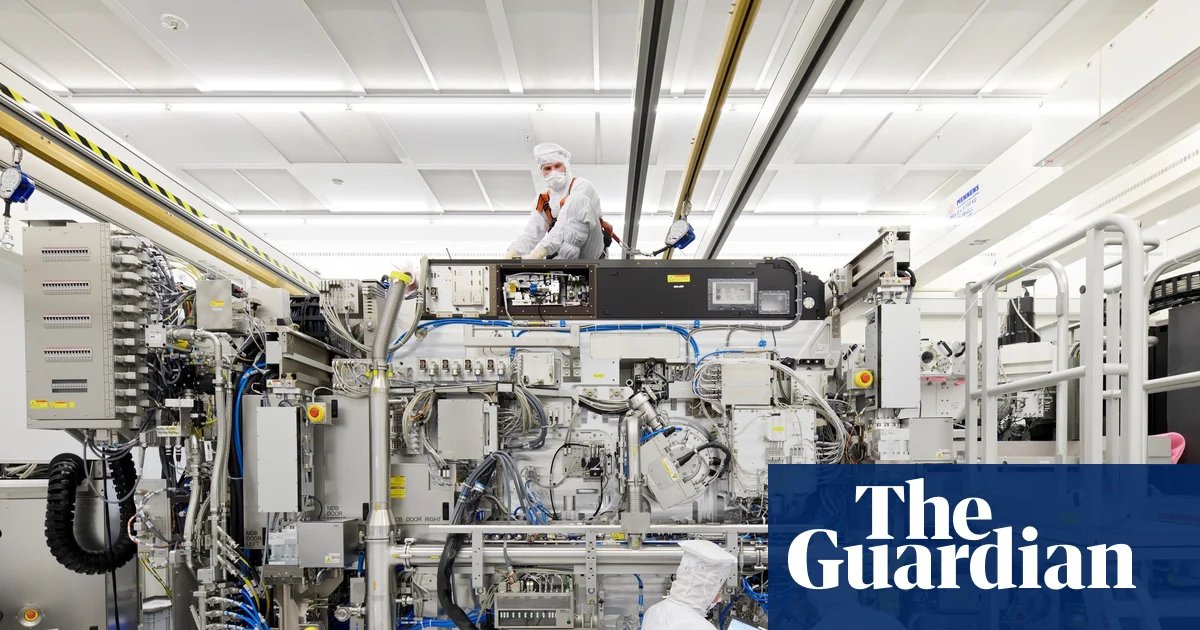
A more serious concern could be the news that China can make the lithography tools. These are essentially extremely precise lasers that allow chipmakers to etch the thinnest lines in the world into wafers of silicon.
Until now, only ASML could manufacture such machines. If this week’s reports are correct, Beijing could – in theory – produce GPUs that rival Nvidia’s. This would spell trouble for the world’s biggest company, and therefore Wall Street. But a serious competitor is still years away.
“Fabs [semiconductor fabrication plants], as I know them, still take years to develop,” said Nguyen.
Mark Boost, the chief executive of the UK cloud company Civo, agreed. “Investors are overreacting to the short-term threat,” he said. “Manufacturing a handful of [deep-ultraviolet] machines is a massive symbolic victory, but not a commercial replacement for ASML overnight.
after newsletter promotion
“Fabs run on efficiency and yield, and until these Chinese tools can match western reliability, ASML’s global dominance remains structurally safe outside mainland China.”
Long term, this week’s advances are gamechanging for the AI economy, although in many ways they should have been predictable. Given US export controls, China has had little choice but to develop domestic capabilities.
Chris Beauchamp, the chief market analyst at IG, an online share trading company, said: “These Chinese chip companies appear poised to do to the big chipmakers what they have done to steel, automobiles and a host of other industries, namely undercut them and outcompete them on price.”
It may be that last week’s correction is an overreaction – but also a reasonable response to a circular and extremely opaque AI economy that rests heavily on the fate of a single company, Nvidia.
Its shares are gradually creeping up again, although they are still below what they were last week. A contributing factor to the investor skittishness appears to be yet another circular, opaque deal.
Last Sunday, the Wall Street Journal reported that Nvidia was considering providing a $250bn (£186bn) backstop to OpenAI for a large datacentre project. This comes roughly half a year after a $100bn deal between the two companies fell apart.
It was a significant factor in Nvidia’s decline over the week, according to Morningstar. The anxiety that underlies this is that the company has become the “central bank of AI” – holding up vast parts of the economy, and the global stock market, in ways that most people, investors included, do not understand.
Many believe that it cannot last. What is on the other side is less clear.
“Nvidia knows the gravy train’s going to run out,” Nguyen said. “Everybody’s waiting for them to fall apart. I don’t know that they will because what they do still has value … at some point in the future, they’ll no longer be one of the most valuable companies in the world. Maybe … they’ll be worth only $2tn. It’s still pretty good.”