
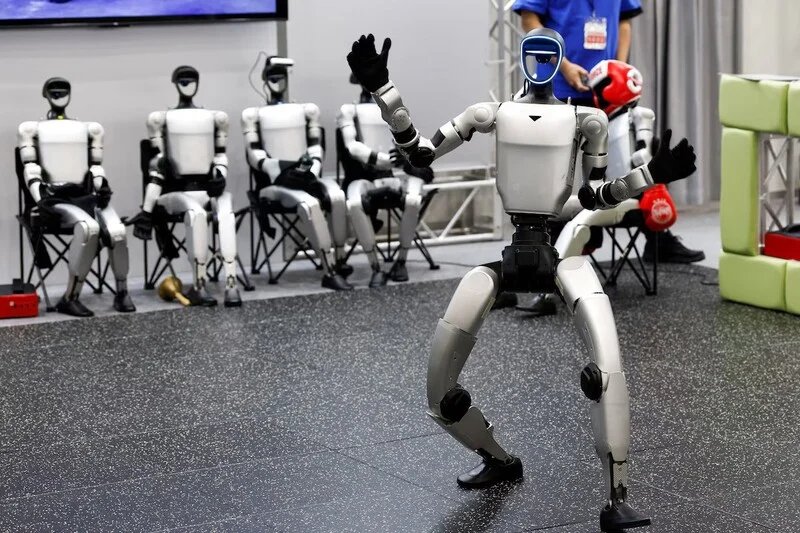
Investing.com — Humanoid robots could create demand for data-centre infrastructure, AI accelerators, memory and edge processors well before widespread commercial deployment begins, according to Barclays analysts mapping more than 100 companies across the emerging value chain.
Investor attention has largely focused on visible hardware such as motors, actuators, sensors and batteries. Yet the biggest near-term constraint is intelligence, as humanoids must perceive their surroundings, reason and adjust their behaviour in unpredictable environments.
The required computing stack has three main layers. Data-centre systems run simulations and generate synthetic training data, foundation models translate perception into actions, and processors inside each robot execute decisions locally under strict latency, power and safety limits.
Simulation is particularly important since developers lack the internet-scale datasets available for training language models. Digital environments can teach robots locomotion, object handling and other skills before real-world deployment, though physical testing remains necessary to cover variables that simulations cannot reproduce accurately.
Demand for compute may scale before robot production as developers train models and create digital twins. This could benefit , , , , , and , among other chip and infrastructure suppliers.
Nvidia already provides an integrated robotics stack spanning Omniverse for digital environments, Isaac Sim for training, GR00T foundation models and Jetson processors for on-robot computing.
The humanoid market is currently estimated at $2 billion to $3 billion. Forecasts range from $10 billion to $25 billion by 2030, with more optimistic projections reaching around $200 billion by 2035.
Still, large-scale economic deployment may be closer to 2035 than 2030, as safety, reliability and autonomy remain unresolved.
Hardware will become more important as production expands. Actuators account for an estimated 30% to 50% of a humanoid’s component cost, compared with 10% to 15% for onboard compute, but low robot volumes currently limit standardisation and supplier investment.