
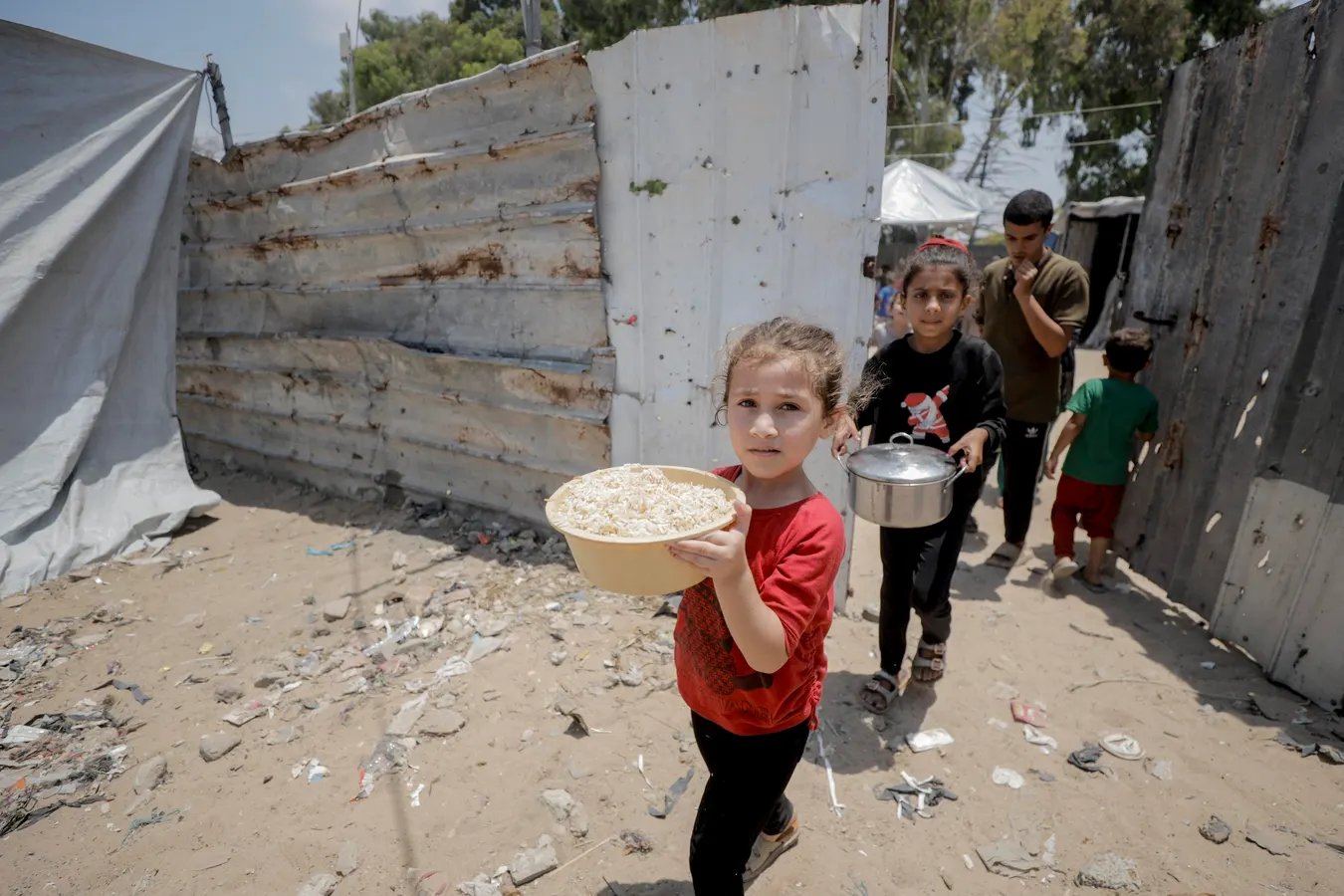

Palestinians carry pots and containers of food during an aid distribution in Gaza City, Gaza Strip, on July 5, 2026. Displaced families across the Gaza Strip continue to depend on aid distributions amid shortages of food and other essentials. Photo by Ahmed Al Arini
Middle East Images/AFP via Getty Images
When Sami Jamal Al-Shannat raised more than £55,000 through a GoFundMe campaign to help his family escape the war in Gaza, it felt as though the hard part was over.
GoFundMe deducted 3.9% in fees, totaling £2,176.02, but does not support payouts in Gaza. The remaining funds had to be paid to a nominated beneficiary living in a supported country, who was then expected to pass the money on.
The arrangement met the platform’s payout requirements, but it left the final transfer dependent on trust between individuals. Sami says that arrangement with his brother-in-law, who acted as the beneficiary, later collapsed. He has not received the full amount raised for his family and the dispute remains unresolved. He describes it as more than a financial dispute, saying the loss has left his wife and children in a state of extreme vulnerability.
“The problem wasn’t raising the money,” he told me from a displacement camp in Gaza. “The problem started when we had to rely on someone else to receive it for us.”
Sami says his priority is to recover the funds and hold those responsible accountable. He is trying to find a lawyer but says he lacks the money and connections needed to secure legal support from Gaza. He also hopes to continue raising support for his family as wartime inflation drives up the cost of food and other essentials.
GoFundMe did not respond to multiple requests for comment sent to its corporate press and media channels. Direct inquiries sent to Chief Executive Tim Cadogan and Chief Corporate Affairs Officer Margaret Richardson via LinkedIn were similarly unanswered before publication, while the platform’s automated customer support channels did not provide a way to reach its media relations team.
The Compliance Trap
His experience exposes a problem in humanitarian crowdfunding. Platforms must operate within banking rules, sanctions regimes and anti-money laundering requirements that limit where they can send funds.
GoFundMe officially attributes these operational barriers to compliance pressures, stating in its public policies that it must comply with international laws and the strict requirements of its payment processors.
When people in crisis cannot receive money directly, it may have to pass through an intermediary, moving responsibility onto individuals and potentially leaving intended recipients without the support raised for them.
This compliance bottleneck can also paralyze global human rights groups. Lyudmyla Kozlovska, President of the Open Dialogue Foundation, says her organisation experienced this when platforms like PayPal, GoFundMe and Wise blocked their fundraising appeals for Ukraine during the critical first months of the 2022 Russian invasion. Using bitcoin, the foundation was able to bypass these traditional delays and deliver emergency humanitarian aid on the second day of the war.
Charities, aid organisations and technology companies have wrestled with the problem of reaching people who cannot access the financial system for years. A growing number of developers argue that the existing model relies on too many intermediaries, particularly when funds must cross borders or reach people in restricted jurisdictions.
Redesigning the Architecture of Trust
Michele Morucci, co-founder of Geyser, a crowdfunding platform built on bitcoin said trust sits at the heart of the problem.
“People think the biggest challenge is moving money,” he told me. “It isn’t. The biggest challenge is deciding who to trust.”
Donors rarely know the people they are supporting. They rely on platforms, charities, journalists and community leaders to help them judge whether a campaign is genuine. Removing one intermediary only creates value if something equally trustworthy replaces it.
Geyser reviews projects before they launch and asks creators to provide evidence of their work, details of their teams and, where necessary, additional documentation. Projects that fail to demonstrate sufficient credibility are not approved.
More than 100 Geyser Field Partners help identify and support projects in communities they know firsthand, creating what Michele describes as a trust chain between local communities and global donors. The aim is to make trust more transparent and easier to evaluate.
Michele said those community partners have already helped direct 12 million satoshis, worth approximately £5,600 at the time of publication, to projects in their own communities. That is equivalent to 0.12 bitcoin, since 100 million satoshis make up one bitcoin. He acknowledged that the model is still new and the available data remains limited.
A Problem Bigger Than One Fundraiser
The weakness Sami’s case exposes is not unique. Crowdfunding platforms can raise money for families facing war, disaster or repression within hours but getting it safely to the intended recipient can be far more complicated.
GoFundMe is not alone in restricting where funds can be paid. Major crowdfunding platforms depend on banks and payment providers and must comply with jurisdiction specific sanctions, identity checks and anti-money laundering rules.
Where direct payouts are not supported, organizers may have to nominate a beneficiary in another jurisdiction to receive the funds on their behalf. That system may satisfy the platform’s legal and banking requirements, but it also shifts responsibility onto the person trusted to receive and pass on the money.
Once the funds reach the nominated beneficiary, the platform may have completed its role, even though the money has not reached the person the campaign was created to help. If the relationship later breaks down, the intended recipient may have limited recourse through the platform.
Campaign records and communications shared and reviewed document multiple attempted transfers, reconciliations and exchanges with GoFundMe support over several months. Bitcoin based crowdfunding projects are experimenting with different ways to handle the same trust and payment challenges.
Moving Trust to the Verifier
Agora approaches that same trust problem differently. The platform allows funds to move directly between donors and recipients, while verification comes from organizations and individuals with first hand knowledge of the campaign.
Mary Kate, co-founder of Soapbox, the team behind Agora explained that donors may not know the person asking for help, but they may recognize and trust the organization that has verified them.
“It allows us to move your trust from the campaign to the verifier,” Mary Kate said. “You might not know the person asking for help, but you may know and trust the organisation that verified them.”
The model leaves the final decision with the donor. A campaign can remain visible even if no verifier supports it, while trusted organizations can add context and credibility without becoming the sole gatekeeper.
“You can still create a campaign even if you don’t have anyone to verify you,” Mary Kate said. “The verifiers add that extra trust level where it is really needed.”
Agora also removes the crowdfunding platform from the payment flow. Donations are sent directly to a wallet controlled by the recipient, which reduces the risk of funds being held by a platform or passed through another person before reaching the family.
Bitcoin allows funds to move across borders without a platform holding them or a beneficiary passing them on. Risks around wallet security, access and exchange rates remain.
For Mary Kate, that control has significance beyond the movement of money.
“We can’t take your account from you. We can’t shut down your campaign. We can’t take your money,” she said. “For people dealing with trauma and a lack of control over their lives, that can be a huge moment of empowerment.”
Direct payments do not solve every problem. Campaigns still need to be checked, donors still need enough information to make informed decisions, and recipients may still misuse funds. Agora is trying to make those risks easier to see while giving recipients greater control over the money raised in their name.
The Unintended Consequences of Financial Sanctions
Sami’s experience is not unique because the underlying problem is not unique. Around the world, activists, journalists and humanitarian organizations are finding it increasingly difficult to move legitimate funds across borders as financial regulation becomes more complex and sanctions affect entire jurisdictions rather than the governments they were designed to target.
Femi Longe, Global Freedom Tech Strategy Lead at the Human Rights Foundation, believes those restrictions often create unintended consequences for the very people humanitarian funding is supposed to help.
“Traditional crowdfunding platforms are regulated and because they move money across borders they have to comply with anti-money laundering rules and sanctions,” he explained. “The problem is that those rules often end up affecting legitimate opposition groups, legitimate non-profits and ordinary people, rather than only the governments they were intended to target.”
Femi describes organizations working lawfully in sanctioned countries that still struggle to receive donations. Visible financial links can expose supporters or their relatives back home to retaliation.
“There are lots of legitimate reasons why someone may want anonymity in their financial flows and in their donations,” he said. “The current system for fundraising doesn’t properly cater for that.”
Lyudmyla warns that this issue extends beyond administrative friction to active “transnational financial repression,” where regimes weaponize global AML/CFT rules to strip dissidents of banking access, even in Western countries.
She referenced a landmark July 2026 resolution by the OSCE Parliamentary Assembly that recognised transnational financial repression as a systemic threat and called for greater protection of donor privacy and privacy preserving digital tools. Lyudmyla told me that bitcoin payment tools are becoming a necessary lifeline for targeted donors and activists.
Political opposition groups, independent journalists and civil society organizations often rely on international donations to continue operating. When those donations become harder to send, or easier to monitor, financial infrastructure can become another form of pressure.
That does not mean regulation should disappear. Public fundraising depends on accountability, transparency and safeguards that protect donors from fraud. Those interviewed recognized that challenge and accepted there is no perfect solution.
Femi believes the goal should be to remove unnecessary intermediaries without removing accountability.
“If they make it so the people running the campaign can directly control the wallets the funds are going into, then I think that’s an improvement on what we have currently,” he said, adding that verification and oversight remain essential parts of any system handling public donations.
The case highlights a fundamental weakness in the architecture of humanitarian finance. Systems built around banks, payment processors and jurisdictional boundaries can struggle to move money to people living through war, political repression or humanitarian crises. None of the people I spoke to suggested technology alone could solve humanitarian fundraising.
Sending money directly to a recipient removes one layer of risk. It does not guarantee that the campaign is genuine, that the organizer is acting honestly or that donations will ultimately be used for the purpose described.
“I don’t believe bitcoin solves everything,” Femi said. “There still needs to be a system that verifies the person setting up the campaign. There still needs to be accountability around how funds are used. Those challenges don’t disappear because the payment becomes direct.”
Michele makes a similar point. Geyser reviews campaigns before they go live, encourages creators to provide evidence and relies on trusted members of the community to build reputation over time. Agora also places verification at the center of its model, allowing recognized organizations and individuals to publicly verify campaigns without becoming custodians of the money.
They don’t claim to have eliminated trust, but each is trying to redesign where trust sits.
Bitcoin as the Base Protocol
The next generation of humanitarian crowdfunding represents more than a temporary patch for a broken legacy model because it is a system transition. Open payment networks can give recipients direct control of the money raised in their names, while decentralized trust networks help donors decide whom to support.
While judgment, verification, and accountability remain essential, this open architecture is bypassing the legacy financial constraints and regulatory barriers that prevent traditional platforms from reaching those in the greatest need.