

By all accounts, the stock should be up. Deliveries and production of its electric vehicles (EVs) were both up sequentially and year over year, handily topping analysts’ expectations.
Yet Tesla (TSLA 7.35%) shares tumbled on Thursday after its report showed it delivered 480,126 EVs during the three months ending in June while also manufacturing 451,758 automobiles. Most analysts were only looking for deliveries of a little over 400,000.
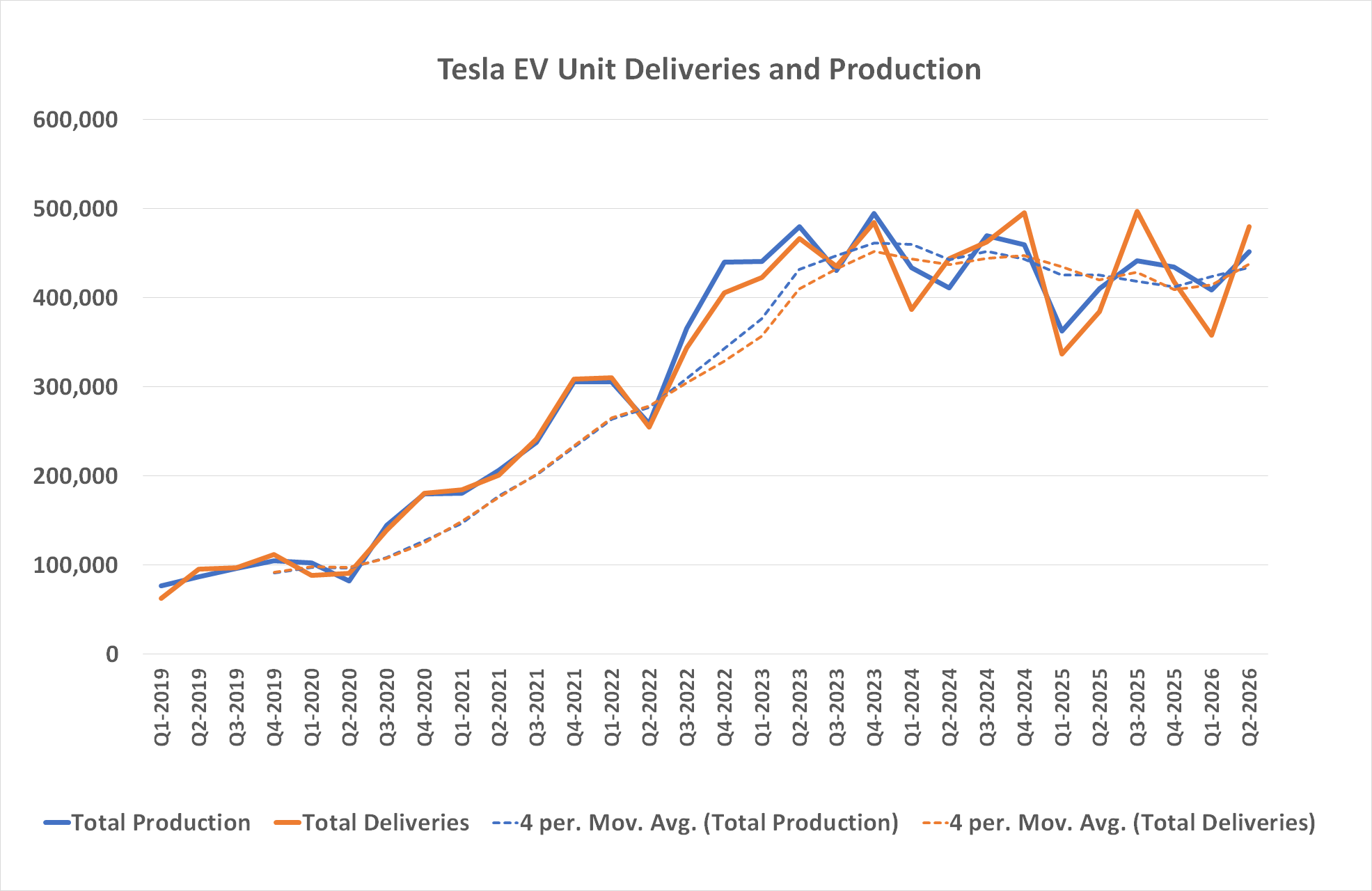
Data source: Tesla. Chart by author.
Importantly, strong deliveries cleared out Q1’s concerning inventory buildup. The strong numbers confirm that the company can not only consistently make automobiles in large numbers but also that its brand still enjoys a certain marketability cache. It just wasn’t enough to satisfy investors.
But there’s more to the story.
Several stumbling blocks, all of which may have tripped the stock up
There are a handful of theories about this stock’s setback. And all of them are reasonable. All of them may have contributed to the sell-off, too.
The prevailing explanation is that American automakers Ford Motor Company and General Motors both suffered severe drop-offs in their U.S. electric vehicle businesses in Q2, which has obvious bearish implications for Tesla as well.

Image source: Getty Images.
It’s not necessarily doing as well as it seemingly should be overseas, either. Although the company doesn’t divulge regional unit data, the China Passenger Car Association reports that over half of Tesla’s Q2 deliveries were made in China, where Tesla is doing well but not as well as its top EV rival BYD (BYDDY +3.68%). BYD delivered nearly 400,000 new-energy vehicles within China in June alone, versus only 89,091 Tesla-made EVs. Moreover, after a catastrophic drop in BYD’s global deliveries in Q1 — to levels below Tesla’s — the Chinese company bounced back last quarter, delivering a Tesla-beating 557,090 units worldwide.
Then there’s the simple possibility that this is nothing more than a “buy the rumor, sell the news” event, where good news is already priced into a stock. Once the news is reported, there’s nothing else new to price in. The next move from that ticker’s recent buyers is an exit. To this end, Tesla shares had rallied 12% in just the three days leading up to Thursday’s report, setting the stage for profit-taking.

Today’s Change
(-7.35%) $-31.26
Current Price
$394.04
Key Data Points
Market Cap
$1.5T
Day’s Range
$389.31 – $432.35
52wk Range
$288.77 – $498.83
Volume
3.8M
Avg Vol
55.5M
Gross Margin
19.07%
Or, maybe investors were simply trying to clean up their portfolios before U.S. exchanges closed for a three-day holiday weekend.
Don’t overthink it
Regardless of the reason, Thursday’s sizable sell-off doesn’t necessarily mean much and certainly doesn’t change the stock’s overarching investment thesis. Tesla has always been a volatile ticker, pushed and pulled by an ever-changing global EV market, energy storage market, and soon, the AI robot market. You own this name for the long haul because it’s a leading brand and has the greatest potential to capitalize on these industries’ ongoing growth. That’s also why you pay a premium for it.
To this end, all the post-report noise and chatter aside, Tesla’s second-quarter delivery and production numbers are precisely the sort of progress and resiliency the bulls want to see … at least on the EV front.