
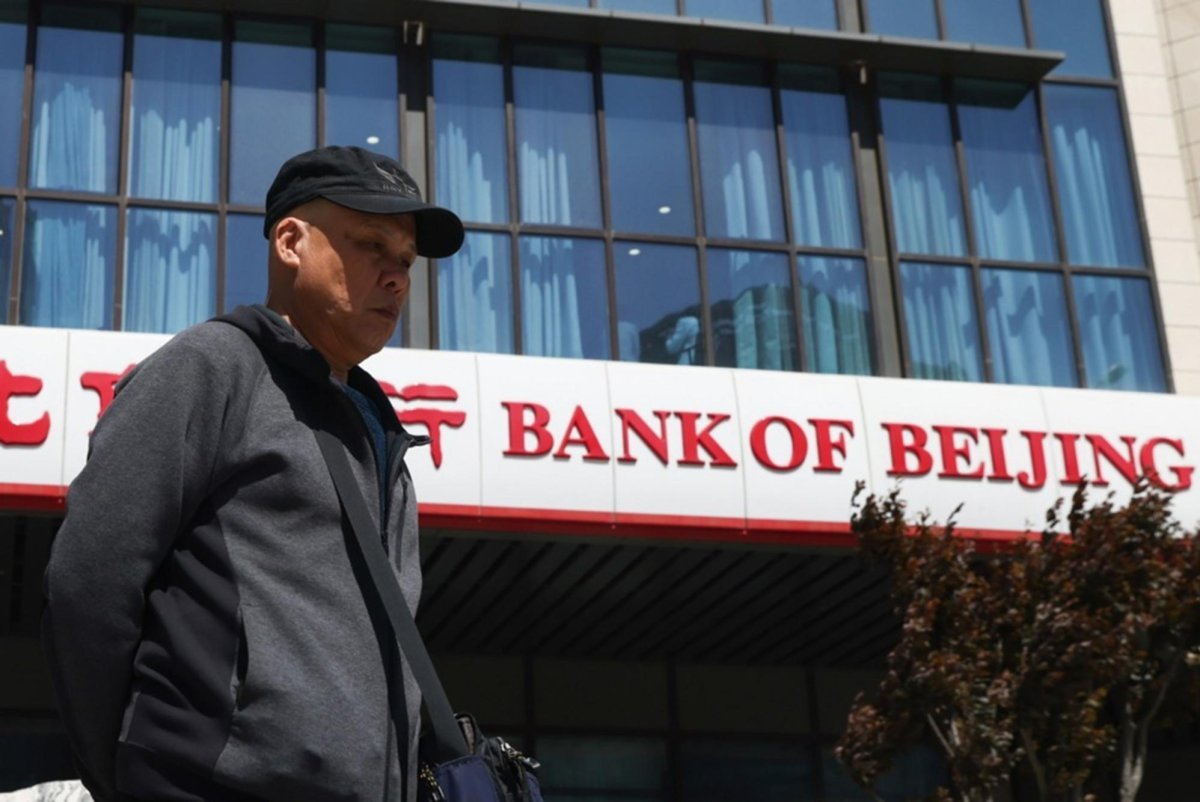
An elderly man walks past a bank branch in Beijing’s Central Business District (CBD) in Beijing, China, 20 April 2026. Photo by WU HAO / EPA
June 29 (Asia Today) — China’s combined government, corporate and household debt has risen above 300% of gross domestic product, while the prolonged property downturn and increasing household defaults are raising concerns about financial stress in the world’s second-largest economy.
China’s macro leverage ratio, a measure of total debt relative to economic output, increased 11.8 percentage points to 302.3% in 2025, according to a report by a research institute affiliated with the Chinese Academy of Social Sciences.
The country’s heavy dependence on borrowing has become particularly visible in its property sector, where developers accumulated large liabilities during years of rapid construction and rising home prices.
China Evergrande Group reported total liabilities of 2.58 trillion yuan, about $382 billion, at the end of 2021. The figure was comparable to the annual economic output of some midsize countries.
Country Garden Holdings and China Vanke also accumulated hundreds of billions of yuan in liabilities as housing sales weakened and property prices fell.
Those figures represent liabilities carried by the companies rather than personal debts owed by their founders. Evergrande was founded by Hui Ka Yan, Country Garden by Yang Guoqiang and Vanke by Wang Shi.
The scale of the liabilities illustrates how deeply China’s property industry relied on debt before regulators began restricting excessive borrowing by developers.
The property downturn has since reduced home sales, weakened household wealth and strained companies that depended on advance payments from buyers to finance construction.
Debt problems have also spread among consumers.
An analysis of financial reports from 26 banks and other data sources estimated that China’s nonperforming household debt rose 21% in 2025 to at least 2.2 trillion yuan, or about $325 billion.
The estimate covered overdue credit card balances, consumer loans and mortgages. As many as 10.6% of China’s approximately 1.1 billion adults may have been behind on debt payments at the end of 2025, according to the analysis.
Borrowers who fall behind on payments are not automatically placed on China’s court blacklist.
People commonly called laolai, or judgment defaulters, are generally those found capable of complying with a court ruling but who refuse to fulfill their obligations or attempt to evade enforcement.
Listed defaulters can face restrictions on air travel, some high-speed train services, luxury purchases, financing and other forms of high spending.
Nearly 2.46 million defaulters were added to the court blacklist in 2024, while more than 2.82 million people and businesses regained normal credit status through a court-administered repair system.
China’s debt pressures are unfolding as the country struggles with a prolonged property slump, weak domestic demand, youth unemployment and tight cash flow among smaller companies and private businesses.
Low-cost meal combinations promoted online as “poor people’s sets” have also become more common, reflecting efforts by consumers to reduce daily expenses.
Households facing lower income or falling property values may rely more heavily on consumer credit, while financially distressed businesses often take on additional loans to remain in operation.
That dynamic risks creating a cycle in which new borrowing is used to repay existing obligations rather than support investment or consumption.
High debt does not necessarily mean China faces an immediate financial collapse. Much of the borrowing is denominated in yuan and held within the domestic financial system.
However, sustained increases in debt could limit household spending, weaken business investment and reduce the government’s ability to respond to future economic shocks.
— Reported by Asia Today; translated by UPI
© Asia Today. Unauthorized reproduction or redistribution prohibited.
Original Korean report: https://www.asiatoday.co.kr/kn/view.php?key=20260629010010061