
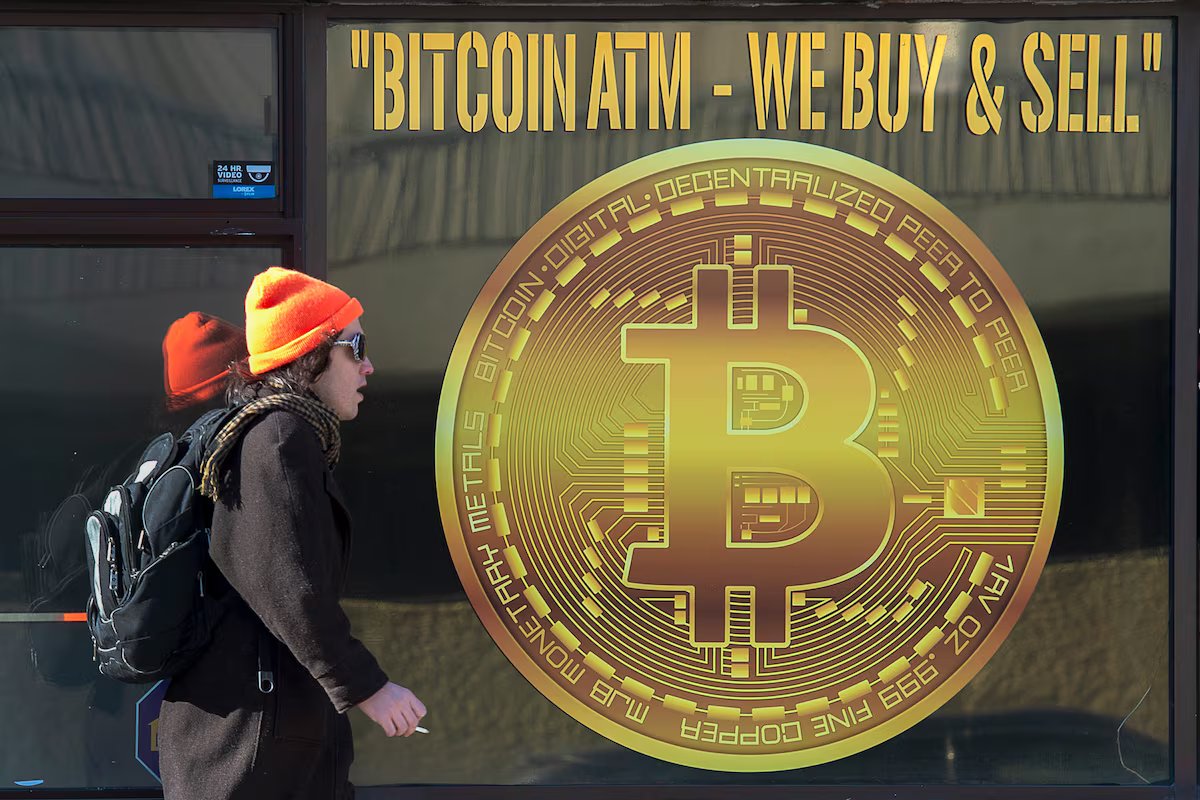
A sign advertises a Bitcoin ATM at a shop in Halifax.Andrew Vaughan/The Canadian Press
Gold has reached record highs this year while bitcoin has fallen back toward its 2024 levels. But do their trading prices really represent their value? The answer to this question depends on the definition of value. From a financial perspective, an asset can have either a fundamental value or a speculative value.
First, we need to differentiate between the two valuations. The fundamental value of an asset is the present value of all its future cash flows. In simple terms, if you take all the cash flows that you will receive from the asset in the future and convert them into today’s dollars, that would be its fundamental value.
A bond would be the simplest example of this. If you bought a five-year Government of Canada savings bond with a face value of $1,000 that pays 3 per cent interest per year, then the cash flows are simple to predict. You will receive a cash flow of $30 per year in interest and then the principal of $1,000 in five years. If you add these cash flows and convert them into today’s dollars, that would give you the fundamental value of the bond. (Converting the cash flows to current dollars can be done with any financial calculator.) If the market price of the bond is different than the fundamental value calculated, then you can say the bond is undervalued or overvalued.
The cash flows of a bond are significantly easier to predict than those of a stock because interest and principal are fixed and stated in the terms. While the valuation concept is the same for stocks because their fundamental value is based on the future income of the company, stock valuations vary because of the subjective nature of predicting future income. Two analysts with different views on a company will calculate different fundamental values for the stock because of their personal inherent optimism or pessimism built into their projections.
Using this methodology, what would be the fundamental value of gold and bitcoin? The financial answer is $0 because there are no projected cash flows from either asset. Neither pays interest nor generates income like a company. That does not imply that they have no value but rather that a fundamental value cannot be calculated for either asset. Accordingly, you cannot determine whether they are undervalued or not. This is one reason why Warren Buffett has never bought gold or bitcoin. His firm was built on the concept of purchasing undervalued investments and these two investments cannot be fundamentally valued.
Opinion: From nothing bitcoin came, and to nothing it will return
Then what is the value that we hear quoted in the markets? This would be considered the speculative value of the asset because it is based on supply and demand. For commodities such as oil, the demand is based primarily on usage but for gold and bitcoin, the demand is generated by other factors. Gold does have some usage demand, such as in the production of jewellery, but that is not the driving factor. Gold has been used as a store of value for the past 5,000 years, but bitcoin only emerged less than two decades ago. However, they share some similarities. Investors use them as a safe haven during uncertain times. Speculative investors also purchase them with the expectation that future demand will increase and hence cause the price to go up.
The supply of both gold and bitcoin is finite, and additional units must be mined, either physically or digitally. Accordingly, if supply is limited, then the expectation of a potentially higher future demand could increase the speculative value of these assets.
Should you invest in gold or bitcoin? The answer to this question depends on the type of investor you are and your strategy. If you are an investor who has the goal of investing in undervalued assets, gold and bitcoin would not be for you. Since a fundamental value for either asset cannot be determined, you can never conclude whether they are undervalued or overvalued.
But if you are a speculative investor, and you are optimistic about the increase in demand for either, then they may be an option. The only dangerous scenario is when a speculative investor buys them under the mistaken belief that they are trading below their fundamental value. Gold and bitcoin can play a role in a portfolio, but only for investors who recognize that their prices reflect speculation, not fundamental value.
Anwar Husain is an award-winning finance professor at the University of Toronto and a senior investment adviser and wealth adviser with Richardson Wealth. He is also a published author in several peer-reviewed academic journals in the areas of finance and economics. He can be reached at Anwar.Husain@RichardsonWealth.com