

On June 5, Bitcoin printed $59,100, its lowest level of 2026, and in a single 24-hour window 351,233 traders were liquidated as $1.75 billion in positions vanished.
BTC fell to its 200-week moving average, a line it had not touched since the 2022 bear market.
The spark was almost insultingly small. Strategy, the firm Michael Saylor chairs, disclosed in a June 1 filing that it sold 32 BTC for roughly $2.5 million to fund the dividend on its STRC preferred stock. Out of a stack north of 843,000 coins, that’s a landlord cracking open a piggy bank to cover one month’s electric bill.
The market didn’t price the math. It priced the symbolism.
Why 32 Coins Broke a Narrative Worth Billions
IBTimes US
For years, Saylor’s entire gravitational pull rested on one vow: never sell.
This was Strategy’s first disclosed net bitcoin reduction, and it cracked the never-sell image overnight, handing nervous retail a reason to bolt.
A stronger-than-expected May jobs report on Friday lifted Treasury yields and piled on, leaving Strategy stock down 24% on the week, its worst since November 2022.
Saylor Stopped Hinting. He Bought.
Then came the turn the panic didn’t see coming. Between June 1 and June 7, Strategy bought 1,550 BTC for about $101.3 million at an average of $65,332, disclosed in a June 8 filing. The company now holds 845,256 coins at an average cost near $75,680, roughly 4% of all the bitcoin that will ever exist.
He’s framing the bleed as opportunity, not obituary:
“[We’re] framing the roughly $4 billion in Bitcoin ETF outflows as capital rotating into AI, not a failure of the thesis.” – Michael Saylor
Read it however you like. The man who lit the fuse just spent nine figures buying the wreckage. There’s even a punchline: rival treasury firm Strive bought 32 BTC, the exact number Strategy had dumped.
Can Bitcoin Hold the Line That Called Every Bottom?
The technicals are stretched to extremes. More than half of all BTC sits at an unrealized loss, and the daily RSI fell to a rare 17 to 18, the kind of oversold reading that tends to precede sharp bounces.
The 200-week moving average near $60,000 lines up almost exactly with the production cost for the most efficient miners, a floor that has marked deep-bear bottoms before.
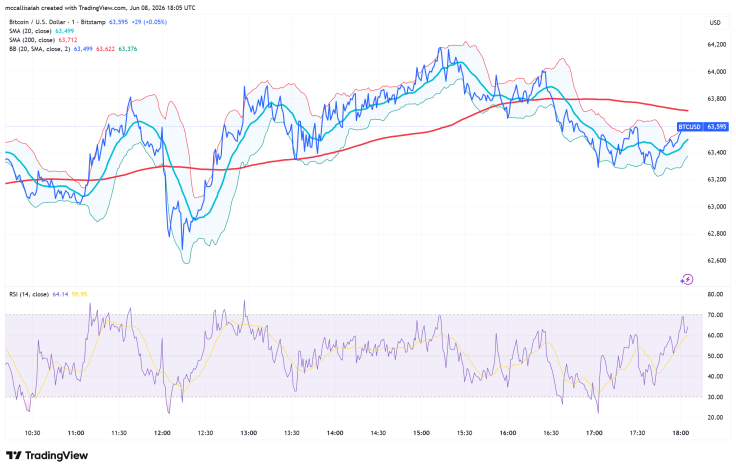
BTC has since clawed back above $63,000. Hold $59,100 and this reads like the fifth textbook 200-week buy zone. Lose it and $58,000 opens, with $50,000 in view.
So the real question: is Saylor buying the bottom, or defending a story he can’t afford to let break?