
Investing.com– Global markets turned risk-off on Friday as a sharp selloff in South Korean equities dragged technology stocks lower across regions, while oil prices climbed on renewed concerns over disruptions in the Strait of Hormuz.
“Markets have lost momentum after President Trump said the US doesn’t need the Strait of Hormuz open ‘at all’,” Deutsche Bank strategists said in a morning note.
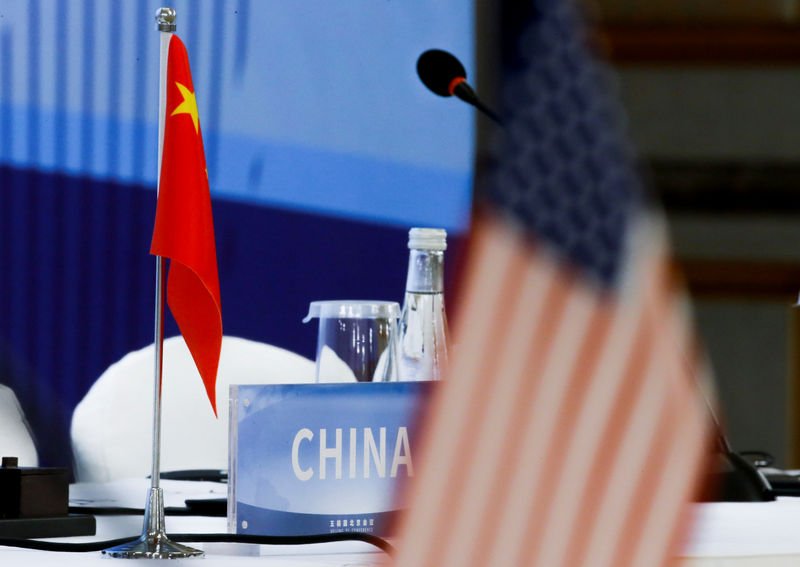
Bond yields also moved higher globally amid rising inflation concerns and weak Treasury demand, while investors assessed the outcome of President Donald Trump’s summit with Chinese President Xi Jinping in Beijing.
Looking at the day ahead, investors will focus on U.S. industrial production data for April and the Empire State manufacturing survey for May.
1. tumbles, chip stocks slide
Asian equities retreated sharply, led by South Korea, where the KOSPI fell 6.1% after briefly topping the 8,000 level earlier in the session. The decline spilled over into global semiconductor names as investors took profits in some of the market’s strongest performers.
dropped 8.6%, while lost 7.7%. In the U.S., memory-chip maker fell 2.2% in premarket trading.
Mainland Chinese stocks held up better than regional peers despite the broader weakness across Asia.
2. Global equities under pressure
U.S. equity futures moved lower following the Asian selloff, with contracts tied to the S&P 500 down 0.8% and futures off about 1.1%. European markets also weakened, with Germany’s falling 1.2%, while the and France’s both declined roughly 1%.
Investor enthusiasm appeared to fade after a strong rally in recent weeks, while geopolitical uncertainty and rising bond yields added further pressure on equities. In the U.K., political developments were also in focus after Prime Minister Keir Starmer faced renewed internal pressure following a parliamentary vacancy that could allow Greater Manchester Mayor Andy Burnham to enter Parliament.
3. Oil heads for weekly gain
Oil prices rose around 3% on Friday and remained on track for strong weekly gains as the Strait of Hormuz effectively stayed closed and efforts to end the conflict remained stalled. future prices were up about 2.9% to $108.75, while futures jumped 3.2% to $104.42.
The latest move higher came after Trump said he was “losing patience” with Iran, fueling fears of a prolonged disruption to energy flows through the Gulf. Markets remain highly sensitive to developments around Hormuz, which handles a significant share of global crude exports.
“Notwithstanding the current prognosis of horrifically low oil inventories, it appears that the focus is progressively shifting towards demand destruction, hence the reluctance to revisit the March or April summits. Of course, such a jump cannot be ruled out in the event of an escalation,” Tamas Varga, analyst at PVM Oil Associates, said.
4. Trump-Xi summit offers limited clarity
Trump departed Beijing aboard Air Force One after holding lengthy talks with Xi that lasted more than two hours on Thursday. While the summit produced few concrete policy announcements, investors drew some encouragement from the warmer tone between the two leaders.
“We didn’t think any of the headlines from Trump’s trip were narrative-shifting at all,” Vital Knowledge analyst Adam Crisafulli wrote.
Trump said both countries wanted the conflict with Iran to end and reiterated that Iran should not obtain nuclear weapons. He also claimed the two sides had reached “fantastic trade deals,” though no details were provided. Chinese officials said the meeting resulted in “a series of new common understandings.”
Markets also took some comfort from comments suggesting trade tensions could ease further. Trump said U.S.-China relations would be “better than ever,” while Chinese state media reported Xi told American executives that China’s “doors to the outside world will open wider and wider.”
5. Bond yields climb globally
Government bonds sold off across major markets, pushing yields higher as investors reassessed inflation risks and central bank expectations. Deutsche Bank strategists noted that “the U.S. rates mood also wasn’t helped by lukewarm demand for the latest auctions as the Treasury increased auction sizes for the past couple of weeks.”
The climbed above 4.05%, while the approached 4.52%. In Japan, the surged to its highest level since 1996 after stronger-than-expected producer prices reinforced expectations that the Bank of Japan could continue tightening policy. European bond futures also fell.