

Several members of the Bitcoin community cast doubt on the US government’s understanding of the Bitcoin network after a high-ranking military official told the Senate Armed Services Committee on Tuesday that the US government runs a Bitcoin node.
“Our research into Bitcoin is as a computer science tool. It’s the combination of cryptography, a blockchain, and a proof of work,” US Navy Admiral Samuel Paparo told the Senate Armed Services Committee.
Bitcoin educator and advocate Matthew Kratter said that it sounded like the admiral was reading from the Bitcoin “Wikipedia page,” casting doubt on Paparo and US Senator Tommy Tuberville’s knowledge of the protocol. Kratter added:
“This is actually pretty embarrassing. These two guys are talking about something they don’t understand. And when he says that, it’s a way of ‘projecting power,’ or that it’s a ‘computer science tool,’ he never really talks about what he means.”
“All I could think is they’re saying absolutely nothing,” Kratter continued. Lola Leetz, a journalist at The Rage, said that Paparo’s Senate testimony was “babbling.”
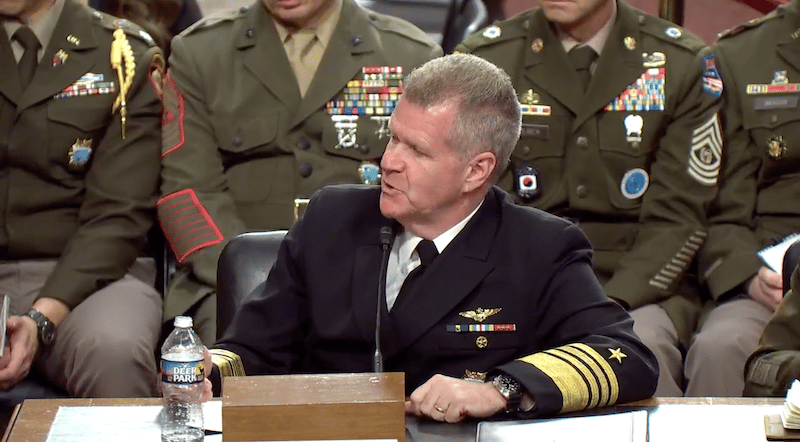
Samuel Paparo testifies before the US Senate Armed Services Committee. Source: US Senate Armed Services Committee
The testimony followed the Iranian government’s announcement that it would accept Bitcoin for shipping tolls through the Strait of Hormuz, a critical oil shipping waterway through which about 20% of the global oil supply passes, strengthening BTC’s case as a strategic asset.
Related: Bitcoin and the US dollar have symbiotic relationship: BPI exec
Current geopolitical tensions highlight the role of Bitcoin as a strategic asset
Iran’s government is accepting oil tolls in Chinese Yuan, US dollar-pegged stablecoins and Bitcoin, but prefers dollar-pegged stablecoins, Sam Lyman, head of research at digital asset advocacy organization Bitcoin Policy Institute (BPI), told Cointelegraph.
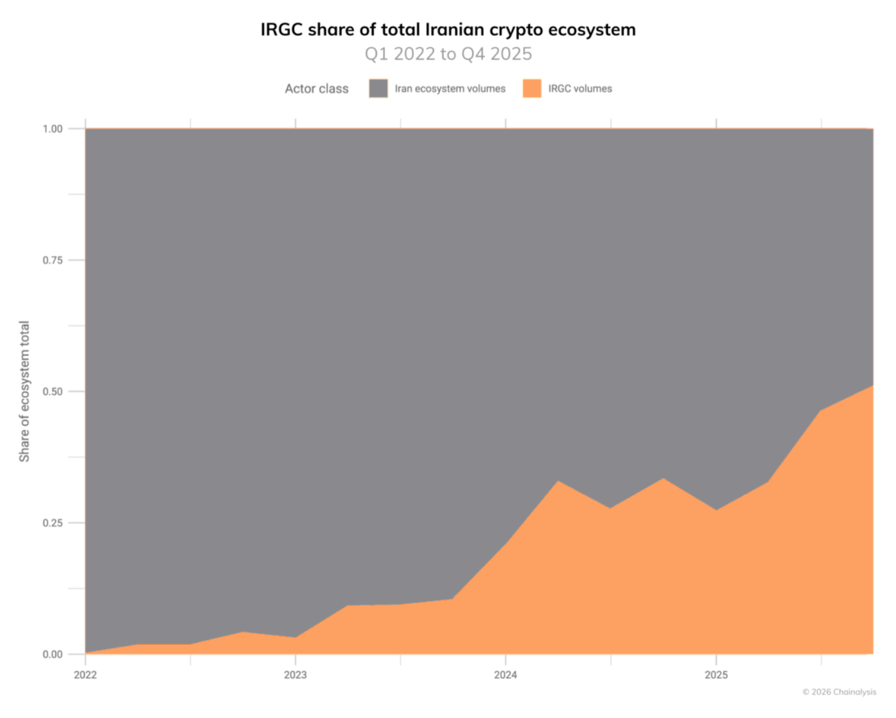
Transactions carried out by the Iranian Revolutionary Guard Corps account for nearly half of the total crypto market volume in Iran. Source: BPI
However, stablecoins can still be frozen at the smart-contract level by the issuer, Lyman said, whereas Bitcoin cannot be frozen because there is no central issuer.
“This is one of the most significant situations where Bitcoin is very clearly a strategic asset,” he told Cointelegraph, adding, “The reason why Iran wants to use Bitcoin for these transactions is that no one can freeze Bitcoin. No one can shut down the Bitcoin network.”
Magazine: Is China hoarding gold so yuan becomes global reserve instead of USD?