
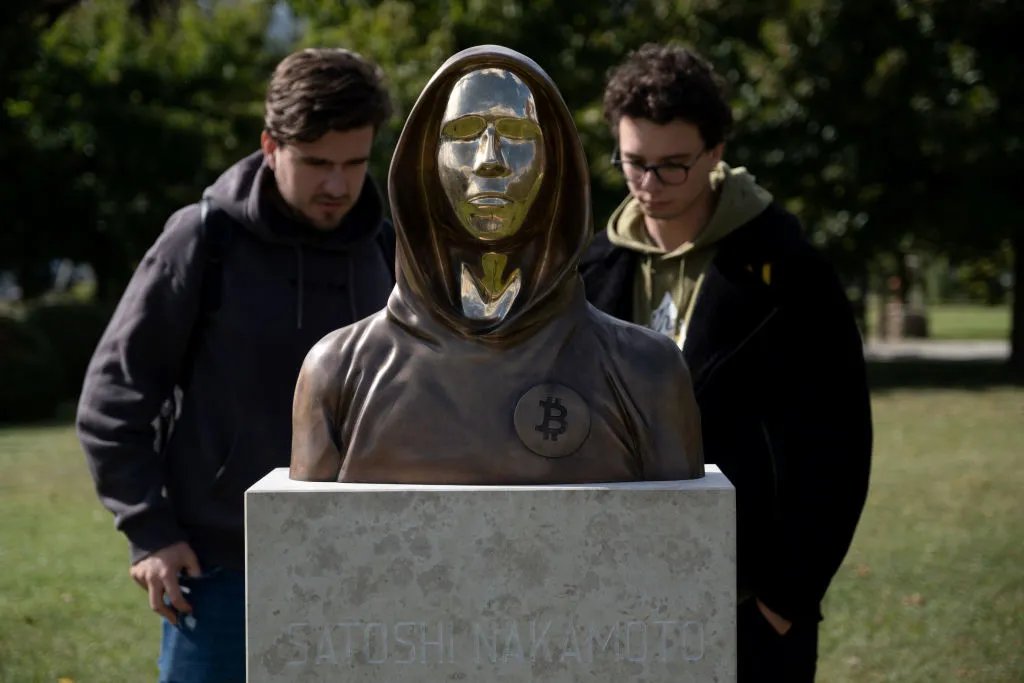

The New York Times reporter John Carreyrou’s new evidence suggesting that British cryptographer Adam Back is the man behind the Bitcoin creator’s pseudonym, Satoshi Nakamoto, is captivating global attention. This renewed scrutiny comes amid heightened volatility in Bitcoin’s price, which fell from its all-time high of more than $125,000 last October to less than half that by February.
The mystery surrounding Satoshi’s identity has fascinated people in and beyond the crypto sphere since 2008, when he began publishing white papers and early developer documents, two years before Bitcoin’s official launch. Satoshi disappeared from public view in 2011, writing to his collaborator Mike Hearn that he had “moved on to other things.”
Though 15 years have passed since Satoshi vanished, interest in the mythology hasn’t waned. Dozens of names have surfaced—some claiming to be Satoshi, others firmly denying it. Now, the trail has grown hot again, pointing toward someone at the center of Bitcoin’s early cryptographic roots.
Carreyrou’s case linking Back to Satoshi Nakamoto rests on several key points. First, Back was deeply involved in the Cypherpunks, a group of crypto-activists with an anarcho-capitalist bent. He holds a doctorate in distributed computer systems (the core architecture behind Bitcoin) and is an authority on both public-key cryptography and the programming language Bitcoin uses. Linguistic analyses of his published work also reveal striking similarities to Satoshi’s, such as unusual hyphenations, inconsistent shifts between British and American spellings, and shared stylistic quirks.
Back has categorically denied being Satoshi. He upheld this stance on today’s edition of The Daily, the New York Times podcast hosted by Natalie Kitroeff. “I guess it’s a coincidence,” Back said of Carreyrou’s findings. “I can only tell you that it’s not me.”
In a 2024 post on X, Back wrote, “No one knows who Satoshi is. And that’s a good thing.” Asked about that statement on the podcast, he explained that systems with outspoken founders “are viewed more as a company’s product or project” rather than evolving organically.
Currently, Back is taking his company, Bitcoin Standard Treasury Company (BSTR), public in the U.S. He has disclosed no assets that would tie him to Satoshi, such as the roughly 1.1 million Bitcoins, worth more than $79 billion now, that analysts estimate Satoshi controls.
Other names previously suspected to be Satoshi Nakamoto
Len Sassaman
Len Sassaman, a cryptographer and Cypherpunk member who died by suicide in 2011, has long been rumored to be Satoshi. The theory gained traction when venture capitalist Evan Hatch published a Medium article suggesting Sassaman as a possible identity. He also appeared as a theory in HBO’s 2024 documentary Money Electric: The Bitcoin Mystery. Sassaman’s widow, Meredith Patterson, has repeatedly said she doesn’t believe he was Satoshi, and the claims have since lost momentum.
Peter Todd
Peter Todd, an early blockchain developer who collaborated with Back, was another subject of speculation. Though featured in Money Electric, Todd, only 23 at the time of the original white paper’s release, has firmly rejected the idea, and most believe he lacked the experience to build the entire Bitcoin system.
Hal Finney
Renowned cryptographer Hal Finney was the first person to receive a Bitcoin transaction directly from Satoshi, fueling theories that he might be the creator. Coincidentally, Finney lived near a man named Dorian Nakamoto, prompting speculation that he borrowed the surname for his pseudonym. However, before his death from ALS in 2014, Finney produced evidence—including email logs and wallet data—showing he was merely a collaborator.
Dorian Nakamoto
Living just blocks from Finney in Temple City, Calif., Dorian Nakamoto was born with the name Satoshi Nakamoto. Newsweek reporter Leah Mcgrath Goodman claimed in 2014 that he was the elusive creator, to which he responded, “The first time I heard the term ‘Bitcoin’ was from my son in mid-February 2014…My prospects for gainful employment [have] been harmed because of Newsweek’s article.”
Nick Szabo
Nick Szabo designed BitGold in 1998, a digital currency concept that paved the way for Bitcoin. Like the Back debate, linguistic researchers have compared Szabo’s writing to Satoshi’s. According to Carreyrou, Szabo recently joined a debate on X about a Bitcoin update, in which he “exposed his ignorance of basic technical aspects of Bitcoin.”
Paul Le Roux
Paul Le Roux, the creator of encryption software E4M, has been another candidate, mainly due to his technical expertise. However, his criminal record, including convictions for drug trafficking and murder, contradicts Satoshi’s image as a moral and idealistic innovator, making this theory less plausible.
Gavin Andresen
Satoshi personally selected software developer Gavin Andresen to succeed him and oversee Bitcoin’s updates, sparking speculation that Andresen might be Satoshi himself. He has denied it and later endorsed computer scientist Craig Wright’s claim—an allegiance that damaged his reputation after Wright’s evidence was found to be falsified.
Wei Dai
Computer scientist Wei Dai, whose “b-money” proposal influenced Bitcoin’s design and was cited in Satoshi’s white paper, has also been named as a potential candidate. He has repeatedly denied the claims, and there’s no credible evidence linking him to Bitcoin’s creation.
Craig Wright
The Australian computer scientist Craig Wright remains the only person to publicly claim he is Satoshi. In 2024, he lost a case in the High Court of England and Wales against the Crypto Open Patent Alliance. The court found his evidence “at best questionable or of very dubious relevance or entirely circumstantial and at worst, fabricated and/or based on documents I am satisfied have been forged on a grand scale.”