
-
The IMF said in a report on China’s economy that the country’s property crisis remains “unresolved.”
-
But China’s hit back at that, saying its property market “has been operating smoothly in general, and is not in a ‘crisis’ situation.”
-
China’s real estate market has been mired in debt woes for the past few years.
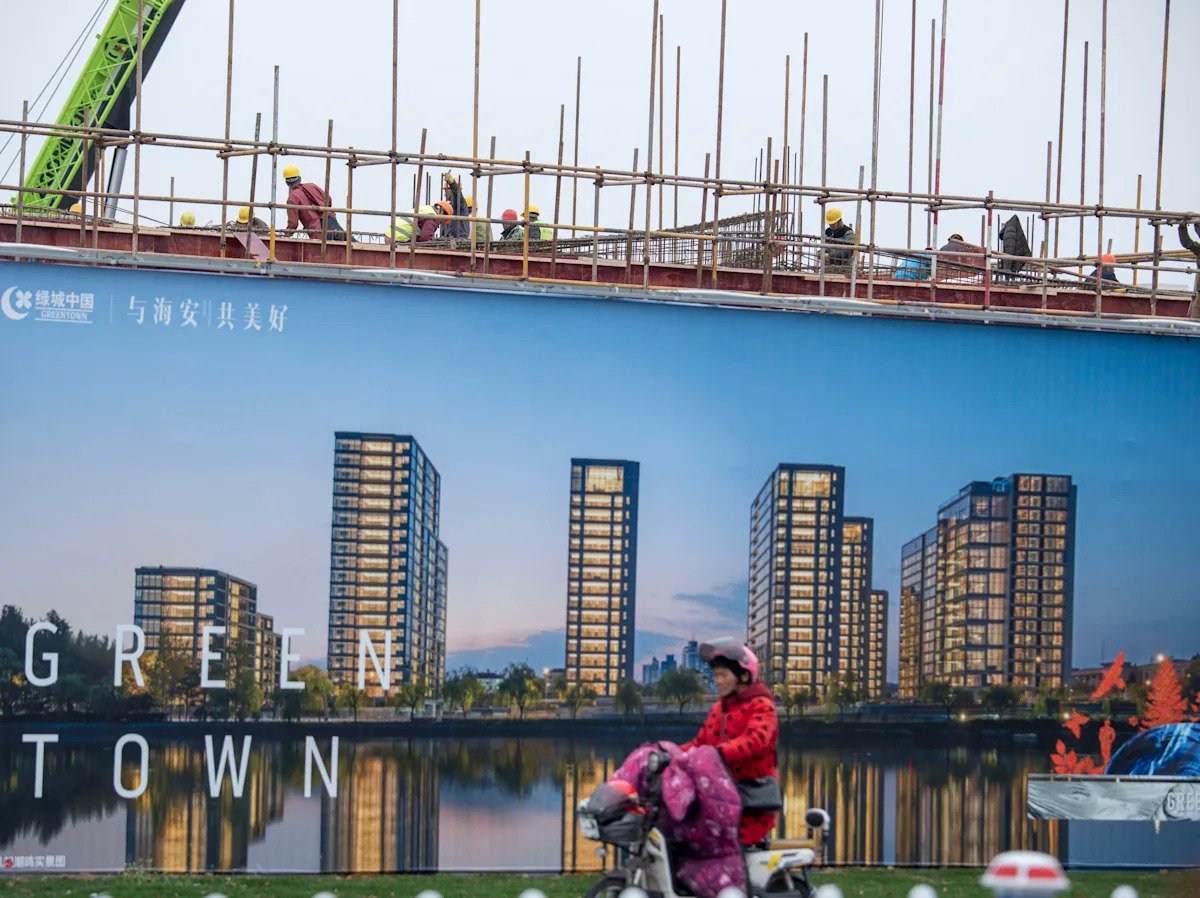
China’s property market woes may be well-documented — but Beijing insists there’s no crisis.
And that’s clashing with the International Monetary Fund’s, or IMF’s read of things. The IMF released its annual review of China’s economy on Friday, in which it said that the real estate crisis “remains unresolved” and that the country’s growth remains “under pressure.”
But China’s taking a contrarian view, saying in a January 12 response to the IMF, included in the Fund’s report, that the country’s property market “has been operating smoothly in general, and is not in a ‘crisis’ situation.”
“The authorities are aware of the risks and are working to address them,” said Zhengxin Zhang, China’s representative to the IMF’s executive board, and Xuefei Bai, a policy adviser at the IMF. “It is inappropriate to overstate the difficulties in the market and potential impacts to the financial sector.”
The IMF says China’s property crisis “intensified” in 2022
The IMF said in its Friday report China’s property crisis “intensified” in 2022.
“Accumulating pressures from the unresolved property crisis could trigger a sharp retrenchment in aggregate demand, with adverse macro-financial feedback loops and potentially large external spillovers,” the IMF said while calling for “further action” at the national level by increasing funding for the completion of stalled projects.
This might help lead the way to market-based restructuring, and contain financial risks, it added.
Despite China’s efforts to reassure investors about the health of its property sector, more than half of 60 mainland China-listed developers are likely to post losses for 2022, per Bloomberg calculations which used public data. And on top of that, investment into China’s property fell 10% in 2022 from a year ago, according to official data released on January 17.
The average net-debt-to-equity ratio at the country’s top 80 real estate companies rose to 152% by the second quarter of 2022 — twice what it was in mid-2020 before debt restrictions on property developers were introduced, Reuters reported, citing analysts from the state-owned Chinese Academy of Social Sciences.
China’s Zhang and Bai acknowledged in their January 12 response China’s real-estate market entered “a new environment” in 2022 due to various factors, such as shrinking demand, weaker market expectations, the pandemic, and liquidity issues at some developers. But the balance sheets of listed developers showed improved liabilities to assets ratio in the first half of 2022, they wrote.
Chinese authorities are also supporting “reasonable market financing,” they said, adding: “the current development of the real estate market is a natural evolution of ‘deleveraging and destocking’ in the past few years.”
“The related risks are local and only concern individual firms, and their impact on the rest of the world has been relatively small,” they added.
Beijing started clamping down on excessive borrowing in 2020
The sharp exchange comes amid an ongoing debt crisis in China’s property sector after Beijing started clamping down on excessive borrowing in 2020, which contributed to the debt troubles at major property developer Evergrande.
The cash crunch led to stalled construction, spurring worries that buyers may never see the apartment they have been paying for.
Banks also tightened lending to the entire property sector amid Evergrande’s liquidity crunch, leading to concerns of a domino effect on China’s financial sector — and the rest of the world.
The debt crisis also had a deep social impact. Chinese millennials, for instance, are grappling with an existential crisis over home ownership due to concerns over whether developers will be able to deliver apartments buyers have paid for, wrote Insider’s Cheryl Teh in October 2021.
“The real problem is that many developers simply do not generate positive cash flow and that the funding model of unfettered pre-sale receipts is broken,” Andrew Lawrence, TS Lombard’s Asia property analyst, wrote in a January 12 note seen by Insider.
Read the original article on Business Insider