
La Nina likely to boost soybean, corn yields in Brazil, Argentina
Australia, Indonesia rainfall may disrupt iron ore, coal, nickel, copper
Increased hurricane activity poses risk to USGC energy infrastructure
The likely return of the climate phenomenon La Nina, and the associated shift in global weather patterns and temperature extremes, is set to result in a fresh wave of disruption and volatility across key global commodity markets.
Not registered?
Receive daily email alerts, subscriber notes & personalize your experience.
Following on from the recent El Nino event — which lasted from the second half of 2023 through to the beginning of 2024 and was one of the five strongest on record — the US National Oceanic and Atmospheric Administration’s Climate Prediction Center estimates that there is currently a 70% likelihood of La Nina developing during Q3 2024 and persisting into Q1 2025, according to its latest update released July 11.
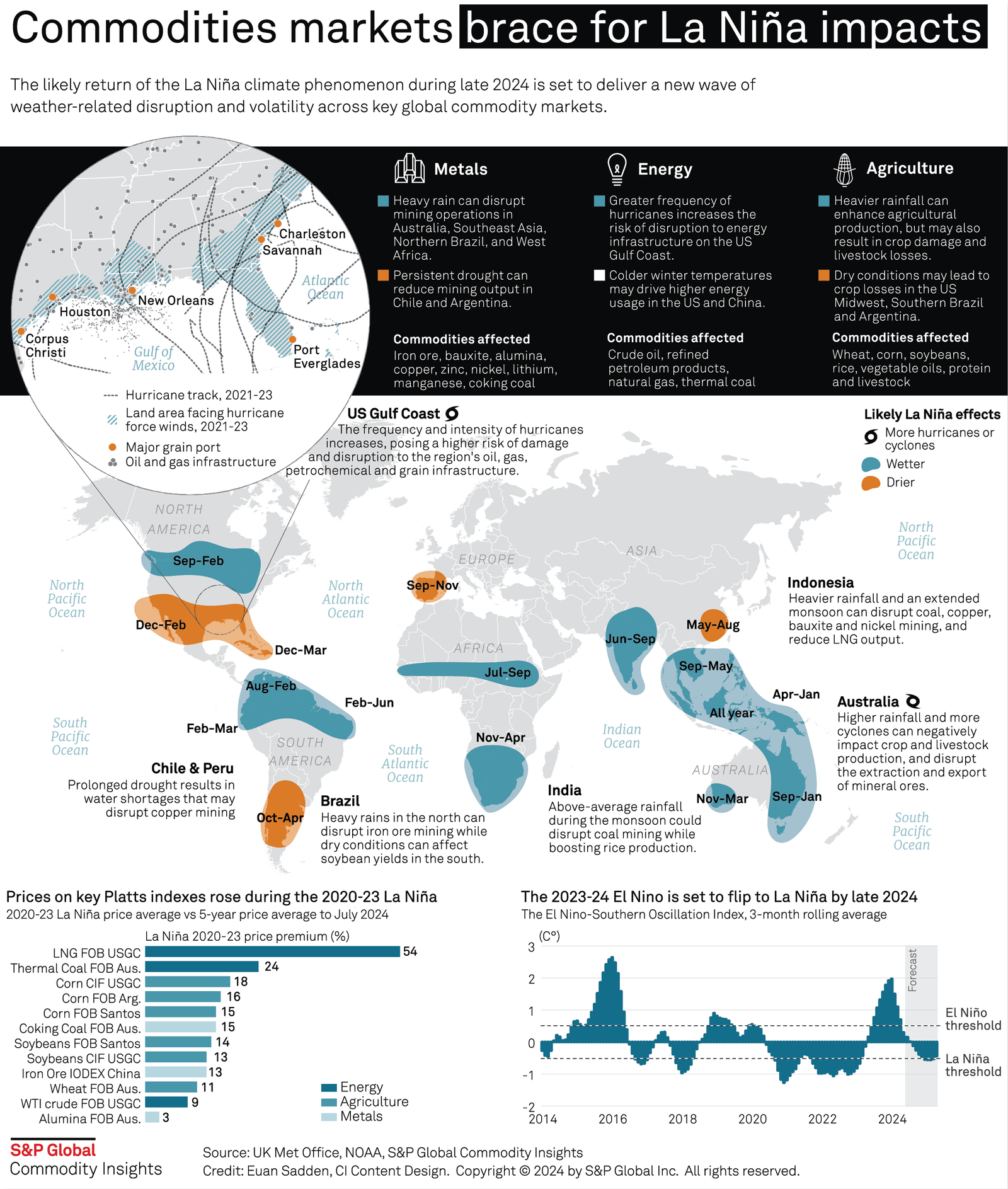
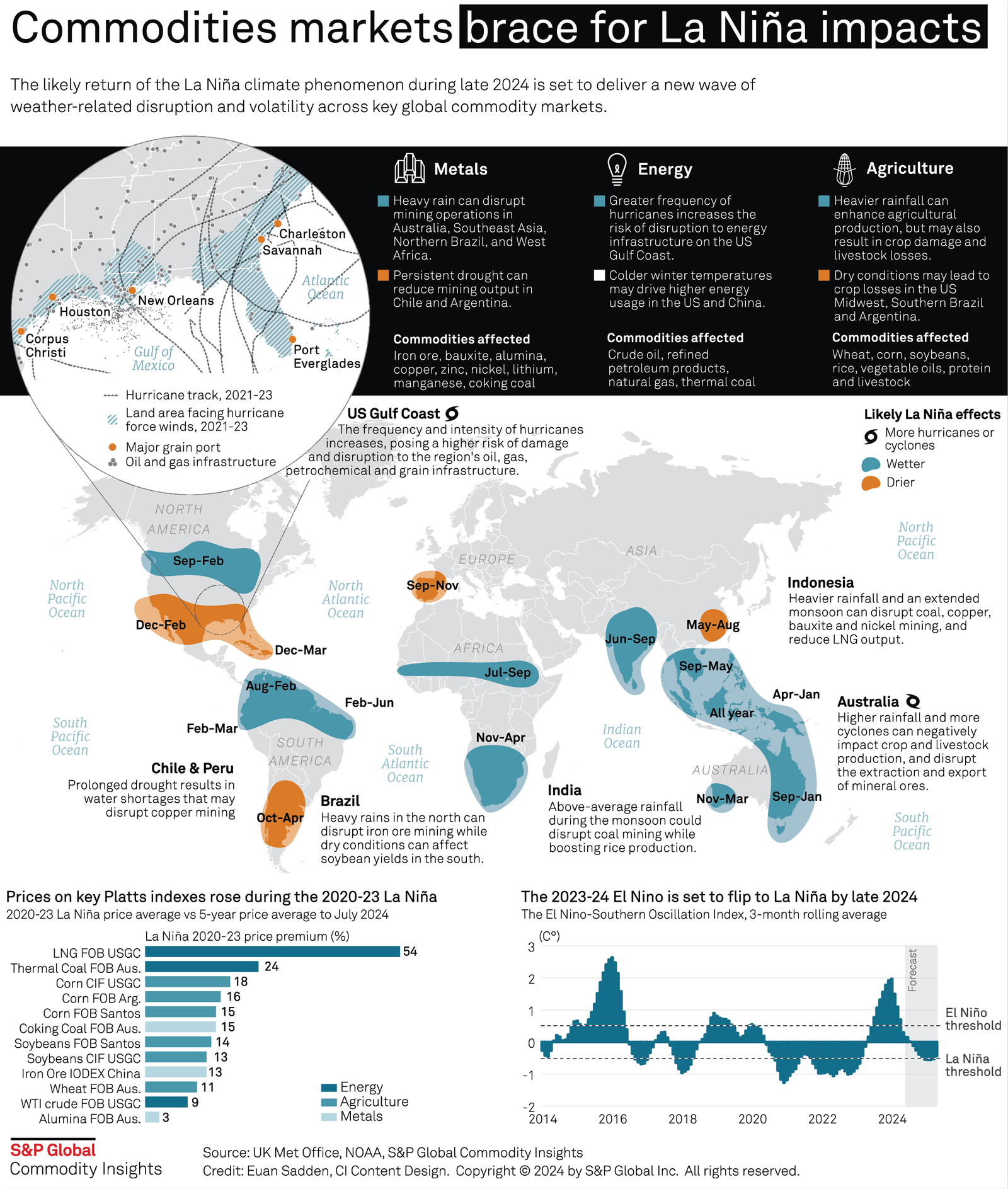
Click here for the full-size infographic
Agriculture
If the weather event develops as predicted, analysts say that the most immediate and obvious impact will be on agricultural markets, though this may well be contradictory and difficult to predict.
Brazil will likely see increased soybean and corn yields due to higher rainfall in the northern growing areas, analysts say, strengthening its export position and potentially lowering global prices for these commodities. However, excessive rainfall may also cause flooding, damaging crops and disrupting logistics.
In Indonesia and Malaysia, increased rice and palm oil production will also strengthen their respective export positions and potentially lower global prices.
Meanwhile, southern US regions will likely face drier conditions, negatively impacting winter wheat, cotton, and sorghum yields. In contrast, the US Midwest may benefit from favorable conditions for corn and soybean production, mitigating some domestic supply concerns.
In terms of livestock markets, enhanced pasture growth in Australia and New Zealand could improve beef and dairy production, boosting exports. However, heavy rainfall may lead to waterlogging and disease outbreaks, potentially affecting overall livestock health.
In the US, livestock producers may struggle with reduced forage availability, affecting beef and poultry output, and potentially leading to higher meat prices domestically and increased imports, analysts say.
Metals
La Nina’s impact on global metals markets will be focused primarily on the extraction and transportation of raw materials, with mining and transport operations in Southeast Asia, Africa and Australia susceptible to disruption arising from heavy rainfall and flooding.
In Australia, heavier-than-average rainfall and the greater frequency — and intensity — of cyclones associated with La Nina could hinder the extraction and export of key mineral commodities, such as iron ore and coking coal.
This impact was most recently demonstrated during a prolonged “triple dip” La Nina that persisted from September 2020 to February 2023, when heavy rainfall and extensive flooding across New South Wales and Queensland temporarily halted mining operations and disrupted key railway routes and port operations.
Australia accounts for more than half of all global seaborne metallurgical coal shipments, meaning that the sector was particularly exposed. Annual export volumes fell by 18% between 2019 and 2023, with the impact of La Nina compounded by weak demand in China.
Iron ore operations in Western Australia would also be susceptible to La Nina’s extreme weather effects, although not to the same extent as the coal industry.
In general, the effect of weather-related disruption on the global iron ore market is less apparent, owing to the presence of substantial Chinese port inventories, which act as a buffer against short-term production curtailments.
Iron ore ports and mines in Western Australia also implement regular shutdowns during the November to April cyclone season, contributing to a seasonal reduction in quarterly export volumes between Q4 and Q1.
It is a similar situation in Brazil, another leading exporter of iron ore, where the onset of La Nina typically brings heavier-than-normal rainfall in the north and dry conditions to the south. For mine operators, La Nina’s heavier-than-average rainfall is particularly problematic for iron ore tailings dams, where water levels can exceed the storage capacity of the dam, increasing the risk of catastrophic failure.
La Nina’s extreme weather also heightens the risk of flooding and landslides in Indonesia, where the mining of coal, copper, nickel and bauxite already faces regular disruption owing to heavy seasonal rainfall.
Markets for key battery metal copper also face heightened risk of disruption more broadly, owing to the increased incidence of dry weather and water shortages in Chile. The 2020-23 La Nina event culminated in one of South America’s worst droughts on record, with Chile enduring three years of severe water shortage, matched by an associated reduction in copper output. Between 2020 and 2023, Chile’s annual copper production fell 7.5%, with producers citing lower ore grades and delays to major investment projects in addition to the persistent water shortages.
Energy
La Nina’s impact on the global energy sector has previously been evident in terms of both supply and demand, with extreme weather events serving to disrupt extracting and refining operations, while cooler temperatures increase demand for electricity and heating in certain areas.
Supply-side effects will likely be focused primarily within the Atlantic basin, where the elevated frequency and intensity of hurricanes associated with the weather event pose a major risk to US Gulf Coast energy infrastructure.
The National Oceanic and Atmospheric Administration is predicting an “above average” Atlantic hurricane season, with 17 to 25 named storms, 8 to 13 hurricanes, and 4 to 7 major hurricanes of category 3 or higher. An average season has around 14 named storms, seven hurricanes, and three major hurricanes.
The US Gulf Coast is a critical region for the country’s energy resources and infrastructure. According to the Energy Information Administration, Gulf federal offshore oil production accounts for 15% of total US crude oil production, and federal offshore natural gas production in the region accounts for 5% of total US dry production. Over 47% of total US petroleum refining capacity is located along the Gulf Coast, as well as 51% of total US natural gas processing plant capacity.
On demand, La Nina often results in colder-than-average winter temperatures in North America and North Asia, contributing to short-term spikes in demand for thermal coal and natural gas.