
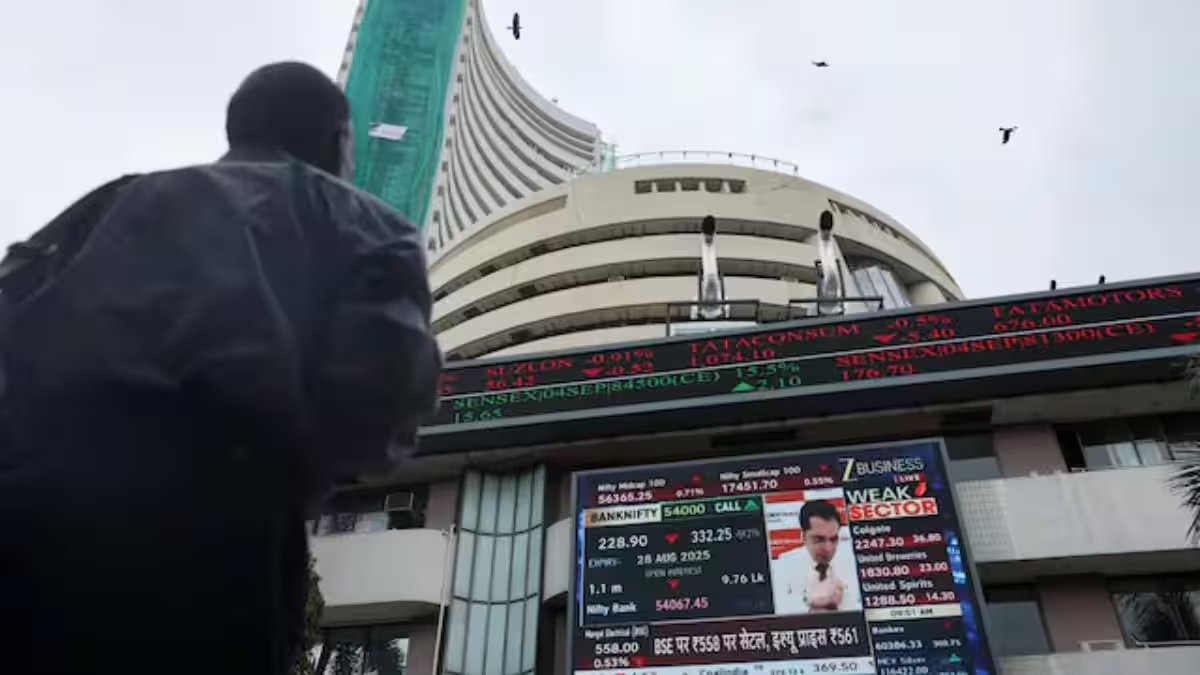
India’s stock markets witnessed a sharp sell-off on Thursday, wiping out nearly Rs 9 lakh crore in investor wealth in a single session. At one point, losses were estimated at over Rs 7.6 lakh crore within the first hour of trade.
The benchmark Sensex plunged over 2,000 points, or by three per cent, to a low of 74,685, while the Nifty50 slipped below the 23,200 mark. The Sensex’s 2.5 per cent drop was one of its sharpest single-day falls in recent months. The BSE’s market capitalisation dropped to Rs 430 lakh crore from Rs 439 lakh crore.
But what do we know? Why is the market falling?
Let’s take a closer look:
West Asian conflict
The biggest trigger behind the crash was the escalating conflict in West Asia in the backdrop of the Iran war. Following strikes on Iran’s gas facilities, President Masoud Pezeshkian warned of “uncontrollable consequences” that “could engulf the entire world”.
Fears of a wider regional war have unsettled global markets, especially due to the risk of disruption in energy supplies. West Asia accounts for nearly one-third of global oil production, making any instability in the region a major concern.
As uncertainty rises, investors typically shift towards safer assets like gold and the US dollar. This “risk-off” sentiment leads to heavy selling in equities, particularly in emerging markets like India,
which often see sharp capital outflows during such periods.
Surge in crude oil prices hits sentiment
Closely linked to geopolitical tensions is the sharp spike in crude oil prices, which surged five per cent to $113 per barrel (around Rs 10,540), a significant jump in a short period. For India, which imports nearly 85 per cent of its crude oil needs, this is a major concern.
Rising crude prices have a cascading impact:
• Higher inflation
• Increased import bill
• Pressure on the rupee
• Rising costs for companies
Even a $10 (around Rs 933) increase in crude oil prices can significantly widen India’s current account deficit, making markets extremely sensitive to such moves.
US Federal Reserve stance dampens hopes
Another key factor weighing on markets was the latest policy stance of the US Federal Reserve. The Fed kept interest rates unchanged but signalled that rate cuts may not come as soon as expected. US interest rates remain elevated at around 5.25–5.50 per cent, keeping global liquidity tight.
“It is likely that the Fed will be on an extended pause until there is more clarity around the effects of the Iran crisis and fading tariff inflation,” Madhavi Arora, Chief Economist for Emkay Global Financial Services, told LiveMint.
HDFC Bank adds to market woes
Shares of HDFC Bank — one of the heaviest-weighted stocks in Indian indices — dropped sharply by around 8 per cent to a 52-week low of Rs 772 on the BSE. This came after chairman Atanu Chakraborty resigned with immediate effect, claiming that “certain happenings and practices within the bank” were “not in congruence” with his personal values and ethics.
The fall in HDFC shares also triggered weakness across the banking sector, which accounts for a large portion of market capitalisation. But HDFC Bank wasn’t alone. Larsen and Toubro sank over 3 per cent, while Bajaj Finance and Shriram Finance also witnessed declines. Aviation stock IndiGo fell over three per cent, while IT stocks such as Infosys, TCS and Wipro also declined.
FIIs step up selling, weak global cues
Foreign institutional investors (FIIs) have been net sellers in recent months, a trend which continued on Thursday.
As per NDTV, FIIs have sold equities worth Rs 77,214 crore this month alone, at an average of over Rs 6,400 crore per session.
A stronger US dollar and rising US bond yields further encourage capital flight from markets like India.
Indian markets also mirrored weakness in global markets. Asian indices declined sharply by up to three per cent after US markets fell over 1 per cent amid signs of stress due to rising oil prices and geopolitical concerns. The S&P 500 and Nasdaq fell 1.36 per cent and 1.46 per cent, respectively, while the Dow sank 1.63 per cent.
In an increasingly interconnected financial system, such global cues often trigger immediate reactions in domestic markets.
Profit booking accelerates the fall, weakening rupee
Another contributing factor was profit booking after recent gains. Markets had rallied in the previous three sessions, prompting investors to lock in gains. When combined with negative global cues, this selling pressure intensified rapidly. The rupee on Thursday fell to 93.34 against the US dollar.
What do experts say?
Experts say that the current correction is largely driven by external shocks rather than domestic fundamentals.
Hitesh Tailor, research analyst at Choice Equity Broking, told Business Today, “Focusing on fundamentally strong stocks during market corrections may be a prudent strategy. Fresh long positions should ideally be considered only after the Nifty convincingly crosses and sustains above the 25,000 mark, as this would indicate improving sentiment and the potential emergence of a stronger bullish trend.”
However, volatility is expected to remain high in the near term, especially if crude oil prices stay elevated or geopolitical tensions escalate further.
India Today quoted VK Vijayakumar, Chief Investment Strategist at Geojit Investments, as saying that the uncertainty around the conflict has intensified following the latest developments, pushing Brent crude to $111 per barrel (around Rs 10,354).
“This is bad news for oil and gas importers like India. If Brent remains above $110 (around Rs 10,261) for an extended period, it will have negative implications for India’s macroeconomic indicators, including GDP growth and corporate earnings,” he said.
Investors are advised to remain cautious and focus on long-term fundamentals rather than reacting to short-term movements.
Bruce Keith, CEO and co-founder of InvestorAi, added, “The movement in the VIX from 19 sharply back to 21 means new geopolitical headlines (Iran/Hormuz escalation overnight) and a crude spike. Given that US VIX was also up 5.8 per cent overnight to 23.7, this looks like a global risk-off move bleeding into Indian markets today (March 19). Previously, the Nifty strung together four green sessions and VIX was cooling nicely — but today’s spike suggests the options market is repricing risk again. The issue is how long it stays here, particularly if crude pushes through $110 (around Rs 10,261), which would force the RBI into an aggressive defence of the rupee.”
FAQs
**1)**Why did the Indian stock market fall today?
The market fell due to a combination of factors including tensions in West Asia, crude oil rising above $110 (around Rs 10,261) per barrel, the US Federal Reserve’s stance, foreign investor outflows, and a sharp fall in banking stocks.
**2)**How much money did investors lose?
Investors lost around Rs 9 lakh crore in market value during the session, with over Rs 7.6 lakh crore wiped out within the first hour of trading.
**3)**What should investors do now?
Experts advise against panic selling. Long-term investors should remain focused on fundamentals.
With inputs from agencies
End of Article