
February 17, 2026 02:10 PM EST
Trump Thinks the Dow Will Hit 100,000 While He’s President. What Would It Take To Get There?
FROM 55 minutes ago
Stock market predictions are getting huge.
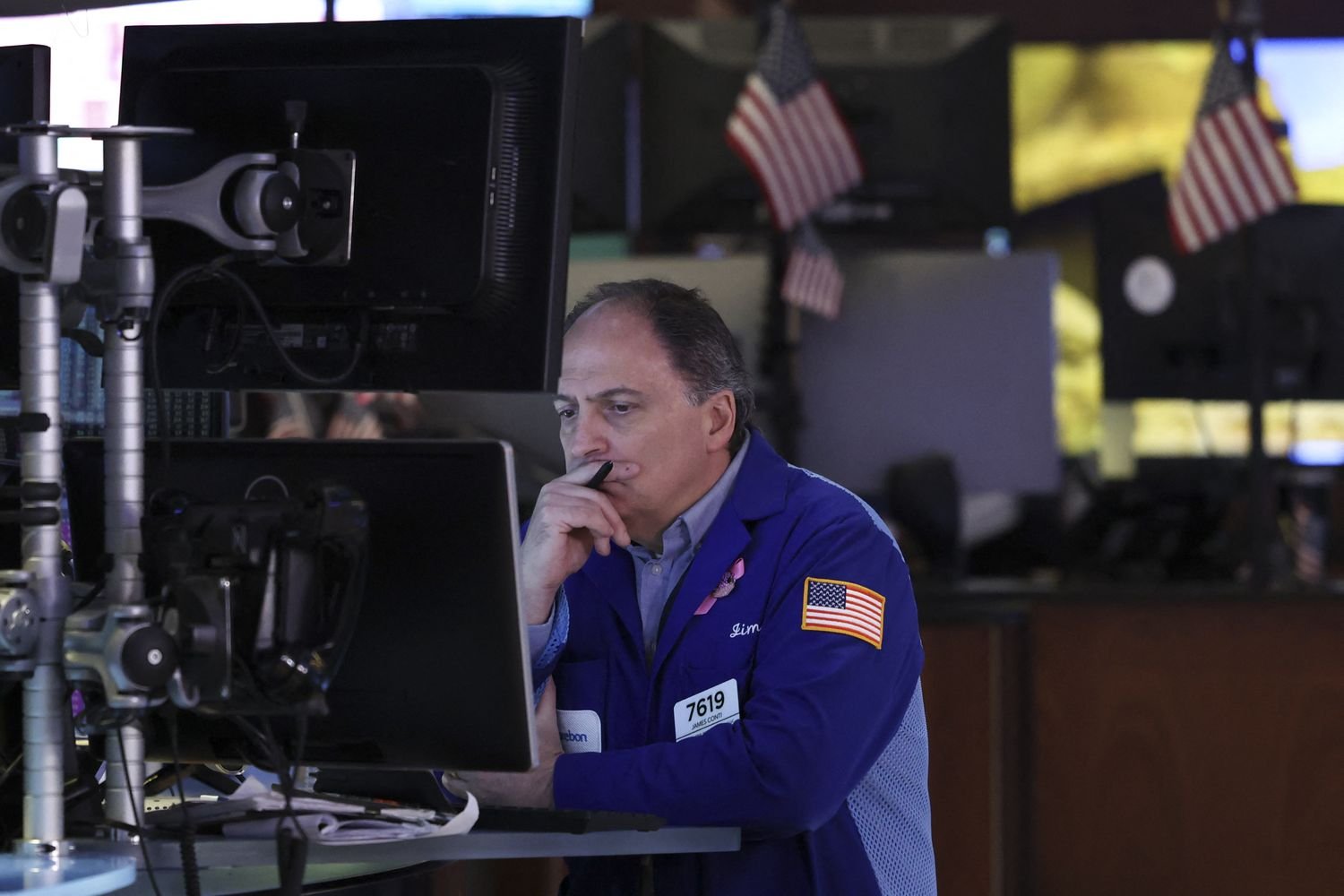
The Dow Jones Industrial Average recently closed above 50,000 for the first time, prompting one very enthusiastic fan—namely, President Donald Trump—to project that the index would double by January 2029. “I am predicting 100,000 on the DOW by the end of my Term,” Trump said in a social media post that attributed the index’s most recent milestone to his policies.
Is that big, round number possible? It would defy historic averages, according to market experts, who even through rose-colored glasses—and assuming index constituents show outsize earnings growth—see a move to 100,000 in under three years as a reach.
Timothy A. Clary / AFP via Getty Images
“I’m optimistic about equity markets over the next couple years,” Jeremiah Buckley, a portfolio manager at Janus Henderson, told Investopedia. “Doing some quick math, I think 60,000 to 70,000 is a reasonable three-year target for the Dow—but 100,000, to me, seems hard to get to in that short period of time.”
The Dow took roughly eight years to get from 25000 to 50000. Based on historic return averages going back to 1928, the index would need about 10 years to get to 100,000, according to data compiled by State Street Investment Management, the firm behind the SPDR Dow Jones Industrial Average ETF (DIA). More recent long-term averages suggest it would take between five and 10 years.
If the Dow could buck historical trends, what would the 30 members of the index have to do? Their earnings growth would have to be around 25% a year, according to Janus’s Buckley. The Dow’s estimated 2026 earnings per share is $2,357, representing a compound annual growth rate of 10% from 2023, according to State Street.
Even with record earnings per share growth, one would have to assume “quite a bit of multiple expansion” for the Dow to get to 100,000, Buckley said. Currently, the price-to-earnings ratio is sitting at around 30, representing a historical high going back to the late 1990s.
February 17, 2026 01:20 PM EST
Norwegian Cruise Line’s Stock Is Surging. An Activist Investor Is Pushing for Big Changes.
FROM 1 hr 46 min ago
Norwegian Cruise Line’s stock is surging Tuesday, as an activist investor looks to shake up the cruise operator’s business.
Shares of Norwegian (NCLH) were up over 11% in recent trading after Elliott Investment Management revealed a more than 10% stake in the company.
The activist investor said it sent a letter and presentation to Norwegian’s board laying out plans to push for a shakeup of its board, along with changes to improve guest experience and profitability, among other things.
“Over the past decade, the Company has fallen from a best-in-class cruise operator at the time of its initial public offering to a clear industry laggard, suffering from inconsistent strategy, weak execution, inaccurate guidance and poor cost discipline,” Elliott wrote in its letter.
Even with Tuesday’s gains, shares of Norwegian have lost nearly 10% of their value in the last 12 months as the cruise line struggled with growing competition and cost pressures. Its rivals Carnival (CCL) and Royal Caribbean (RCL), meanwhile, have seen their stocks surge roughly 25% over the same period.
A Norwegian Cruise Line spokesperson told Investopedia that the company is committed to delivering value for investors under the leadership of new CEO John Chidsey, and plans to offer more details when the company reports earnings on March 2.
Norwegian announced the appointment of Chidsey last week, replacing Harry Sommer. In its letter, Elliott criticized the choice of Chidsey, the former CEO of Subway and Burger King and a longtime Norwegian board member, as lacking experience in the cruise industry.
Elliott said it is prepared to take its case directly to shareholders at the company’s upcoming annual meeting. It suggested the proposed changes could help Norwegian stock recover to its pre-pandemic level around $56, more than double Friday’s close.
February 17, 2026 12:17 PM EST
Packaged Food Stocks Slump After General Mills Cuts 2026 Forecasts Amid ‘Challenging’ Consumer Landscape
FROM 2 hr 49 min ago
Shares of General Mills (GIS) slumped more than 7% on Tuesday after the company behind Wheaties and Cheerios cut its full-year sales and profit forecast, citing a “challenging” consumer environment.
General Mills expects organic net sales to fall between 1.5% and 2% this year. In December the company forecast sales could grow up to 1% this year. Adjusted earnings per share are expected to decline between 16% and 20%, compared with a prior forecast of a 10% to 15% decline.
“Weak consumer sentiment, heightened uncertainty, and significant volatility have weighed on category growth and impacted consumer purchase patterns, resulting in a slower pace and higher cost of volume recovery than initially expected,” the company said in a press release on Tuesday.
The stocks of fellow packaged food giants Campbell’s (CPB), Mondelez International (MDLZ), and Kraft Heinz (KHC) slumped on Tuesday. All three were down more than 4% in recent trading.
Chief Executive Officer Jeff Harmening, speaking at a conference on Tuesday, said persistent inflation, SNAP benefit reductions, and geopolitical uncertainty “have led to significant consumer stress, especially for the middle- and lower-income groups.” As a result, he said, consumers are increasingly buying goods on sale, rather than at full price.
Low- and middle-income consumers have been hit particularly hard in recent years by surging inflation and a stalled job market. By comparison, the finances of upper-income consumers with more exposure to the stock market have been buoyed by a years-long bull market. In the most recent University of Michigan Survey of Consumers, there was about a 20-point gap between the sentiment of respondents without stock holdings and those with the largest stock holdings.
February 17, 2026 11:11 AM EST
Record Share of Investors Say AI Spending Is Getting Out of Hand
FROM 3 hr 54 min ago
Professional investors are more anxious than they’ve ever been about AI’s big price tag.
A net 35% of fund managers surveyed by Bank of America earlier this month said companies are “overinvesting,” a record high and up sharply from 14% in December.
Big Tech is on pace to spend more than $600 billion on infrastructure—the majority of it dedicated to training and running AI—this year. Investors are increasingly concerned the tech giants will struggle to realize a return on their investment if AI demand or the industry’s economics don’t play out as expected. Those concerns have loomed over the stock market for several months, weighing on shares of hyperscalers like Microsoft (MSFT) and Amazon (AMZN).
Tech stocks were under pressure again on Tuesday, with most of the Magnificent Seven trading in the red. Software stocks, which have been hammered this year by anxiety about AI-driven disruption, continued to slump. The iShares Expanded Tech-Software Sector ETF (IGV) has shed nearly a quarter of its value since the start of the year.
Investors say overspending on AI is a risk for more than just the tech companies footing the bill. Nearly one in three surveyed investors called “AI hyperscaler capex” the most likely source of a “systemic credit event,” the second-most common answer behind private equity/credit. And a quarter of respondents identified an AI bubble as the biggest risk to the stock market, making it the most common answer.
February 17, 2026 09:58 AM EST
What To Expect In Markets This Week
FROM 5 hr 8 min ago
A closely watched retail earnings report and some inflation data will highlight a holiday shortened trading week.
PCE Inflation, Q4 GDP Lead Data Releases
Investors will get another look at December inflation with Friday’s release of the PCE report. Inflation measured by the Consumer Price Index remained unchanged in December, ad the PCE report is closely followed by the Federal Reserve, meaning its pricing data could influence how officials view the path of interest rates. The minutes for the January meeting of the Federal Reserve are also likely to provide insight into officials’ views on the state of the economy.
Investors will get their first look at economic growth measurements for the fourth quarter with the Thursday release of GDP. It comes after the Bureau of Economic Analysis reported strong economic growth in the third quarter, with its final revisions coming in at 4.4%.
New home sales and housing starts data for both November and December are scheduled for release this week, and pending home sales for January will provide a forward-looking indicator for the housing market. Two reports on U.S. international trade are also due this week, while durable-goods orders for December can offer insight into the health of the manufacturing sector.
Walmart Earnings First Under New CEO; 13F Watch Starts
Walmart is set to issue its first earnings report under new CEO John Furner. The retailer recently hit $1 trillion in market capitalization, making it the first big box store to reach that size. In its last report, Walmart posted a 4.2% increase in comparable sales and raised its full-year sales forecast.
Meanwhile, the quarterly 13F fillings that detail the holdings and transactions of Berkshire Hathaway (BRK.A, BRK.B) and other big investors are expected to start showing up this week, illustrating fourth-quarter portfolio changes. Big moves by Berkshire would be considered some of the last under Warren Buffett.
Get the week’s full calendar of corporate and economic events here.
February 17, 2026 09:06 AM EST
Stock Futures Slip as Tech Stocks Continue To Slump
FROM 6 hours ago
Futures contracts connected to the Dow Jones Industrial Average were down 0.2% in premarket trading on Tuesday.
S&P 500 futures slid 0.4%.
Nasdaq 100 futures were off nearly 0.9%.