
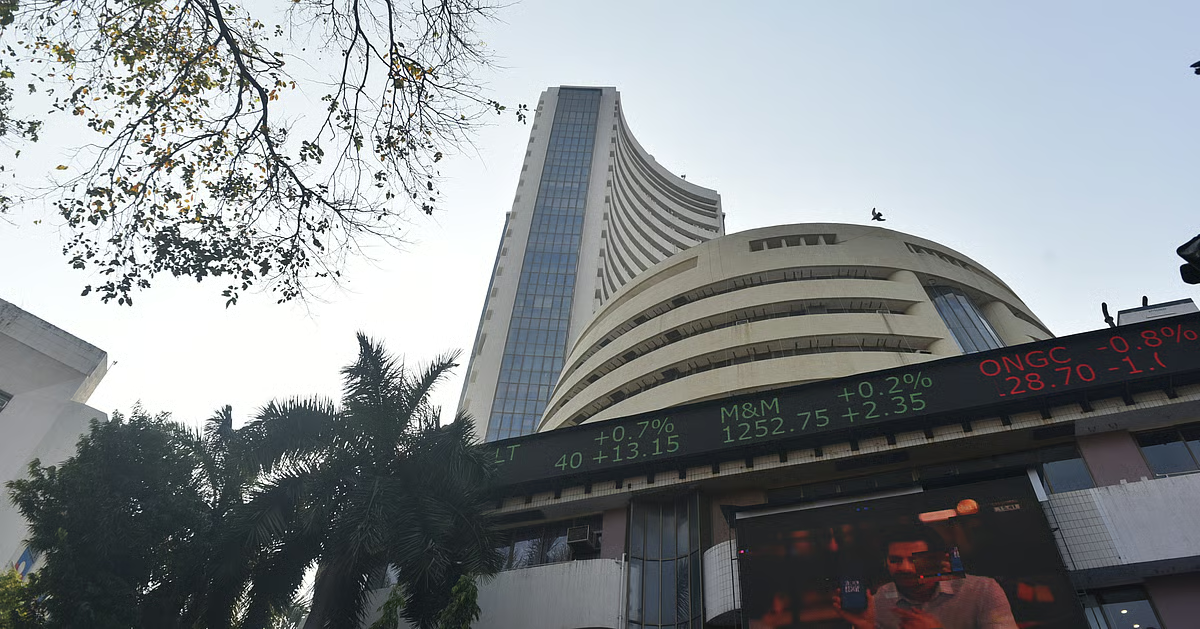
Analysts warned that volatility is likely to persist in the near term until clarity emerges on the US-Europe standoff over Greenland tariffs. “Both sides have hardened their positions, and the uncertainty will continue for some time. A new development is likely today with the US Supreme Court ruling on President Trump’s tariffs,” one market observer noted.
Amid the turbulence, the IMF offered a silver lining, raising India’s FY26 GDP growth forecast to 7.3 per cent — a confirmation of the economy’s resilience despite global and domestic headwinds. Analysts suggested that upcoming Q3 corporate earnings, beginning with auto companies, could provide a clearer signal of recovery in corporate performance.
Globally, Asia-Pacific markets mirrored the cautious mood. Investors weighed renewed US tariff threats against Europe, further escalating trade anxieties. China’s central bank opted to keep its loan prime rates unchanged, aiming for targeted sectoral support rather than broad stimulus. Asian benchmarks reacted cautiously: Shanghai shed 0.3 per cent, Shenzhen dropped 1.22 per cent, Japan’s Nikkei declined 1.03 per cent, Hong Kong’s Hang Seng eased 0.09 per cent, while South Korea’s Kospi managed a modest 0.13 per cent gain.
Across the Atlantic, US equities ended in the red in the previous session, with Nasdaq retreating 0.06 per cent, the S&P 500 down 0.06 per cent, and the Dow shedding 0.17 per cent.
Investor flows highlighted the divergence between foreign and domestic sentiment. On January 19, FIIs sold net equities worth Rs 3,263 crore, while domestic institutional investors (DIIs) emerged as net buyers to the tune of Rs 4,234 crore, underscoring domestic confidence in the broader market’s long-term trajectory.
With IANS inputs