
John Yang:
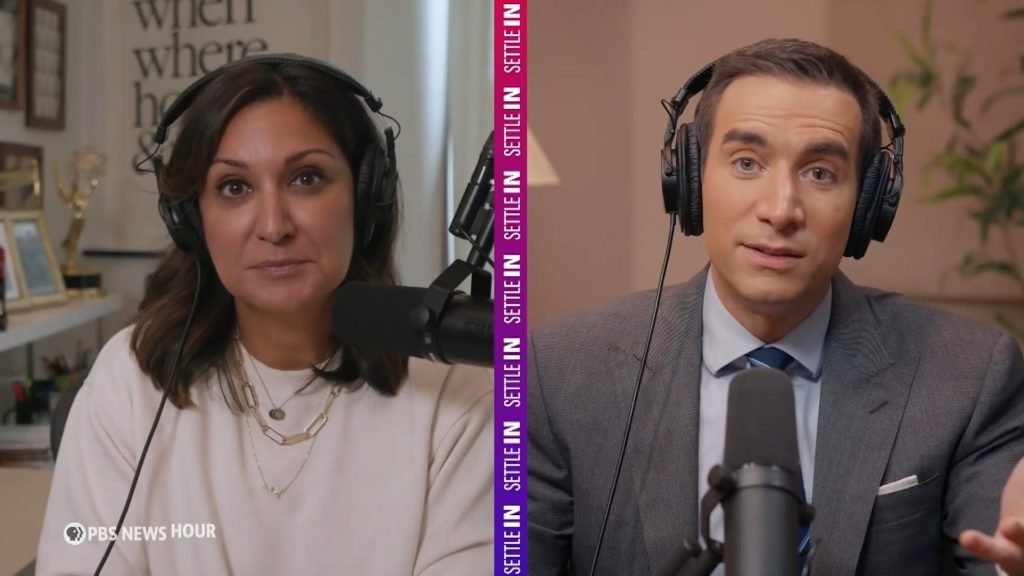
This week, we’re launching our new video podcast, “Settle In.”
In the premiere episode, Amna Nawaz has a fascinating discussion with financial journalist Andrew Ross Sorkin about his new book, “1929: Inside the Greatest Crash in Wall Street History and How It Shattered a Nation.”
In their conversation, Sorkin describes how Wall Street titans persuaded everyday Americans to invest in the stock market using borrowed money.
Amna Nawaz:
I want to underscore here what you lay out so well through stories in the book, which was this idea that, at the time, that big change of being able to buy stock on credit, that was a huge shift, right? How dramatic was that shift, when people were suddenly able to do that?
Andrew Ross Sorkin, Author, “1929: Inside the Greatest Crash in Wall Street History and How It Shattered a Nation”: Oh, that was a huge shift. And, by the way, it was even a broader shift in America.
I mean, up until 1919…
Amna Nawaz:
Yes.
Andrew Ross Sorkin:
… taking a loan was considered like a moral sin. It was something that only the grubby of the grubs would do. It would be like going to a pawn shop. It was really something that was looked down upon.
Amna Nawaz:
Like culturally, right?
Andrew Ross Sorkin:
Culturally, culturally.
Amna Nawaz:
Yes.
Andrew Ross Sorkin:
Just as a — you did not want to be somebody who took on credit. And what happened in 1919 was, General Motors decided they needed to sell more cars.
And how are they going to sell more cars? They’re going to start to loan people money. And somehow people decided that that was acceptable because it was a big purchase. And so if you’re going to buy a car and you needed to take the loan from GM.
Well, then Sears Roebuck clocked what was going on and said, oh, goodness, people are willing to do this. That’s interesting. We are now going to actually sell appliances and we will loan you money so that you can buy those appliances. Again, some of those are expensive products.
And then folks like Charlie Mitchell on Wall Street see what’s going on and say, ah, we can do this too. And now we are going to democratize finance. That was really the phrase during that period.
Amna Nawaz:
Yes.
Andrew Ross Sorkin:
We’re going to take finance away just from the elites and now make it available to everybody by loaning people money so that they can also play in the markets.
Amna Nawaz:
So, there’s a democratization of the financial world going on, but, of course, the little guy is always at a bit of a disadvantage. And you outline some of these really shady practices that were engaged in by the bankers.
They would form sort of an investment pool, right? Then they would drive up the stock price.
Andrew Ross Sorkin:
Right.
Amna Nawaz:
They would bring in ordinary investors, and then what?
Andrew Ross Sorkin:
A couple of very rich, wealthy, typically men got together, sometimes, by the way, in their wives’ names for tax purposes, were effectively putting together a group that was going to run what might be described as a pump-and-dump scheme, where they would say, you’re going to buy at $100, then the next person’s going to buy in at $200, then $300, then $400.
And at some point, we all know the day that we’re pulling the rug, meaning we’re all going to sell at the same time. But we’re hoping that all of the little guys and everybody else who’s not part of the scheme, they will buy up on top of us, so that we will be the winners and effectively they will be the losers.
It was almost like actors on a trading floor with their own instructions about what they’re supposed to do at any given point. It was shocking.
Amna Nawaz:
And then ordinary investors, everyday Americans are just caught in the middle of all this?
Andrew Ross Sorkin:
Well, ultimately, that’s what happened. And the worst part about it is, it wasn’t just that the stock market crashed in October.
And, by the way, I think our perception that the market dropped on one day is clearly wrong.
Amna Nawaz:
Yes.
Andrew Ross Sorkin:
It actually happened over a series of days. And then a whole bunch of other things happened that genuinely led to the Great Depression.
But as the stock market was dropping, it wasn’t just that you were losing money insofar as the stock went from $50 to $30 or $40 and therefore you lost $10 or $20. The problem was, because you had borrowed all that money, you were on the hook.
Amna Nawaz:
Yes.
Andrew Ross Sorkin:
So, famously, Groucho Marx, who apparently, according to his son, was somebody who actually was very conservative about his money, at least thought he was, had been spending all of his time at this brokerage in Long Island trading constantly and being told, of course, by the broker, everything’s going to be fine. This is all — this is the future. You have to invest in this stuff. Otherwise, you’re going to be on the losing end of things.
Gets a call in the late October and says, you got to come down here. You got to pay up your margin loan. And he doesn’t have the money. And so what happens? He ends up having to mortgage his home. And so I think there was a generational almost scarring that took place during this period.
Amna Nawaz:
Wow.
Andrew Ross Sorkin:
And it becomes very dramatic. A whole bunch of people, some of the characters in the book ultimately kill themselves. There are people who jump out of windows.
I don’t tell the story in the book, but my grandfather was 11 years old during this period, and his older brother was actually a messenger boy down on Wall Street. And he had taken my grandfather down there in October. He actually missed a day of school. And my grandfather watched somebody jump out the window. This is after the crash.
Amna Nawaz:
What? Wow.
Andrew Ross Sorkin:
And he would always tell us the story because he would always tell us that he would never buy stock. He lived until he was 91 years old and never bought a share of any stock, no stock. He kept the money.
Amna Nawaz:
Because of what he lived through and what he witnessed.
Andrew Ross Sorkin:
Because of what he witnessed, he would say: “Andrew, the stock market is not for us. It’s for these other people.”
And so he bought bonds. I think he probably kept some cash under his mattress. But I think there was a whole generation of people that were psychologically scarred by this period, no doubt.
Amna Nawaz:
Yes.
Andrew Ross Sorkin:
You can hear and watch full episodes of “Settle In” on YouTube, Spotify, Apple Podcasts, and wherever you get your podcasts.