
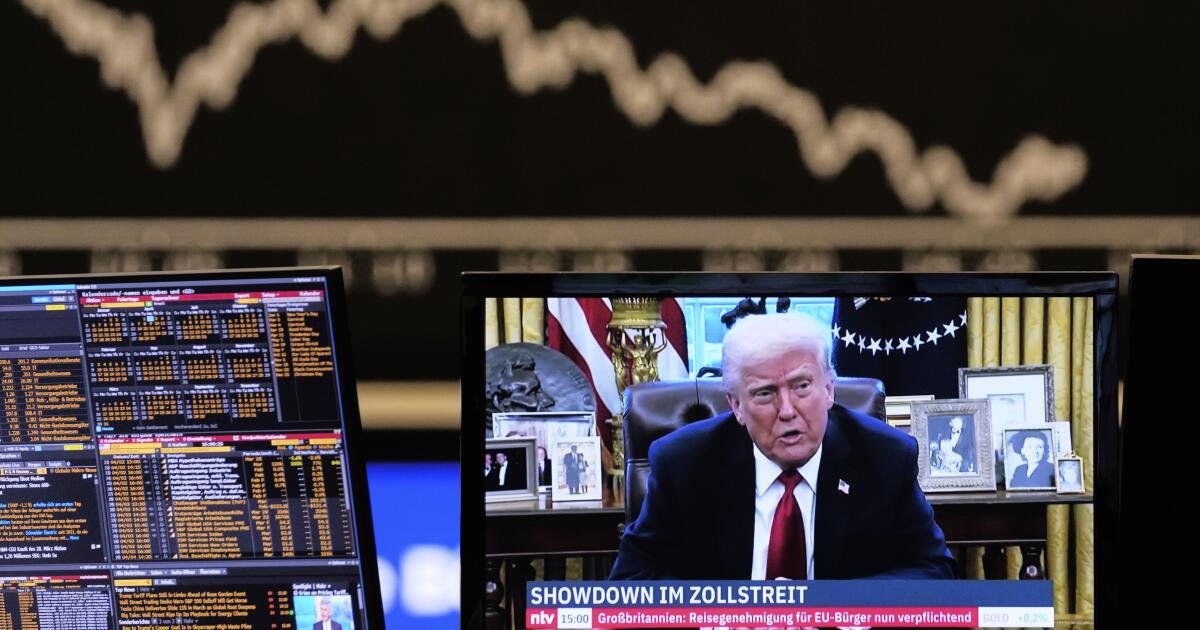
Trump has crowed about the gains in the U.S. stock market during his term, but in 2025 investors saw more opportunity in the rest of the world.
If you’re a stock market investor you might be feeling pretty good about how your portfolio of U.S. equities fared in the first year of President Trump’s term.
All the major market indices seemed to be firing on all cylinders, with the Standard & Poor’s 500 index gaining 17.9% through the full year.
But if you’re the type of investor who looks for things to regret, pay no attention to the rest of the world’s stock markets. That’s because overseas markets did better than the U.S. market in 2025 — a lot better. The MSCI World ex-USA index — that is, all the stock markets except the U.S. — gained more than 32% last year, nearly double the percentage gains of U.S. markets.
That’s a major departure from recent trends. Since 2013, the MSCI US index had bested the non-U.S. index every year except 2017 and 2022, sometimes by a wide margin — in 2024, for instance, the U.S. index gained 24.6%, while non-U.S. markets gained only 4.7%.
The Trump trade is dead. Long live the anti-Trump trade.
— Katie Martin, Financial Times
Broken down into individual country markets (also by MSCI indices), in 2025 the U.S. ranked 21st out of 23 developed markets, with only New Zealand and Denmark doing worse. Leading the pack were Austria and Spain, with 86% gains, but superior records were turned in by Finland, Ireland and Hong Kong, with gains of 50% or more; and the Netherlands, Norway, Britain and Japan, with gains of 40% or more.
Investment analysts cite several factors to explain this trend. Judging by traditional metrics such as price/earnings multiples, the U.S. markets have been much more expensive than those in the rest of the world. Indeed, they’re historically expensive. The Standard & Poor’s 500 index traded in 2025 at about 23 times expected corporate earnings; the historical average is 18 times earnings.
Investment managers also have become nervous about the concentration of market gains within the U.S. technology sector, especially in companies associated with artificial intelligence R&D. Fears that AI is an investment bubble that could take down the S&P’s highest fliers have investors looking elsewhere for returns.
But one factor recurs in almost all the market analyses tracking relative performance by U.S. and non-U.S. markets: Donald Trump.
Investors started 2025 with optimism about Trump’s influence on trading opportunities, given his apparent commitment to deregulation and his braggadocio about America’s dominant position in the world and his determination to preserve, even increase it.
That hasn’t been the case for months.
”The Trump trade is dead. Long live the anti-Trump trade,” Katie Martin of the Financial Times wrote this week. “Wherever you look in financial markets, you see signs that global investors are going out of their way to avoid Donald Trump’s America.”
Two Trump policy initiatives are commonly cited by wary investment experts. One, of course, is Trump’s on-and-off tariffs, which have left investors with little ability to assess international trade flows. The Supreme Court’s invalidation of most Trump tariffs and the bellicosity of his response, which included the immediate imposition of new 10% tariffs across the board and the threat to increase them to 15%, have done nothing to settle investors’ nerves.
Then there’s Trump’s driving down the value of the dollar through his agitation for lower interest rates, among other policies. For overseas investors, a weaker dollar makes U.S. assets more expensive relative to the outside world.

It would be one thing if trade flows and the dollar’s value reflected economic conditions that investors could themselves parse in creating a picture of investment opportunities. That’s not the case just now. “The current uncertainty is entirely man-made (largely by one orange-hued man in particular) but could well continue at least until the US mid-term elections in November,” Sam Burns of Mill Street Research wrote on Dec. 29.
Trump hasn’t been shy about trumpeting U.S. stock market gains as emblems of his policy wisdom. “The stock market has set 53 all-time record highs since the election,” he said in his State of the Union address Tuesday. “Think of that, one year, boosting pensions, 401(k)s and retirement accounts for the millions and the millions of Americans.”
Trump asserted: “Since I took office, the typical 401(k) balance is up by at least $30,000. That’s a lot of money. … Because the stock market has done so well, setting all those records, your 401(k)s are way up.”
Trump’s figure doesn’t conform to findings by retirement professionals such as the 401(k) overseers at Bank of America. They reported that the average account balance grew by only about $13,000 in 2025. I asked the White House for the source of Trump’s claim, but haven’t heard back.
Interpreting stock market returns as snapshots of the economy is a mug’s game. Despite that, at her recent appearance before a House committee, Atty. Gen. Pam Bondi tried to deflect questions about her handling of the Jeffrey Epstein records by crowing about it.
“The Dow is over 50,000 right now, she declared. “Americans’ 401(k)s and retirement savings are booming. That’s what we should be talking about.”
I predicted that the administration would use the Dow industrial average’s break above 50,000 to assert that “the overall economy is firing on all cylinders, thanks to his policies.” The Dow reached that mark on Feb. 6. But Feb. 11, the day of Bondi’s testimony, was the last day the index closed above 50,000. On Thursday, it closed at 49,499.50, or about 1.4% below its Feb. 10 peak close of 50,188.14.
To use a metric suggested by economist Justin Wolfers of the University of Michigan, if you invested $48,488 in the Dow on the day Trump took office last year, when the Dow closed at 48,448 points, you would have had $50,000 on Feb. 6. That’s a gain of about 3.2%. But if you had invested the same amount in the global stock market not including the U.S. (based on the MSCI World ex-USA index), on that same day you would have had nearly $60,000. That’s a gain of nearly 24%.
Broader market indices tell essentially the same story. From Jan. 17, 2025, the last day before Trump’s inauguration, through Thursday’s close, the MSCI US stock index gained a cumulative 16.3%. But the world index minus the U.S. gained nearly 42%.
The gulf between U.S. and non-U.S. performance has continued into the current year. The S&P 500 has gained about 0.74% this year through Wednesday, while the MSCI World ex-USA index has gained about 8.9%. That’s “the best start for a calendar year for global stocks relative to the S&P 500 going back to at least 1996,” Morningstar reports.
It wouldn’t be unusual for the discrepancy between the U.S. and global markets to shrink or even reverse itself over the course of this year.
That’s what happened in 2017, when overseas markets as tracked by MSCI beat the U.S. by more than three percentage points, and 2022, when global markets lost money but U.S. markets underperformed the rest of the world by more than five percentage points.
Economic conditions change, and often the stock markets march to their own drummers. The one thing less likely to change is that Trump is set to remain president until Jan. 20, 2029. Make your investment bets accordingly.