

Suranjana TewariAsia Business Correspondent
“Construction stops, mortgage stops. Deliver homes and get repaid!”
That was one of the chants disgruntled apartment buyers in China used at a protest in June. But their ire over unfinished homes didn’t stop at signs and chants.
Hundreds of them stopped paying their mortgages – a radical step for China, where dissent is not tolerated.
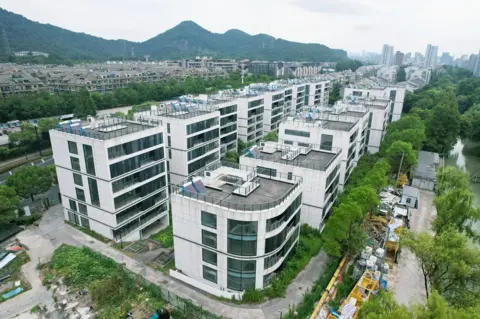
A young couple who moved to Zhengzhou in central China told the BBC that after receiving the down payment last year, the developer withdrew from the project and construction stalled.
“I have imagined countless times the joy of living in a new home, but now it all feels ridiculous,” the woman, who did not wish to be named, said.
A woman in her late 20s who also bought a home in Zhengzhou told the BBC that she too is ready to stop paying her mortgage: “After the project is fully resumed, I’ll continue paying.”
Many of them can pay but are choosing not to, unlike the US subprime mortgage crisis in 2007 when money was lent to high-risk borrowers who then defaulted.
They have purchased homes in roughly 320 projects around the country, according to a crowd-sourced estimate on Github where homeowners have been posting about their decision. But it’s unclear how many actually stopped paying.
The boycotted loans could total $145bn (£120bn), S&P Global ratings estimates. Other analysts say it could be even higher.
The revolt has rattled authorities, focusing attention on a market already under pressure from a slowing economy and a serious cash crunch.
More alarmingly, it has signalled a lack of confidence in one of the main pillars of the world’s second largest economy.
“Mortgage boycotts, driven by deteriorating sentiment toward property, are… a very serious threat to the financial position of the sector,” think tank Oxford Economics said in a recent note.
Why does China’s property crisis matter?
China’s property sector makes up a third of its economic output. That includes houses, rental and brokering services; industries producing white goods that go into apartments; and construction materials.
But China’s economy has been slowing – in the last quarter it grew by just 0.4% compared to the previous year. Some economists don’t expect any growth this year.
That’s largely because of Beijing’s zero-Covid strategy – repeated lockdowns and continued restrictions have affected incomes and, in turn, savings and investments.

 Getty Images
The size of China’s economy means that disruption in a crucial market – like property – can affect the global financial system.
Experts believe contagion is the concern now – banks won’t lend if they believe the sector is tanking.
“It will all depend on policy,” says Ding Shuang, head of Greater China economic research at Standard Chartered. “Unlike in other parts of the world where property bubbles break because of the markets, this is government-inflicted.”
Thirty real estate companies have already missed foreign debt payments. Evergrande, which defaulted last year on its $300bn debt, is the most high-profile casualty. S&P has warned that if sales do not pick up, more companies could follow suit.
Demand for homes is also not rising as China undergoes a demographic change with urbanisation and population growth slowing.
“The fundamental issue is that we have reached a turning point in the housing market in China,” says Julian Evans-Pritchard, a senior China economist at Capital Economics.
How did we get here?
Real estate accounts for about 70% of personal wealth in China – and home buyers often pay upfront for unfinished projects.
These “pre-sales” make up 70%-80% of new home sales in China, Mr Evans-Pritchard said, adding that developers need that money because they use it to fund several projects at once.
But many young and middle class Chinese are no longer investing in property, likely because of a weak economy, job losses and pay cuts – and now the fear that developers might not complete projects.
“That’s part of the problem – developers were counting on new money coming in, and those new sales are not happening anymore,” Mr Evans-Pritchard said.
More than $220bn worth of loans could be tied to unfinished projects, according to banking group ANZ. And credit – a major source of cash in the boom years – has also dried up.
In 2020, China’s government introduced the “three red lines” – accounting measures to limit how much developers could borrow. That cut off funding, and the subsequent lack of confidence in the market has also affected banks’ willingness to lend to property companies.
What is the government doing?
For one, Beijing is putting the onus on local governments – they’re offering reduced deposits, tax rebates and cash subsidies to home buyers, and relief funds to developers. But this comes at a cost because local coffers will take a hit as property developers buy less land.
“I think this is the moment for the central government and regulators to step in,” Mr Ding said. “At some point it will step in to ring-fence the problem of some companies. The sector is too important for the economy.”
 Getty Images
The Financial Times recently reported that China issued $148bn in loans to help property developers, and Bloomberg reported that mortgage holders may be given a payment holiday without it affecting their credit score.
But in a recent note, Oxford Economics said any government intervention in real estate and infrastructure may provide a short-term boost but that “it is not ideal for China’s longer-term growth as the government and the financial sector are being forced to help sustain an unproductive (and failing) real estate industry”.
This is also not just a financial crisis. The boycott of mortgages risks becoming a serious social issue, Mr Ding said.
And that could become a problem for President Xi Jinping ahead of a crucial party congress later this year where he is expected to seek a historic third term.
What happens next?
Analysts say the reported bailout – $148bn – may not be enough. Capital Economics estimates companies need $444bn just to complete halted projects.
It’s also not clear whether banks – especially smaller rural ones – can absorb the cost of the mortgage strike.
Even if construction restarts, many developers may not survive because house sales are unlikely to shore up sentiment. Sales in China’s 100 top developers dropped by 39.7% in July compared to the same period last year, according to China Real Estate Information Corp (CRIC).
This crisis is the clearest indication yet that China’s economy is at a crossroads.
“The government is trying its best to find new sources of growth but that’s going to be challenging because the economy has been very reliant on property, infrastructure investment and exports over the last three decades,” Mr Evans-Pritchard said.
“The era of very rapid growth in China is probably now over… and that’s most obvious in the property sector at the moment.”
Additional reporting by BBC Beijing